
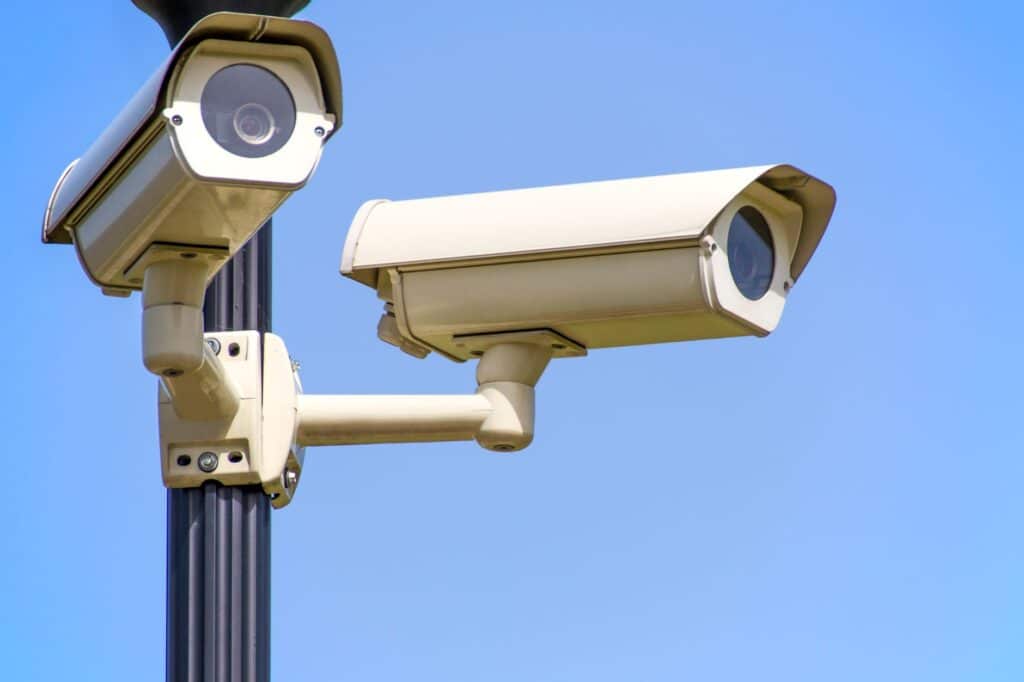
Rainproof is not the same as weather-ready.
A camera may keep recording through a spring downpour, then fail weeks later when morning fog condenses behind the lens, a hard freeze stiffens a cable seal, or summer heat warps the gasket around its housing. Those are not edge cases: they are the conditions that expose weak enclosure design.
Marketing terms such as weatherproof and all-weather say little on their own. The useful evidence is a tested ingress rating, a stated operating-temperature range, and installation details that prevent water from pooling at connectors. A high IP rating cannot compensate for a power adapter left in the rain, nor does cold tolerance guarantee clear video when condensation forms. Assessing how smart security systems work also means checking the weak links around the camera—not just the camera body. Match the rating to the site’s actual wind-driven rain, dust, sun exposure, and winter lows.
- Look for an explicit IP rating and operating-temperature range, not a generic weatherproof claim.
The two digits measure different threats
IP44: sheltered outdoor use
The first 4 blocks tools, insects, and wires larger than 1 mm; the second 4 resists splashing water from any direction. It suits a covered porch, not an exposed wall driven by rain.
IP54–IP55: basic weather exposure
A 5 for solids means dust is kept out in harmful quantities, while 4 or 5 for water covers splashes or low-pressure water jets. These ratings can work under eaves, but mounting position still matters.
IP65: rain-ready, not immersion-proof
Dust-tight construction is paired with protection from water jets. IP65 is a sensible minimum for a camera facing ordinary rain, provided cable entries and the mounting surface are sealed properly.
IP66: stronger jet resistance
The dust rating remains 6, and the second 6 withstands more forceful water jets. It adds margin for wind-driven rain and washdown-prone locations; it does not mean the camera can sit underwater.
IP67: temporary submersion protection
The 6 still means dust-tight; 7 means survival after temporary immersion under the test conditions specified by the manufacturer. It says nothing about prolonged submersion, saltwater, freezing, UV exposure, or condensation inside a cable junction.
Dust enters where the housing is interrupted
Dust is not merely cosmetic. In dry, windy locations, airborne grit can accumulate around seals, abrade moving parts, block microphone ports and vents, and eventually find a path to the circuit board. The risk rises near unpaved roads, agricultural fields, desert lots, landscaping work, and active construction sites.
The first IP digit indicates resistance to solid ingress; IP6X means dust-tight under the relevant test. But that protection only applies to the assembled product in its intended configuration. A robust-looking camera body can still fail through the installation’s weak links:
- Cable glands that are loose, oversized, or missing their compression insert
- Pan/tilt joints, lens surrounds, speaker and microphone openings
- Mounting interfaces where a bracket or junction box leaves an unsealed gap
- Unused ports with absent caps, and connectors hanging below the camera
For dusty sites, the camera should be mounted with cables routed through a weatherproof junction box or conduit, with glands tightened around the actual cable diameter. Inspection matters: a dry ring of fine dust at a seam is evidence that wind is carrying particles into that interface. Cleaning the exterior before opening any cover also prevents grit from being pushed inside during service.
Treat every cable exit, port cap, bracket joint, and service cover as part of the camera’s weather seal.
Rainproof Is Not Stormproof
IPX4 covers splashing water, not a direct hose-like stream.
A camera under an eave may see only splash and runoff. One mounted on a bare post can face wind-driven rain striking seals, the lens rim, and cable entry from every direction.
The 5 means water jets; the 6 means more powerful jets.
IP65 is a sensible minimum for a normally exposed residential installation. IP66 adds useful margin for open elevations, coastal wind, frequent severe storms, or washdown-prone commercial sites.
IPX7 tests temporary immersion under specified conditions, not ongoing high-pressure spray.
Immersion protection helps where brief flooding is plausible, but it does not replace jet resistance. The full code matters: IP67 is not the same claim as IP66, while IP68 testing depends on the manufacturer’s stated depth and duration.
When IP67 earns its place
IP67 is not “better IP66” in every direction. The 7 indicates survival after temporary immersion under the standard’s defined conditions—commonly up to 1 metre for 30 minutes—while the 6 still denotes dust-tight construction. That matters when a camera may sit in pooled floodwater, on a low dock piling, or near a wash-down area where a brief submersion is credible.
It does not establish resistance to high-pressure water jets. A unit can pass an immersion test yet have seals, lens rings, or cable entries that fare poorly against repeated wind-driven spray or hose cleaning. For an exposed wall or pole, IP66 may therefore be the more relevant rating.
Check the hazards the IP code misses
IP67 also says nothing conclusive about:
- Salt exposure: marine air can corrode screws, brackets, connectors, and cable terminations.
- UV aging: sunlight hardens plastics and degrades gasket materials over time.
- Thermal cycling: daily expansion and contraction can loosen seals and draw moisture inward.
Specify IP67 where temporary flooding is the documented risk. For dockside installations, pair it with marine-grade hardware, sealed connectors, UV-rated cable, and a sheltered mounting position; the rating alone is not a coastal durability claim.
Weather limits beyond the IP code
An IP rating says nothing about whether a camera can operate reliably in heat or cold. Check the operating-temperature range, which applies while recording, transmitting, and moving an IR filter or pan-tilt mechanism. The storage range is less demanding: it only indicates what the unpowered unit can survive in a box. A camera rated to operate at -20°C may still need a heater, suitable PoE cabling, or a protected power supply in prolonged freezing weather.
Direct sunlight can push a dark housing far above the published ambient maximum. On a south- or west-facing wall, allow shade, a light-colored mounting surface, and clearance behind the body for airflow; avoid placing the lens beneath metal flashing that radiates heat. UV exposure also embrittles cheap plastics and cable jackets, while daily heating and cooling can draw moist air through marginal seals and create internal condensation.
Wind is a mechanical rating in practice. A long arm or pole mount can vibrate enough to blur video, loosen fasteners, and fatigue connectors. Use a rigid bracket, stainless hardware where appropriate, and a drip loop that does not become a wind-loaded cable loop.
Near coasts, roads treated with salt, or industrial sites, specify corrosion-resistant hardware and inspect it annually. A stated NEMA enclosure type can add useful context—for example, NEMA 4X addresses water and corrosion—but it does not replace checking the exact manufacturer claim. In outage-prone sites, pair the installation with backup power for outdoor cameras, since cold weather can reduce battery capacity when it is needed most.
The Installation Sets the Real Weather Rating
-
Rate the whole assembly by its weakest part
An IP66 camera on an unsealed junction box, cracked conduit fitting, or indoor-rated cable is not an IP66 installation. The enclosure, gland, connectors, and mounting hardware must suit the same exposure.
-
Route the cable to shed water
Bring cable in from below where the design permits, leave a drip loop before the entry point, and avoid runs that guide water directly into a gland. Support the cable so its weight cannot loosen the seal.
-
Protect every gasket and gland
Use the supplied gasket, correct gland insert, and specified tightening method. A pinched O-ring, oversized cable, or unused knockout without its plug creates a direct leak path.
-
Keep ports and joins out of the weather
Ethernet couplers, reset covers, and power adapters belong inside a compatible weatherproof box, not behind the camera under tape. The box needs its own gasketed lid, cable entries, and drainage strategy.
-
Follow the approved mounting orientation
Drain paths, sunshades, and cable exits work only in the orientations the manufacturer specifies. Inverting a turret or dome can trap water against seals and invalidate its tested protection.
A junction box is not automatically weatherproof because the camera above it is. Match the box to the camera model, mounting plate, cable-gland sizes, and conduit type; incompatible plates can leave concealed gaps behind the base.
The mounting plan should also address camera safety and privacy considerations. Relocating a camera to keep connectors sheltered must not create an unsafe ladder-access point or aim the lens into a neighbor’s private area.
The Weather at the Camera Matters Most
A soffit can keep off vertical rain, but wind can drive water upward and roof runoff can overshoot the gutter. Check the camera’s actual position during a hard rain; an IP54 unit suits only a genuinely dry recess, while an eave-edge installation merits IP65 or better.
This is the demanding rain location: wind-driven water reaches seams, and a high pole sees more gust load and vibration. Choose IP66 where storms are routine, use a rigid rated bracket, and aim the lens away from prevailing rain; this also preserves night-vision range for outdoor coverage.
Snow is rarely the direct problem. Meltwater refreezes around joints, icicles drip onto housings, and repeated temperature swings pull moisture through weak seals. Confirm the minimum operating temperature, cold-start behavior, and whether the power supply is rated for the same conditions.
Windblown grit calls for IP6X and sealed glands; salt air needs corrosion-resistant fasteners and brackets even when the camera itself is IP66. Do not overlook irrigation: a low-mounted unit can receive a daily, close-range spray more punishing than rain.
-
Map the exposure
Note eaves, prevailing rain, sprinkler reach, wind-driven dust, salt air, and any path for meltwater or standing water.
-
Choose the minimum rating
Use the exposure—not the local forecast—to set the floor: IP65 for openly exposed cameras, IP66 where driven rain or washdown is credible, and IP67 only where brief submersion is plausible.
-
Check claims beyond IP
Confirm the operating-temperature range, UV and corrosion provisions, wind-load limits, and any NEMA claim. Verify that the box, gland, power supply, and mount are rated for the same conditions.
-
Confirm the installation kit
Make sure weather boots, gasketed junction boxes, drip loops, sealing plugs, and the correct fasteners are included or specified. The same checks help when planning an outdoor smart-lighting installation.
-
Inspect after severe weather
After a storm or freeze-thaw cycle, check seals for displacement, clear drainage paths, tighten mounts, and look for moisture, corrosion, or stressed connectors.
A Weather Rating Is Only the Starting Point
A dependable outdoor camera is selected for its actual exposure, then installed as a sealed, draining system and checked after conditions that stress it. The housing rating, the accessories, and ongoing inspection must all support one another.