
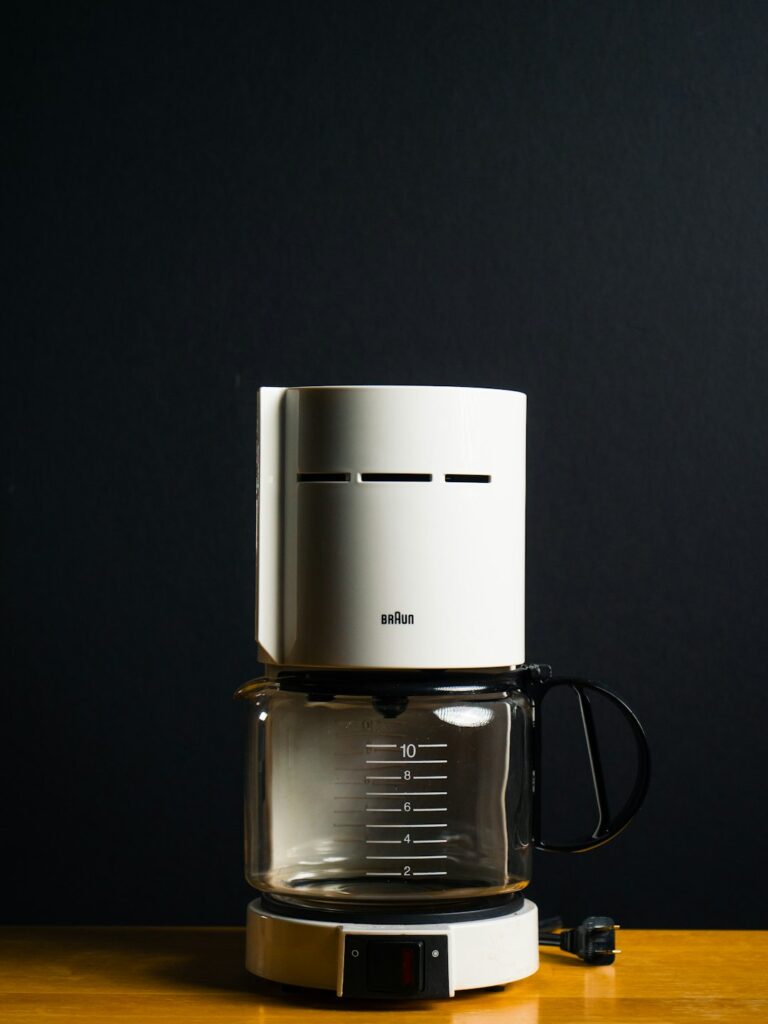
A “12-cup” label counts the brewer’s serving marks, not twelve standard 8-fluid-ounce measuring cups. If each maker cup represents 5 fluid ounces, a full pot starts with about 60 fluid ounces of water (roughly 1.8 liters), not 96. For more on this distinction, see how many ounces a coffee maker cup holds.
Before measuring grounds, check the brewer’s manual for its stated full-pot capacity or read the 12-cup fill mark on the carafe or reservoir. Cup sizes vary by manufacturer, so two machines labeled “12-cup” may call for different amounts of water. If the markings are unclear, fill the carafe to its 12-cup line and pour that water into a liquid measuring jug. Use the volume of water added to calculate the coffee dose.
The finished pot will contain somewhat less liquid than went into the machine because spent grounds retain some brewing water. That difference is normal; the amount in the finished carafe should not be mistaken for the amount of water used to brew it.
A 1:16–1:18 ratio means one gram of dry coffee for every 16–18 grams of water added to the machine. Measure the water before brewing, rather than using the volume of coffee in the finished carafe: some water remains in the grounds.
For a 12-cup maker filled with 60 US fluid ounces of water (about 1,775 grams), that range works out to roughly 99–111 grams of coffee. The middle, 1:17, calls for about 104 grams and is a practical everyday starting point for drip coffee. It also explains why 100 grams is a useful rounded full-pot estimate.
The midpoint is not a universally correct strength. A 1:16 ratio uses more coffee and will generally taste stronger; 1:18 uses less and will generally taste lighter. Grind size and the beans chosen for the brew can also change how the cup tastes. After brewing a pot, adjust the coffee dose in small increments while keeping the water amount the same.
For a 12-cup maker that holds 60 US fluid ounces of water, start with 105 grams of ground coffee. That is the practical full-pot answer when each marked “cup” represents five fluid ounces. If the machine uses six-fluid-ounce cups, a full reservoir holds 72 fluid ounces and needs more coffee.
The calculation uses the water added, not the amount of brewed coffee that reaches the carafe. Sixty US fluid ounces is about 1,775 milliliters (NIST unit conversions). Since a milliliter of water weighs approximately one gram, that is roughly 1,775 grams of water. Dividing by the 1:17 coffee-to-water starting ratio gives 104 grams of coffee, conveniently rounded to 105 grams.
A reasonable starting range is 100–110 grams for this fill level.
| Marked cup size | Water at the 12-cup line | Coffee at 1:17 | Starting range |
|---|---|---|---|
| 5 fl oz | 60 fl oz (about 1,775 g) | 104 g | 100–110 g |
| 6 fl oz | 72 fl oz (about 2,130 g) | 125 g | 118–133 g |
These are amounts of dry grounds, measured before brewing. Check the reservoir’s ounce markings or the maker’s manual rather than assuming every “12-cup” machine has the same capacity.
For a 12-cup maker that takes 60 fluid ounces of water, the roughly 100-gram starting dose works out to about 18–22 level tablespoons of ground coffee. That is a practical range, not an exact conversion: a tablespoon measures volume, while the brewing ratio measures coffee by weight.
Grind size changes how much coffee fits in the spoon. Finer grounds can pack more tightly than coarse grounds, and beans differ in density; darker roasts are generally less dense than lighter roasts. A heaping tablespoon adds another variable, so level measures give a more useful count.
A coffee scoop is not necessarily a tablespoon. Many scoops hold two tablespoons, making 18–22 tablespoons approximately 9–11 level scoops. Check the scoop’s stated capacity before using that shortcut, especially if it came with the machine.
For a partial pot, multiply the full-pot coffee dose by the fraction of the reservoir filled:
Smaller-batch dose = full-pot dose × (filled maker-cup markings ÷ full-pot maker-cup markings)
For example, if a 12-cup fill takes 100 grams of coffee, filling to the 6-cup mark calls for about 50 grams. On a machine whose full reservoir takes 125 grams, the same 6-cup marking calls for about 62–63 grams. These calculations use the coffee maker’s markings, not six eight-ounce mugs.
Treat the result as a starting point. Some drip machines brew small amounts differently because water flow, brew time, or filter-basket coverage changes at lower fill levels. Check the manual for a minimum fill level or small-batch setting; for frequent partial pots, compare drip coffee makers designed for smaller batches.
Once the starting dose has been brewed, keep the water volume fixed while adjusting the grounds. For a 60-fluid-ounce fill made with 100 grams of coffee, try 105–110 grams if the cup tastes thin, or 90–95 grams if it tastes too strong. A small change makes it easier to tell which dose is preferable than a large jump would.
Use the same coffee, grind setting and reservoir mark for the comparison. If the pot seems weak despite a reasonable dose, fixing weak drip coffee may involve more than adding grounds: an uneven grind, a short brew cycle or water that does not heat adequately can also affect the result.
Strength and flavor are different clues. Coffee can taste concentrated yet sour, or thin yet bitter. Persistent sourness may point to insufficient extraction; bitter or harsh flavors may point to excessive extraction, although the beans and roast also influence taste. If changing the dose does not solve the problem, check that the machine is clean and brewing normally, then try a small grind adjustment rather than continuing to add or remove coffee.
Record the reservoir volume and the dose that produces the preferred cup—for example, “60 fluid ounces of water, 105 grams of coffee.” Keeping those two numbers together makes the next full pot repeatable, even if the finished coffee measures less than the water poured in.