
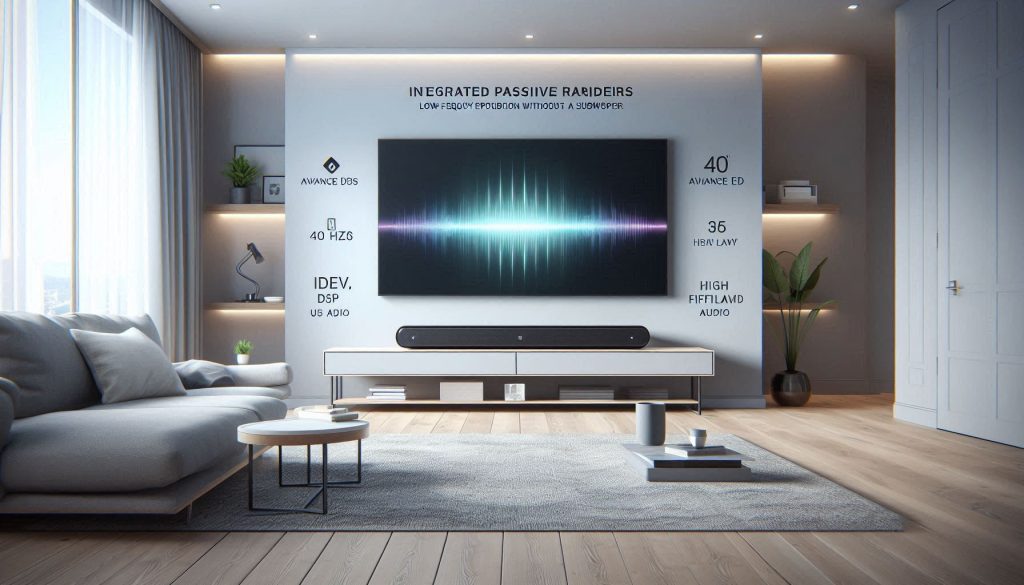
Upgrading your home theater doesn’t always require a cluttered living room filled with black boxes and tangled wires. The best all-in-one soundbars offer a streamlined solution for those seeking high-fidelity audio and deep, resonant bass without the need for a bulky external subwoofer. Thanks to innovations in integrated passive radiators and advanced Digital Signal Processing (DSP), modern single-unit soundbars can now reproduce frequencies as low as 40 Hz, providing a rich, cinematic experience that fits perfectly in minimalist setups or smaller apartments.
When selecting the right model, it is crucial to look beyond marketing “peak wattage” and focus on objective performance data such as frequency response and total harmonic distortion (THD). Whether you are prioritizing crystal-clear dialogue for nightly news or immersive Dolby Atmos for weekend movie marathons, choosing a bar with robust internal drivers ensures you don’t sacrifice impact for convenience. This guide explores the top-rated standalone units that balance space-saving design with premium acoustic engineering, helping you achieve a “plug-and-play” theater experience that sounds as good as it looks.
Why choose an all-in-one soundbar without a subwoofer
You want great TV and music sound without the extra bulk, cost, or cabling of a separate subwoofer. Modern single-unit soundbars can deliver surprisingly deep bass using forward-firing drivers, passive radiators, and advanced DSP—some models reproduce down to 40 Hz in-room. That means you get cleaner setup, smaller footprint, and fewer decisions, while accepting the trade-off that TRUE reference-level low-frequency output remains the domain of dedicated subs.
This guide gives you practical, data-driven criteria to choose the best no-subwoofer soundbar. First, learn how all-in-one units reproduce bass without a subwoofer. Then review critical specs and measurements to evaluate them. We cover room size, placement, and acoustics that affect bass perception; connectivity, features, and processing that matter more than raw wattage; performance categories tied to use cases; and setup, calibration, and tuning tips to maximize bass from a single-unit soundbar.
Read on now.
How all-in-one soundbars reproduce bass without a subwoofer
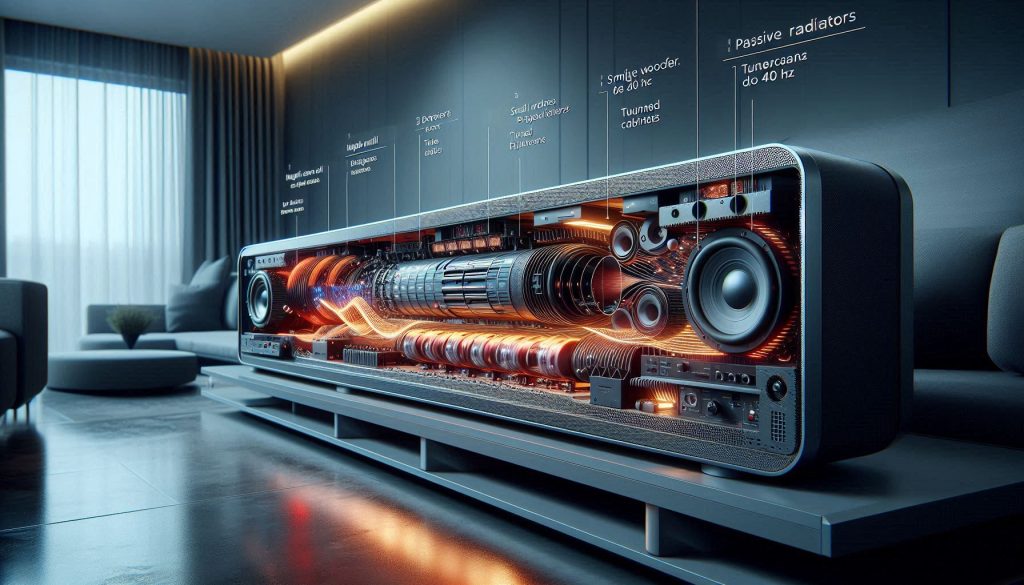
How drivers and cabinets produce low notes
You get bass from an all-in-one by moving air—more cone area or more cone excursion (long-throw drivers) equals more low-frequency output. Manufacturers compensate for tiny enclosure volume with:
In practice, long-throw woofers and passive radiators push usable energy down into the 40–60 Hz neighborhood in-room; below ~40 Hz you rapidly hit physical limits without a separate sub.
DSP, EQ, and psychoacoustic tricks
Digital signal processing is the other half of the trick. You’ll see:
These tools are powerful, but they trade absolute low-frequency energy for “apparent” depth. You’ll hear fullness, not the same pure sine-wave authority of a dedicated sub.
Objective measures that predict real-room bass
When evaluating models, prioritize measured data over marketing wattage:
Realistic expectations and quick tips
Expect an integrated soundbar to deliver impactful movie and music bass down to roughly 40–60 Hz in a typical living room—enhanced by wall/ corner coupling—but not the 20–30 Hz authority a standalone sub gives. Next, we’ll dig into how to read those measurements and which specific specs matter when comparing models.
Critical specs and measurements to evaluate no-subwoofer soundbars
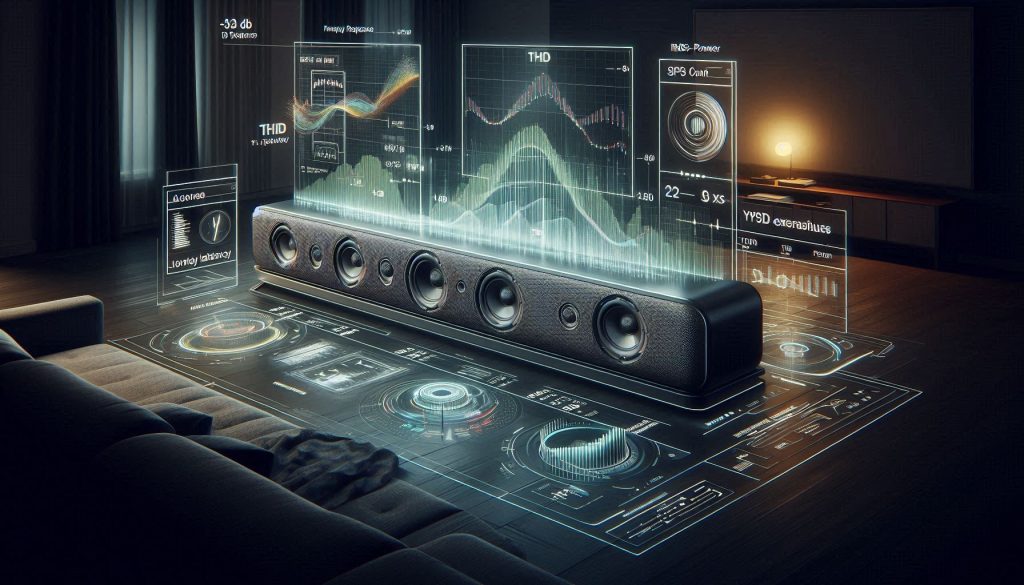
When marketing blur and marketing watts don’t cut it, focus on hard numbers. Below are the objective metrics and practical thresholds you should use to compare all-in-one bars and predict real-room bass and clarity.
Key specs and what they tell you
Frequency response (report both anechoic and in-room)
Measured SPL at 1 m
Distortion (THD) vs frequency and SPL
Driver count/size, Xmax, and effective cone area
Amplifier power (RMS) vs peak watts
Latency
How reviewers measure and how to read graphs
Quick checklist you can use right now:
Armed with those numbers, you’ll translate lab graphs into real expectations for your room and listening priorities—next we’ll cover room interaction and placement tricks that make those specs sing.
Room size, placement, and acoustic interactions that affect bass perception
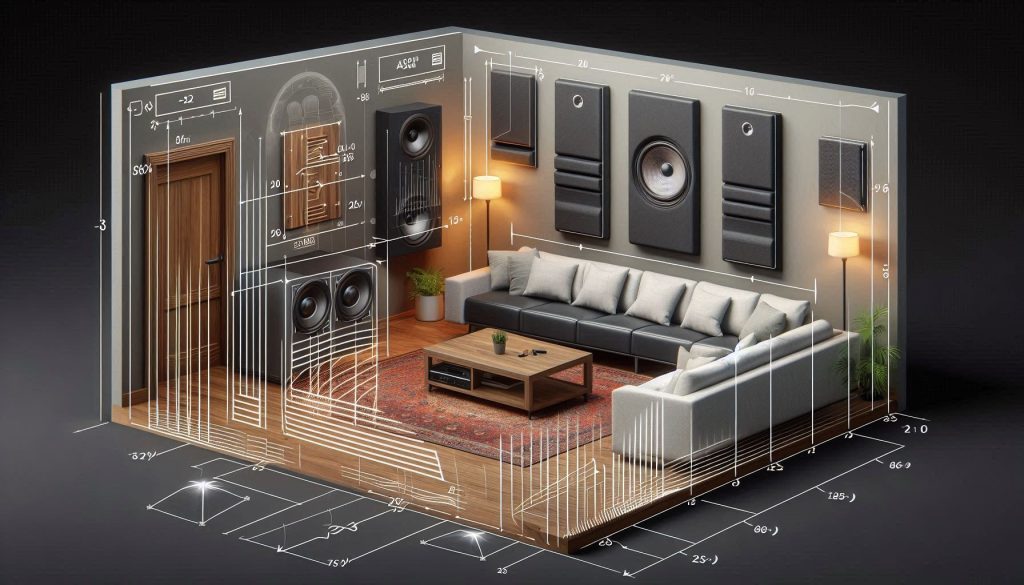
You can have the best no-subwoofer soundbar, but your room will ultimately decide how much bass you feel. The trick is learning which variables you can control quickly (placement, listening position, simple treatments) and which require a different product choice.
Room volume and seating distance
Smaller rooms tend to give more low‑frequency reinforcement: the room’s modal response boosts certain bands, so a compact bedroom can make a bar sound fuller than the same bar in a big open-plan living room. Conversely, in a large 5×6 m space you’ll often be missing energy below ~60 Hz unless the bar has substantial low‑end capability.
Tip: move the listening position in 0.5–1 m increments. You’ll often escape a null or find a peak just by shifting the couch.
Using boundaries and placement
Boundary coupling is your friend with no sub. Placing the bar on a TV stand flush against a wall or wall‑mounting it will usually increase bass by several dB in the 40–80 Hz region compared with a free‑standing placement. Typical measured gains are in the range of about +3–9 dB depending on frequency and room — enough to turn thin bass into something pleasing.
Practical placements:
Example models: a Sennheiser Ambeo or Sony HT‑A7000 will still outperform most bars in a large room, but in a small living room a Sonos Arc placed close to the wall can sound surprisingly authoritative due to boundary gain and processing.
When to prioritize boundary‑coupled output
If you’re in a small-to-medium room and can’t add a sub, choose a bar engineered to exploit boundary gain—multiple forward and downward‑firing woofers or ported radiators help. If you have a large open room, prioritize bars with documented low‑frequency extension (measured -3 dB nearer to 40 Hz).
Quick acoustic fixes you can do today
Next we’ll look at connectivity and processing choices that help these placement gains translate into musical, punchy bass.
Connectivity, features, and processing that matter more than raw wattage
Beyond drivers and specs, the way a soundbar connects, processes, and integrates into your system often changes what you actually hear more than a few extra watts. Here are the features to prioritize and how to use them.
HDMI ARC vs. eARC: get the right channel
Object formats and upmixing
Built‑in streaming and ecosystem fit
Room calibration, EQ, and dialogue features
Latency, lip‑sync, and gaming
Trade‑offs: neutrality vs. proprietary shine
Practical checklist: prioritize eARC + calibration + EQ flexibility for best real‑world results; match streaming/multiroom support to your ecosystem; test processing on/off and use low‑latency modes for gaming or live TV.
Performance categories and how to pick the best model for your use case
This section groups no-sub soundbars into practical performance buckets so you can match a bar to how you actually use it. For each bucket you’ll get selection criteria, quick objective thresholds to scan for on spec sheets, and the realistic trade-offs.
Compact — dialogue and small-room TV
Best if you sit close and prioritize speech intelligibility, streaming TV, and a tidy footprint.
Mid-sized — balanced movies and music
Best if you want good movie impact plus credible stereo music in a typical living room.
Wide soundstage / virtual-surround — immersive home cinema without a sub
Best if you want a cinematic, enveloping field (height cues, object audio) but can’t/won’t add a sub.
High-output — larger rooms and impact-first listening
Best if your room is large and you still want authoritative playback without a separate sub.
Which to pick quickly
Setup, calibration, and tuning tips to maximize bass from an all-in-one soundbar
Positioning and angling: small moves, big changes
Move the bar first — don’t assume fixed furniture. Pulling the bar 5–20 cm away from a hard wall often reduces 60–120 Hz boom. If you can, angle (toe‑in) toward your main seat to tighten bass imaging. In a quick real-world fix: one tester moved a mid-sized bar 15 cm forward and reduced perceived boom by ~6–8 dB at the listening position.
Use onboard calibration and manual EQ
Run any built‑in room calibration (Sony, Sonos, Bose all include one). Then inspect results—don’t accept a calibration that aggressively boosts sub‑bass. If you have manual EQ:
Bass management even with no sub
If your bar offers a “subwoofer level,” crossover, or LFE settings:
Safe loudness and avoiding driver strain
Aim for average listening levels of 70–85 dB; allow short peaks up to 95–100 dB for movies. Warning signs of strain:
Measurement-based troubleshooting
Use Room EQ Wizard (REW) on a laptop or apps like AudioTools (iOS) / Spectroid (Android). Play pink noise (local file or YouTube) and:
Maintenance and when to upgrade
Keep ports and drivers dust‑free, update firmware, and avoid sealing vents when wall‑mounted. Consider an external sub when:
With your bar tuned and behaving, continue to the Conclusion to lock in the best long‑term choice for your room and priorities.
Making the right no-subwoofer soundbar choice for your room and priorities
You should now be able to judge whether an all-in-one soundbar will satisfy your bass needs, compare models by objective metrics (low-frequency extension, distortion, and measured SPL), and use placement and tuning to eke out the best performance. Focus first on room size and required LF extension: small rooms can accept 50–60 Hz extension, larger rooms or home theater use need deeper response. Prioritize measured LF extension and distortion over claimed wattage, then check features — room correction, HDMI eARC, dialogue enhancement, and virtual height — that match your use cases.
Quick checklist to finalize your pick: confirm measured low-frequency -3 dB point and THD at listening levels, match the bar’s size to your room, verify eARC and calibration tools, and ensure placement options suit furniture and boundaries. With those points covered, you’ll balance convenience and verifiable performance — audition where possible and choose the soundbar that best aligns with your room and priorities.