
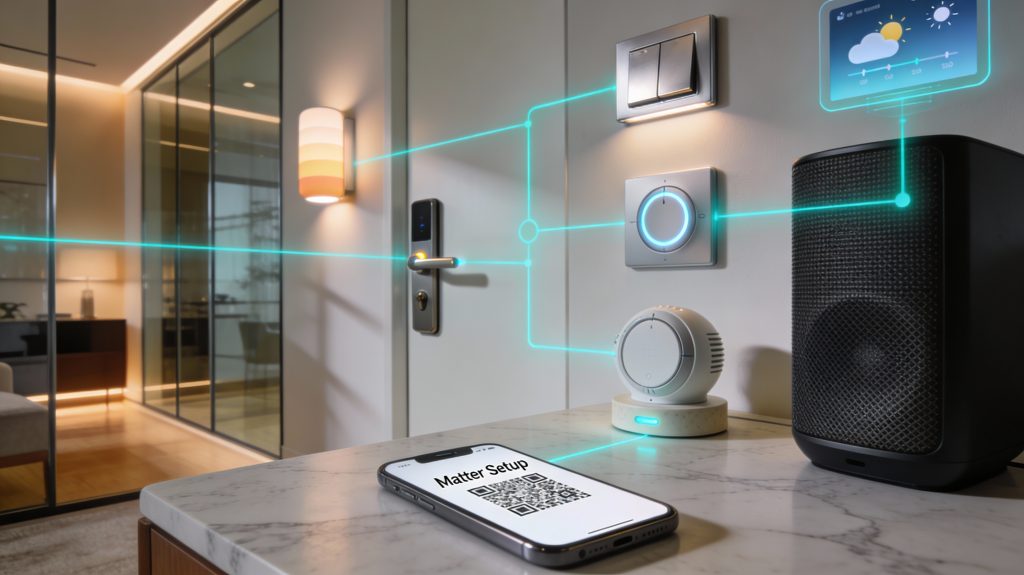
Are you tired of juggling multiple apps, proprietary hubs, and the endless “compatibility puzzle” of modern tech? Matter is the revolutionary interoperability standard designed to strip away the complexity of the smart home. By creating a unified language for devices to communicate over Wi-Fi, Ethernet, and Thread, Matter ensures that your favorite products—whether from Apple, Google, Amazon, or Samsung—work together seamlessly and reliably. This guide serves as your entry point into a more cohesive ecosystem, breaking down how this royalty-free protocol reduces fragmentation and puts the focus back on user experience rather than technical workarounds.
In the following sections, we provide a deep dive into the practical benefits of the Matter standard, from simplified QR-code commissioning to enhanced local security and lower latency. You will learn how to audit your current network, choose the right Thread border routers, and manage a staged migration that future-proofs your electronics. Whether you are a hobbyist looking to streamline a few smart bulbs or a power user building a resilient, data-driven home automation system, this comprehensive guide offers the actionable steps needed to achieve a truly unified smart home.
A Clear Entry Point to a Unified Smart Home
Are you tired of juggling apps, hubs, and compatibility puzzles? Matter is a single interoperable standard designed to simplify smart homes and reduce fragmentation. It creates consistent rules so devices from different brands can work together reliably.
In this guide you’ll get a concise explanation of what Matter is, how it works, and the practical benefits for everyday use. You’ll learn how to prepare your network, choose compatible devices, and manage commissioning and troubleshooting.
Use this guide to decide whether to plan a Matter migration or start a new deployment. It gives clear, data-driven steps so your smart home becomes more secure, resilient, and future-proof. Read on to learn practical steps.
What Matter Is: The Foundation for Interoperability

What Matter actually is
Matter is an application-layer standard that defines how smart-home devices talk, discover each other, and present capabilities to controllers and apps. Think of it as a common language and rulebook: devices use IP-based networking (Wi‑Fi, Ethernet, or Thread) and a shared data model so a light, lock, or thermostat can be controlled in a consistent way regardless of brand.
In plain terms, Matter standardizes:
Who’s involved — and why that matters to you
Matter is backed by device makers, chipset vendors (Silicon Labs, Nordic, etc.), platform owners (Apple, Google, Amazon), and the Connectivity Standards Alliance. That broad buy‑in means manufacturers are incentivized to ship devices that interoperate out of the box. For you, that translates into fewer dead-end purchases and longer product lifecycles.
Real-world product touchpoints you’ll see: HomePod mini and Google Nest Hub can act as controllers/Thread border routers; many newer bulbs and plugs are shipping with Matter support. When shopping, the “Matter” or “Works with Matter” label is the quick signal to look for.
Benefits you should expect
Imagine adding a new light and not needing the vendor app to get the bulb online — that’s the day-to-day change Matter targets.
What Matter does not change
Quick, practical buying tips
These choices get you the interoperability gains without abandoning brand features you value.
How Matter Works: Protocols, Architecture, and Data Models

You’ve seen what Matter promises. Now here’s the practical, technical scaffolding that makes it work — explained so you can apply it when buying, setting up, or troubleshooting devices.
Network and transport: IPv6 first, the right link for the job
Matter runs on IP (IPv6), which means devices speak a routable, internet-style protocol. How they carry those packets depends on the use case:
Practical tips: ensure you have a Thread border router in your home (HomePod mini, Apple TV 4K, Nest Hub) for Thread devices to reach your main network. Keep BLE enabled on your phone during setup and confirm your router or gateway supports IPv6 or provides necessary translation services.
Matter’s data model and device abstraction
Matter models devices as endpoints that expose clusters — named groups of attributes and commands (for example: On/Off, LevelControl, TemperatureMeasurement). That abstraction is what lets any Matter controller interpret a device consistently.
Example: a Matter smart bulb typically exposes On/Off, Brightness (LevelControl), and ColorControl clusters. That means an app from vendor A and an app from vendor B can both dim and change color the same way.
Commissioning and discovery
Commissioning uses a short, secure flow — scan a QR code or tap NFC; a BLE handshake authenticates the setup code; the device receives network credentials and a certificate for future secure connections. Discovery then happens over IP (mDNS/UDP) so controllers find devices automatically.
How-to: have the device’s QR/NFC code handy, ensure your controller (phone or hub) is nearby, and let the commission complete before moving the device out of range.
Security model: attestation, certificates, and secure sessions
Security is baked in: devices ship with vendor-signed attestation certificates proving origin. During commissioning and normal operation Matter negotiates authenticated, encrypted sessions (initial password-authenticated exchange during setup, then certificate-based sessions for day-to-day). The result: strong mutual authentication and per-session encryption.
Buy Matter-certified devices and keep firmware updated — those two steps preserve the chain of trust.
How interoperability plays out
Because Matter defines the object model and exact semantics (units, attribute names, allowed ranges), devices behave predictably across apps. That’s why a Matter light you add with Nanoleaf or Eve appears with the same controls in Apple Home and Google Home — no translation layer required. When choosing devices, check the advertised clusters or “supported features” to ensure they cover the functions you need.
Practical Benefits: What Matter Delivers for Your Home and Integrations

You’ve seen the plumbing. Here’s what it actually gives you day-to-day — for homeowners and professional integrators alike.
Faster, more reliable setup (so you spend less time troubleshooting)
With Matter’s unified commissioning, setup time typically drops from “fiddle with vendor apps and bridges” to a straightforward QR/NFC scan and join. In practice you’ll often be fully up in minutes, not tens of minutes.
Practical tips:
Example: adding a Nanoleaf Essentials bulb and an Eve Energy plug on the same visit now uses identical flows — no separate vendor app choreography.
Consistent control across apps and voice assistants
Because Matter standardizes capabilities (on/off, brightness, color, locks, sensors), the same device behaves the same in Apple Home, Google Home, and other controllers. That eliminates “it works in one app but not another” support calls.
What you can do immediately:
Fewer support calls and predictable integrations for professionals
Integrators see fewer edge-case compatibility problems: Matter reduces custom translation layers and vendor-specific quirks, meaning:
Operational tip: create a short, repeatable checklist for commissioning and post-commission testing that you run on every install.
Privacy, latency, and reliability advantages
Matter emphasizes local-first operation. That translates into measurable outcomes:
Real-world safeguard: when your internet drops, your Matter lights and locks often still respond to local voice or app commands and scheduled automations instead of failing silently.
Resilience and long-term manageability
Matter supports negotiated fallbacks (Thread → Wi‑Fi, local controller takeover) and standardized OTA paths. Best practices:
These features reduce future surprises and make scaling a multi-room system far more predictable — whether you’re expanding yourself or handing off to a pro.
Preparing Your Home: Network, Device Selection, and Compatibility

Network readiness: mesh planning and backbone
Start by treating your smart home like a small enterprise network. Thread creates a low-power mesh, but it still needs planning: place Thread-capable devices (sensors, bulbs, plugs) so they can hop signals — roughly one Thread router (a mains-powered device or border router) per floor or per 3–4 rooms in complex layouts. Thread border routers you can buy or already own include models such as the Apple HomePod mini and Google Nest Hub (2nd gen); vendor pages list supported models.
For Wi‑Fi, prefer a dual‑band Wi‑Fi 6 router or mesh (example: Netgear Orbi AX, Google Nest Wifi Pro) to handle dozens of cameras, phones, and Matter-over-Wi‑Fi devices. Always run your critical controllers (home hub, Hue Bridge, NAS) on Ethernet where possible — a wired backbone reduces latency and gives reliable DHCP/IPv6 behavior for Matter controllers.
Device selection: certification and feature sets
Buy devices that are Matter-certified or explicitly advertised as Matter-upgradable. Look for:
Examples: Nanoleaf Essentials bulbs and Eve Energy plugs are frequently Matter-native; Philips Hue devices still use the Hue Bridge for Zigbee legacy but have a clear upgrade path.
Compatibility checks before purchase
Do these quick checks before adding a product to your cart:
A practical tip: read the product manual and support FAQ for “Matter” and “OTA updates” details rather than just marketing blurbs.
Firmware policies and vendor trust signals
Prefer vendors who publish OTA/update policies (support duration, security patch cadence). Conservative target: vendors promising 3–5 years of updates. Look for transparent changelogs, public firmware tools, and responsive support forums.
Vendor certification marks to look for:
Managing mixed environments and legacy bridges
You will likely have a mix of Matter-native and legacy devices. Best practices:
These steps will make commissioning and troubleshooting far smoother as you move into the next phase — commissioning, managing OTA updates, and long-term operations.
Adoption Roadmap: Commissioning, Troubleshooting, and Long-Term Management

Commissioning workflow — step by step
Commission devices in controlled batches rather than all at once. A reliable 5-step flow:
- Prepare: update hub/border router firmware (e.g., HomePod mini, Nest Hub), ensure controller app versions are current.
- Stage: add 5–10 devices in one room first (lights, a plug, a sensor).
- Commission: follow BLE/QR flow; verify local control immediately (turn on/off, read sensor).
- Validate: run automated scenes and measure responses over 24–48 hours.
- Rollout: stagger additional rooms in groups once validation passes.
A real-world tip: when you commissioned a set of 12 bulbs in one evening, you’ll save hours by catching a repeated firmware bug early.
Testing and validation checklist
Run these tests before broad deployment:
Use Home Assistant logs or Prometheus + Grafana for automated metric capture.
Common failures and fixes
Network partitioning
Commissioning failures
Certificate/credential problems
Monitoring and metrics to track
Track these KPIs to prove improvement over legacy systems:
Automate alerts for drops in these metrics; a ping/health-check every 5 minutes is a practical cadence.
Lifecycle and security best practices
With commissioning routines, clear troubleshooting playbooks, and measurable monitoring in place, you’ll minimize surprises and manage Matter deployments predictably — leading into the final planning steps.
Next Steps: Planning a Smooth Transition to Matter
Assess your current network and device inventory; prioritize certified Matter devices and ensure you have border routers (Thread BR/Thread border routers or Wi‑Fi bridges). Plan a staged migration: pilot a room, validate commissioning flows, then expand. Set measurable goals for uptime, latency, and successful device onboarding rates.
Use the data-driven checks and metrics described earlier to validate success and guide adjustments. A standards-based approach reduces fragmentation and future-proofs your home. Start small, measure rigorously, and iterate until your smart home meets your reliability and user-experience targets. Track results quarterly and adjust priorities.