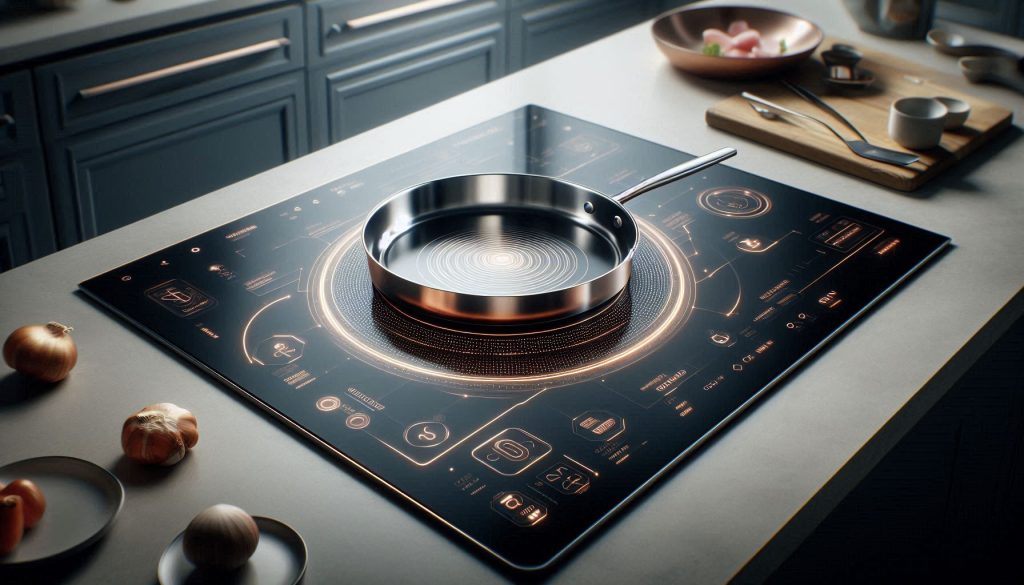
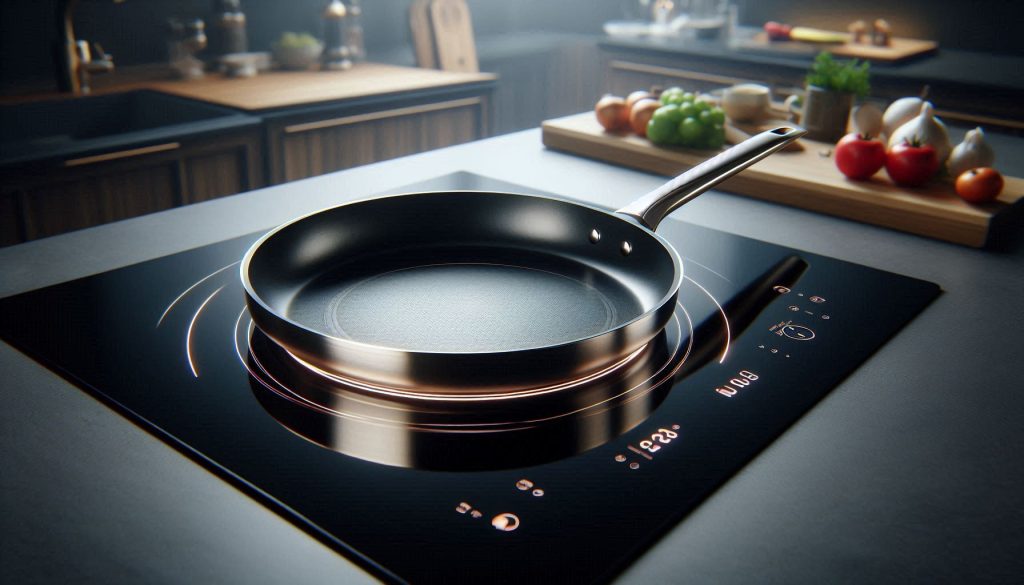
Precision is the hallmark of gourmet cooking, but even the most skilled chef is limited by the tools in their arsenal. In the realm of high-end cookware, the shift from traditional heavy metals to smart sensors and even heating technology is redefining what it means to have a “luxury” kitchen. Beyond aesthetic appeal, the best tech-forward luxury pans utilize integrated thermocouples and advanced PID control loops to eliminate unpredictable hot spots and provide real-time thermal feedback. By bridging the gap between raw heat and digital accuracy, these engineered systems ensure consistent sears, stable emulsions, and professional-grade results that were once exclusive to laboratory-grade equipment.
This comprehensive guide takes a data-driven deep dive into the mechanics of modern culinary technology, from the physics of thermal uniformity to the nuances of sensor placement. Whether you are comparing multi-ply clad construction or evaluating the sampling rates of Bluetooth-enabled cookware, understanding these metrics is essential for any serious cook. We will explore how high-performance materials like copper and aluminum cores interact with closed-loop feedback systems to deliver unparalleled temperature control. From practical buying rubrics to long-term care strategies, learn how to invest in smart cookware that transforms data into delicious, repeatable outcomes.
Why Smart Sensors and Even Heating Matter in Luxury Pans
You need cookware that delivers predictable, repeatable results when precision matters. Integrating smart sensors and engineered heat-distribution systems into high-end pans changes outcomes: better temperature control, more consistent sears and sauces, fewer hot spots, and measurable energy efficiency.
This article gives a data-driven look at how sensing technologies work and how accuracy and heat uniformity are measured. You’ll learn about materials, core construction, and design choices that deliver even heat. You’ll get a practical buying guide that prioritizes features and integration. Finally, you’ll find care and testing strategies to verify long-term performance so your pans keep producing professional results. Expect clear metrics, real-world tests, and actionable recommendations for serious cooks.
1
How Smart Sensors and Feedback Systems Work in Cookware
Smart sensors and feedback systems enable precise, even heating in next-generation luxury cookware.
Sensor types and where they live
You’ll encounter three practical sensor families in tech-forward pans:
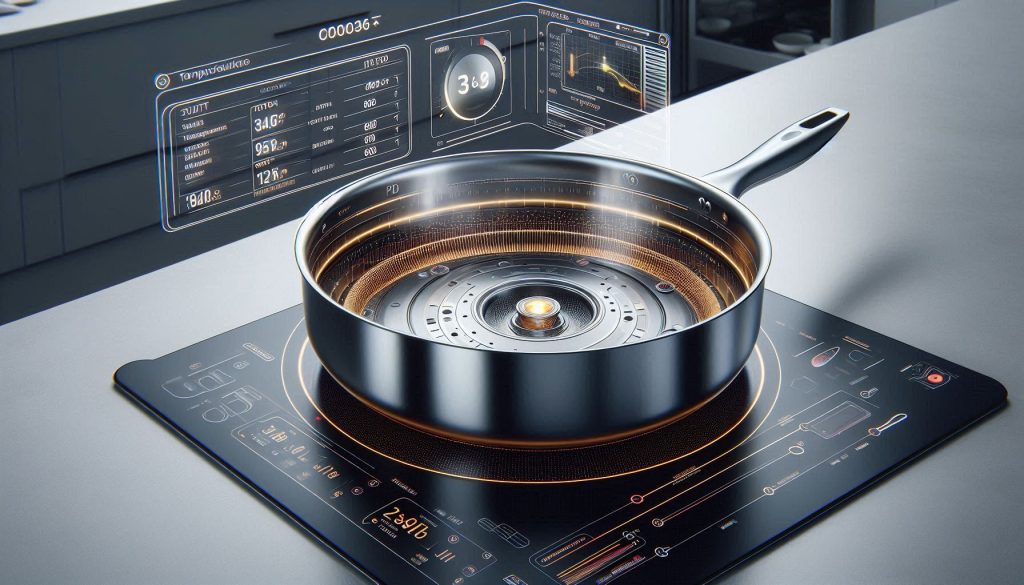
Thermocouples — small, fast, and rugged; they sit at the pan’s base or in an embedded ring and report quick surface changes (response time: milliseconds to a few hundred ms).
RTDs (resistance temperature detectors) — more stable and linear than most thermocouples, often embedded in the cooking surface or probe stalks; response slower but with better long-term accuracy.
Infrared (IR) sensors — non-contact, reading immediate surface skin temperature; they’re useful for searing but don’t tell you the metal’s bulk or a sauce’s internal temp.
Where sensors are placed matters. An embedded probe in the base measures the metal’s bulk temperature (what the burner actually heats). A surface-mounted sensor reads the frying surface where protein meets metal. External probes (like a Weber iGrill or Thermapen used for verification) let you spot-check food or pan centerline temps without relying on the pan’s firmware.
How raw data becomes control
Sensor readings feed microcontrollers that run feedback algorithms. The most common control architecture is a PID loop (proportional-integral-derivative). In plain terms:
Proportional corrects based on how far you are from the setpoint.
Integral corrects accumulated steady-state error.
Derivative predicts and damps future overshoot.
Good firmware adds hysteresis management and adaptive PID tuning so the system doesn’t “chatter” the burner on/off for every 1°F wiggle. Typical hysteresis dead-bands are 1–3°F (0.5–1.5°C) for cooking applications.
Latency, sampling rate, and transient events
Sampling rate (how often the sensor is read) and latency (sensor + processing + actuator delay) determine responsiveness. Practical systems sample 1–10 times per second. A fast thermocouple read at 5–10 Hz lets a PID reduce transient overshoot during events like adding cold stock; a sluggish RTD sampled at 0.5–1 Hz can lag and cause a 10–30°F overshoot in fast pans.
Closed-loop control meaningfully reduces overshoot and variance. In real kitchens, open-loop electric or gas heating can overshoot by 15–40°F (8–22°C) during rapid transients; properly tuned closed-loop systems routinely hold surface temperatures within ±2–5°F (±1–3°C), improving consistency for sears, emulsions, and temperature-sensitive sauces.
Quick, actionable tips
Prefer embedded contact sensors if you want reliable pan-level control.
Look for stated sampling rates and control tolerances; aim for systems that quote ±2–5°F accuracy.
Use an external RTD probe (Thermapen-style) to verify performance during the first few uses.
Next you’ll dig into how those reported accuracies are measured and what sensor metrics matter when comparing luxury tech pans.
2
Sensor Accuracy, Metrics, and How Even Heat Is Measured
Objective thermal metrics reveal how accurately luxury pans sense temperature and distribute heat evenly.
You need objective metrics to compare products. This section breaks down the measurement criteria you should care about and the common test methods manufacturers and reviewers use so you can spot real performance versus marketing spin.
Key metrics — what to look for and why they matter
Sensor accuracy and precision: how close and how repeatable readings are (good: ±2–5°F / ±1–3°C accuracy; elite systems claim ±1–2°F).
Response time and thermal lag: how quickly a sensor reflects surface changes (milliseconds for fast thermocouples; seconds for some RTDs). Faster response matters for transients like adding a cold ingredient.
Repeatability: can the pan hit the same temperature profile run after run? Look for standard deviation in repeated tests.
Spatial temperature variance (ΔT): difference between hottest and coolest points on the cooking surface. Truly even pans typically show ΔT <5–10°F across the usable surface.
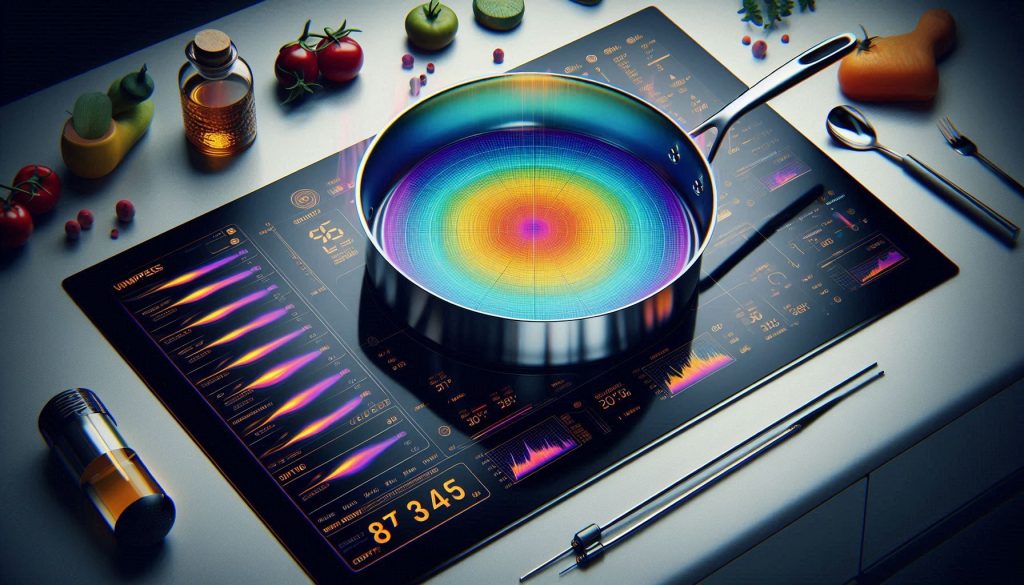
Thermal uniformity maps: color-coded maps showing surface temps — mean deviation and maximum hot-spot differential should be provided.
Time-to-target and recovery rate: how long to reach a set temp and how quickly the surface returns (°F/sec) after a disturbance.
Energy-to-temperature efficiency: how much input energy (watts or joules) it takes to raise the pan or a known load to temperature — useful when comparing induction vs. gas performance.
Common test methods explained
Multi-point thermocouple arrays: an array (9–16 points) of K-type thermocouples attached across the surface gives a numerical ΔT map. This is the gold-standard for spatial accuracy.
Thermal imaging (IR cameras): FLIR or Fluke IR cameras produce quick thermal uniformity maps; remember emissivity and reflections can bias readings, so calibrate or corroborate with contact sensors.
Calorimetric tests: measure energy input vs. temperature rise using a known mass (water or aluminum block). This yields energy-to-temp efficiency and time-to-target numbers.
How to interpret results
Mean temperature deviation: average difference from setpoint; target ≤±5°F for reliable cooking.
Maximum hot-spot differential: the single worst ΔT — under 10°F is excellent for searing and sauces.
Time-to-target: judge relative performance (e.g., 350°F in 4–6 minutes on induction vs. 8–12 on low-power gas).
Recovery rate: after adding cold stock, a good pan with active control should recover within seconds to a few tens of seconds; quantify as °F/sec.
When comparing specs or reviews, demand the test method and conditions (empty pan vs. loaded, power setting, ambient temp). Real-world claims from Hestan Cue-style systems are most meaningful when backed by thermocouple arrays or independent IR mapping. Next, you’ll see how materials, core construction, and design choices translate these measured metrics into the even heat you actually feel in the pan.
3
Materials, Core Construction, and Design Choices that Deliver Even Heat
precision materials and layered core design are the foundation of even, predictable heat.
You’ve read metrics and sensor behavior — now understand the hardware that makes those numbers real. The materials, layer sequencing, thickness and geometry determine whether heat spreads like a flat pancake or bubbles up as hot spots.
Materials compared: conduction, capacity, and real-world behavior
Aluminum: excellent conductor and light weight. It heats fast and spreads heat well, but needs protection (anodized or clad) because it’s reactive. Great for quick temperature changes and weeknight sautés.
Copper: best thermal conductivity — fastest to respond and the most uniform at thin gauge. Reactive and expensive; ideal if you want instantaneous control (think pro chefs’ copper saucières).
Stainless steel: durable and slow to conduct on its own. Used for exterior layers and cooking surfaces because it’s non-reactive and easy to clean.
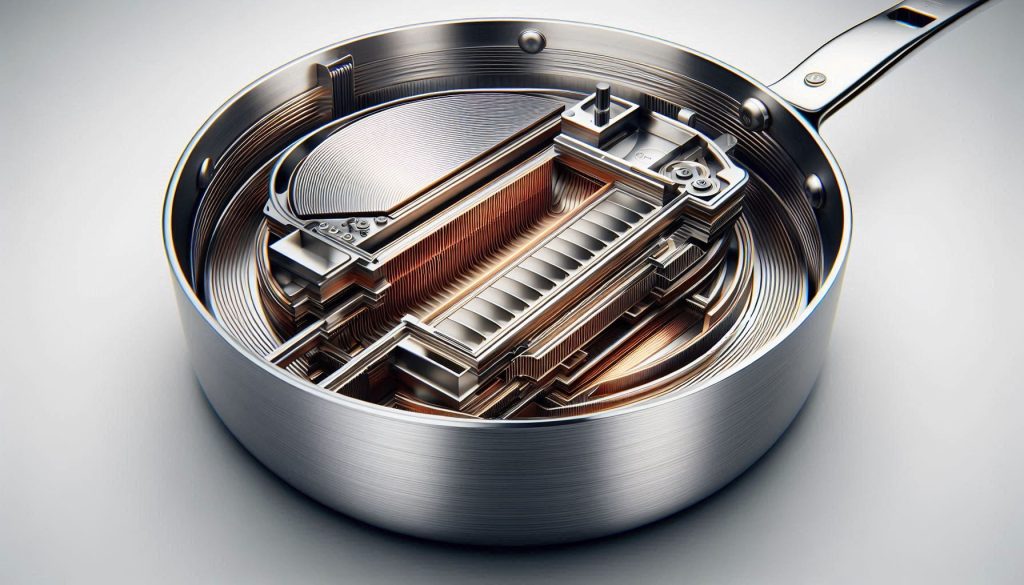
Composite multilayer (clad): combines the above — e.g., stainless-aluminum-stainless or stainless-copper-aluminum-stainless. These give you the usability of stainless with the conduction of aluminum or copper.
Example models: All‑Clad D3 (3‑ply stainless/aluminum) for balanced performance; All‑Clad CopperCore or Mauviel M’heritage for copper’s responsiveness; Demeyere Atlantis or All‑Clad D5 (multi-ply) for heavy thermal mass and evenness.
Core thickness, thermal mass, and layer sequencing
Core thickness: thicker conductive cores spread heat farther and increase thermal stability. Thin cores react faster but can show local ΔT under a concentrated flame.
Thermal mass: more mass = better retention and recovery after adding cold ingredients, but slower to change temperature. Use high mass for braises and searing; low mass for quick pan sauces.
Layer sequencing: placing the most conductive metal near the heat source improves spread; outer stainless retains durability and induction compatibility. Copper or thick aluminum cores center heat and minimize hot spots.
Practical tip: a 3–5 mm effective conductive layer (in aggregate) is commonly where you’ll notice a strong balance of spread and response for everyday pans.
Surface finish, base flatness, and skirt geometry
Finish: a smooth, flat contact surface maximizes heat transfer to stovetops (especially electric/glass). Highly polished bottoms transfer well on smooth surfaces; matte/textured finishes can slightly reduce contact area.
Flatness: even a small warp creates dramatic ΔT on gas flames. Check flatness on a tile or with a straightedge before buying.
Skirt geometry: tall, straight sides inhibit lateral conduction to the rim; flared sides promote rapid evaporation and more even browning across the surface. For reductions and pan sauces, moderate slump in the skirt is helpful.
Trade-offs and sensor integration
Responsiveness vs. retention: choose based on technique — searing and rapid deglazing favor copper/aluminum cores; slow, steady cooking and heat recovery favor heavier multi-ply or cast iron.
Weight and handling: heavier pans give stability but fatigue your wrist.
Induction compatibility: requires a magnetic exterior (ferrous stainless). Multi-ply designs commonly address this.
Coatings & sensor housings: thick nonstick coatings and adhesive-bonded sensor pockets add thermal insulation and lag. Prefer pans with flush-mounted metal sensor housings or integrated sensors specified for minimal thermal impedance.
How to apply this now: prioritize the core material and thickness that match your cooking style, verify base flatness in-store or via reviews, and check whether the pan’s sensor mounting is metal-to-metal to avoid misleading temperature feedback.
4
A Practical Buying Guide: Features, Integration, and Verification You Should Prioritize
measurable features and real integration matter more than marketing in tech-enabled cookware.
When you evaluate luxury tech-enabled pans, be literal—buy measurable features and integration quality, not marketing. Below are prioritized criteria, a practical rubric for comparing claims, specific questions to ask, quick verification steps, and a simple cost‑benefit framework tying price to expected performance and service life.
Prioritized buying criteria
Sensor calibration and stated accuracy: look for NIST‑traceable or manufacturer-stated ±°C/°F tolerances.
Firmware update pathways: OTA (Wi‑Fi/Bluetooth) or wired updates and an update history.
App and cooktop interoperability: open standards (Bluetooth LE, Wi‑Fi) and explicit compatibility lists (e.g., Hestan Cue works with its induction base).
Built‑in safety cutoffs: automatic shutdown above set temperatures or after sensor failure.
Repairability and sensor replacement: replaceable sensor modules and documented service parts.
Warranty scope: separate coverage for electronics versus cookware body, length, and international support.
Documented third‑party test results and certifications: independent thermal-mapping tests, FCC/CE, RoHS, NSF (food-contact), or UL for electronics.
Recovery time after adding cold ingredient: excellent < 30 s to return within target band on medium heat; poor > 90 s.Use these thresholds when reading specs or test reports.
Questions to ask manufacturers and retailers
Is the sensor calibration traceable to a standards lab? Can I see a certificate?
How are firmware updates delivered and how long will updates be supported?
Can sensors be replaced independently of the pan, and what’s the cost?
Which cooktops or induction bases are explicitly supported?
Are there third‑party thermal-mapping reports I can review?
Quick verification steps you can do
In store: check base flatness with a straightedge; wobble equals potential ΔT.
At home: use an infrared thermometer or thermocouple to map a heating cycle (three or four spots). Compare readings at target temps.
Functional test: sear a thin steak or fry an egg. Note evenness and smoke point behavior; smart feedback should correlate with observed results.
Cost‑benefit framework
Budget tier (<$200): basic construction, few or no electronics — lower risk, longer mechanical life.
Mid tier ($200–$400): decent cores, basic sensors/firmware — best ROI for most cooks.
Premium (+$400): advanced sensor suites, warranty/service, replaceable electronics — pay extra for longevity, software support, and verified accuracy.
These checks keep you from paying for glossy apps without substance — and help ensure the tech in your luxury pan earns its keep in the kitchen.
5
Care, Testing, and Long-Term Performance of Smart Luxury Pans
precision care and long-term performance define modern smart luxury cookware
You bought a tech-forward pan because you want repeatable results for years. Treat its sensor electronics and premium finishes like the instruments they are: regular care, simple validation, and informed servicing keep performance predictable.
Routine maintenance and safe handling
Clean sensors and electronics with a soft, damp microfiber; avoid abrasive pads, oven cleaners, and bleach.
Never immerse a non‑waterproof sensor module; check the IP rating (IP67 vs IPX0 makes a big difference).
Avoid thermal shock: don’t run cold water over a screaming-hot pan or move it abruptly from full heat to the fridge—cracked enamels and sensor adhesive failures are common.
For induction: keep the base flat and clean; abrasive scrubbing of the induction-contact surface can damage the mating surface and reduce heat transfer.
Protect advanced finishes: ceramic and nonstick coatings last longest at low-to-medium heat, with wooden or silicone utensils and minimal aerosol oils.
Simple, reproducible at‑home validation tests
Start with thermometer checks (recommended tools: a contact thermocouple, e.g., Type‑K, and a spot IR like Fluke 62 or an attachable FLIR/Seek thermal camera).
Calibration sanity checks: confirm your probe reads ~0°C in an ice slurry and ~100°C at a rolling boil (adjust for altitude).
Thermal map: heat the pan to a working setpoint and record 3–5 spot temperatures (center, mid, edge). Note ΔT across the surface.
Water‑bead uniformity: sprinkle even droplets—consistent, simultaneous beading indicates even surface temperature; isolated sputtering points show hotspots.
Sear-cook trial: sear a thin steak or fry four eggs, one in each quadrant. Look for uniform browning time and color. Log recovery time after adding a cold ingredient; excellent systems return within ~30s.
When to repair, recalibrate, or replace
Seek professional service if you see:
Persistent sensor drift beyond the manufacturer tolerance (e.g., >±2°C).
Repeated communication errors, battery failure in sealed modules, or visible corrosion at connectors.
Significant base deformation or ΔT increases that affect cooking results.Manufacturers (Hestan Cue and similar) typically offer replaceable sensor modules or recalibration—ask for service certificates and repair turnaround times before purchase.
Firmware, wear, and privacy
Expect electronics to age faster than the pan body—batteries, adhesives, and connectors commonly fail within 3–7 years. Track firmware updates and security patches; install only vendor-signed updates. Review the privacy policy: know whether temperature logs or usage patterns are stored in the cloud, how long they’re retained, and whether data is shared. Prefer local-only modes if privacy or long-term data storage is a concern.
Interpreting long-term data
Keep a simple log (date, max temp, ΔT, recover time). Look for trends: gradual drift in max temp, increasing ΔT, or slower recovery are early signs of wear. When performance no longer meets your dwelling thresholds (e.g., ΔT >10°C for searing), plan service or replacement.
With predictable care and a few reproducible tests, your smart pan can stay reliable and useful—now, let’s bring everything together to choose the right model for consistent results.
Choosing the Right Tech-Forward Pan for Consistent Results
You should prioritize objective sensor accuracy, proven thermal uniformity, compatible materials, and clear construction methods when evaluating luxury smart pans. Look for vendors that publish sensor metrics, thermal-camera or lab test results, and materials specs (core thickness, alloy, and bonding). Use the buying rubric and simple home tests described earlier to verify claims before purchase. Favor designs with durable integrations rather than glued or proprietary single-point sensors.
Investing in well-engineered, sensor-integrated cookware delivers repeatability, energy efficiency, and fewer replacements. Start with measured data, confirm via your own tests, and choose the pan that consistently reproduces the results you expect in your kitchen. Make data-driven choices and cook with confidence every single time.