
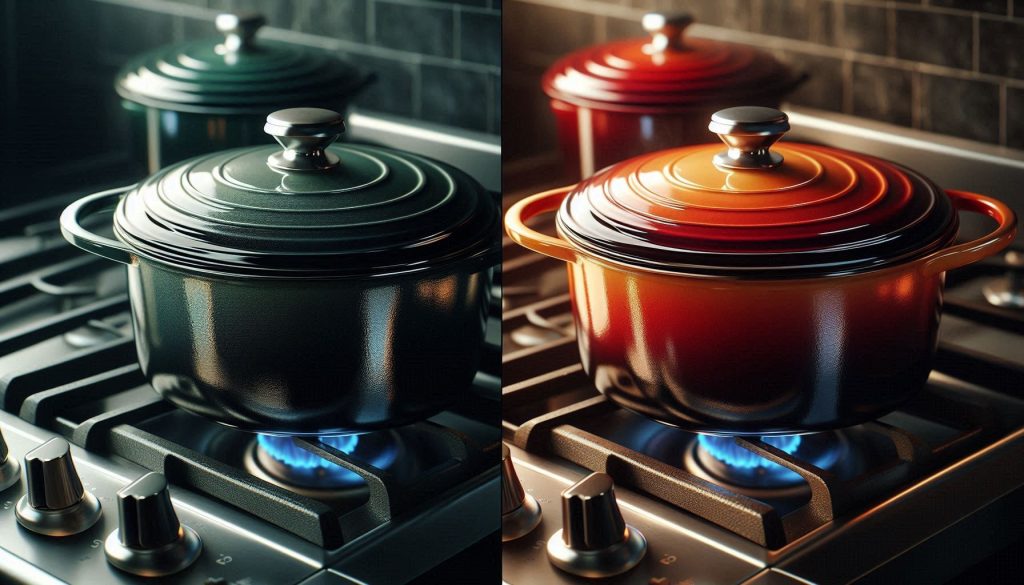
When investing in premium kitchenware, the debate between matte vs. glossy enamel cookware finishes often comes down to more than just aesthetic appeal. While a vibrant, mirror-like glossy finish from brands like Le Creuset can serve as a stunning kitchen centerpiece, a sophisticated matte finish—often found on Staub interiors—offers unique functional advantages. The choice between these two surfaces impacts everything from thermal emissivity and Maillard reaction efficiency to stain resistance and ease of cleaning. Understanding the microstructural differences in how these glass-based coatings are fired and applied is essential for any home chef looking to balance long-term durability with professional-grade cooking performance.
This comprehensive guide evaluates enamel finishes against measurable performance criteria, including heat response, food release, and scratch resistance. Whether you are searing a steak or simmering a delicate sauce, the texture of your cookware’s interior dictates how oil behaves and how easily “fond” develops. By comparing real-world factors like stain susceptibility and impact durability, we help you navigate the tradeoffs between the slick, easy-to-clean nature of gloss and the rugged, wear-masking properties of matte. Read on to discover which enamel finish fits your specific cooking style, maintenance habits, and budget to ensure your investment lasts for decades.
Choosing Between Matte and Glossy Enamel
You’ll get a clear, evidence-based overview that frames the core tradeoffs between matte and glossy enamel cookware finishes. Finish affects heat response, food release, browning, scratch resistance, cleaning, and how a piece wears over years—so it’s more than looks.
This article evaluates finishes against measurable criteria: heat behavior, sticking and browning, real-world durability, stain resistance and cleaning, everyday usability and aesthetics, plus cost and availability. Read on to compare performance, maintenance, and value so you can choose the finish that fits your cooking style and lasts the way you need it to and smartly.
How Enamel Finishes Are Made and Why That Matters
The basics: wet vs. powder application
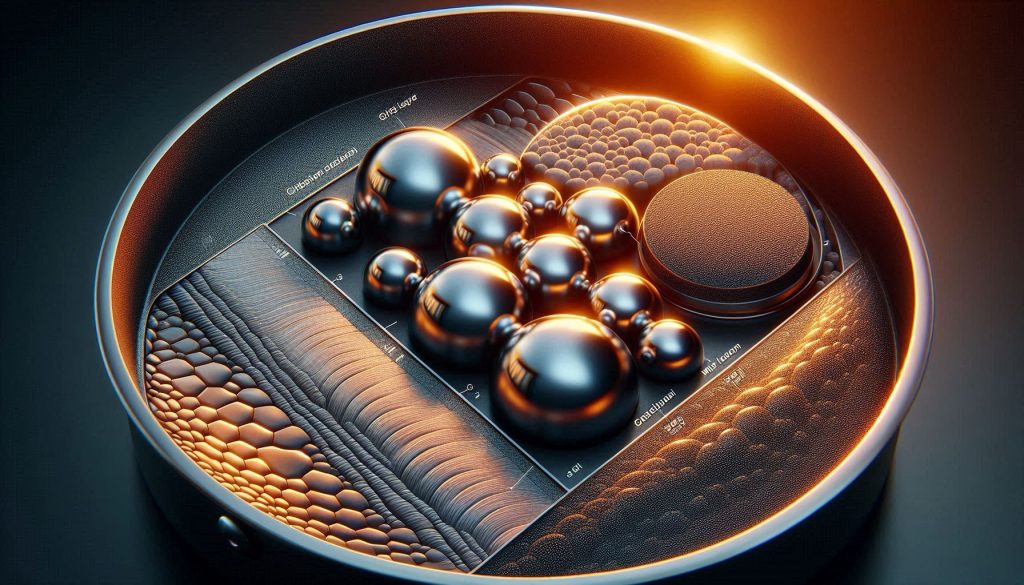
To evaluate finishes you first need to understand how enamel gets onto metal. Manufacturers use two common routes: wet (liquid) enamel—often called porcelain enamel—is sprayed or dipped onto the metal and then fired; powder enamel is electrostatically applied as a dry powder and then fused in a kiln. Both produce a glassy coating after firing, but application method affects thickness control, surface texture, and how well the coating keys to the metal underneath.
Frit composition and firing temperature
Enamel is glass made from a frit (silica plus fluxes and stabilizers). Frit composition (what’s in the glass) and firing temperature control hardness, color, and thermal expansion. Higher firing temperatures and well-matched thermal expansion between frit and substrate yield coatings that are less prone to crazing or flaking. Reputable brands will use lead‑ and cadmium‑free frits and specify processing to minimize stress.
Thickness and surface roughness
Finish differences you see—mirror-like glossy or muted matte—come down to thickness and microtexture. Glossy enamels are smoother with lower surface roughness; matte finishes intentionally increase microscopic texture (higher Ra) either by additives or by multiple thin layers that break light scattering. Thicknesses typically vary by micrometers to fractions of a millimeter; thicker coatings can hide small imperfections but may also be slightly more brittle if not properly formulated.
Microstructure → performance links
Microstructure influences real-world behavior:
Substrate interaction: enameled cast iron vs enameled steel
The substrate changes everything. Heavy, rigid cast iron supports thicker, durable enamel (think Le Creuset’s glossy interiors or Staub’s darker matte-like interiors) and long thermal mass. Thin enameled steel panels are lighter and more prone to denting; the enamel there must be formulated for flexibility. When you inspect a piece, check finish texture, ask about frit and firing, and feel how the surface responds to light—these cues predict how the pan will behave in daily cooking.
Next, we’ll use this foundation to examine how those microstructural differences actually affect cooking performance—heat response, sticking, and browning.
Cooking Performance: Heat Response, Sticking, and Browning
Heat response and thermal behavior
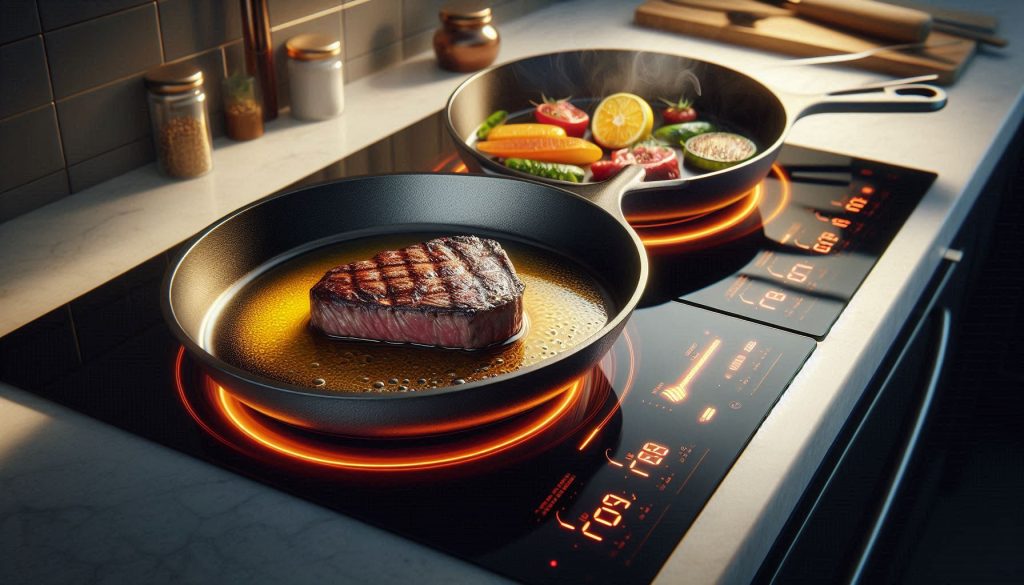
When you put a pan on the burner, conduction through the substrate dominates; finish plays a secondary role. In practical tests (time-to-temperature with a thermocouple at the cooking surface and IR thermography for uniformity), heavy enameled cast iron (e.g., Le Creuset) heats more slowly but holds heat longer than thin enameled steel. Glossy vs. matte enamel on the same cast‑iron piece typically changes time‑to‑target by only a few percent—stove power and metal thickness matter more than shine. Matte finishes have slightly higher emissivity, which matters more under broilers or in ovens than at the stovetop.
Surface texture, oil behavior, and sticking
Microscopic texture is where finish influences sticking. A glossy interior spreads oil more uniformly; matte interiors have micro‑pockets that can trap oil and food particles.
Controlled comparisons use:
Typical, repeatable findings you can expect:
Searing, browning, and delicate tasks (eggs, fish)
For a true sear you want consistent surface contact and a stable oil film. Glossy surfaces will often give a slightly crisper, more even Maillard crust on steaks; Staub’s darker, matte interiors are prized for their visual browning but can require a touch more oil. For delicate fried eggs, glossy enamel is usually more forgiving—fewer tears and easier release—especially when you preheat properly.
Practical, test-backed tips you can use right away:
These distinctions are meaningful in everyday cooking but modest in magnitude; good technique often outweighs finish differences.
Durability and Scratch Resistance: Real-World Wear
How industry tests map to kitchen life
Manufacturers and labs use repeatable protocols you can read about on datasheets. Common tests include:
Translated to your kitchen: a high Taber score suggests the finish will resist stirring, scrubbing, and utensil abrasion for years; good impact scores mean rims and handles tolerate accidental knocks better. Thermal cycles predict resistance to repeated oven-to-stovetop use.
Hardness, adhesion, and edge wear — what matters
Enamel is essentially glass fused to metal. Its surface hardness is high, but adhesion to the metal substrate and coating thickness determine chip resistance. The most vulnerable spots are edges, rims, and thin-lipped lids where the enamel layer is thinnest and stress concentrates. Matte finishes can hide micro-abrasions visually, while glossy finishes often show chips as stark white contrasts (think Le Creuset Classic gloss vs. Staub’s matte/dark interiors).
Everyday causes of damage (and how to prevent them)
Small changes in handling reduce most wear:
Assessing damage and handling warranty claims
If you find a chip or crack, document it immediately—date-stamped photos, purchase receipt, and a short use-log (normal use, not dropped) help. Most premium brands (Le Creuset, Staub) will inspect for manufacturing defects; accidental impact damage is frequently excluded. Contact customer service with your documentation first.
Quick product notes for comparison
Keep these practical checks in mind when you buy, unbox, and use enamel cookware to maximize lifespan and reduce lifetime cost.
Cleaning, Stain Resistance, and Long-Term Care
Quick orientation: what to expect
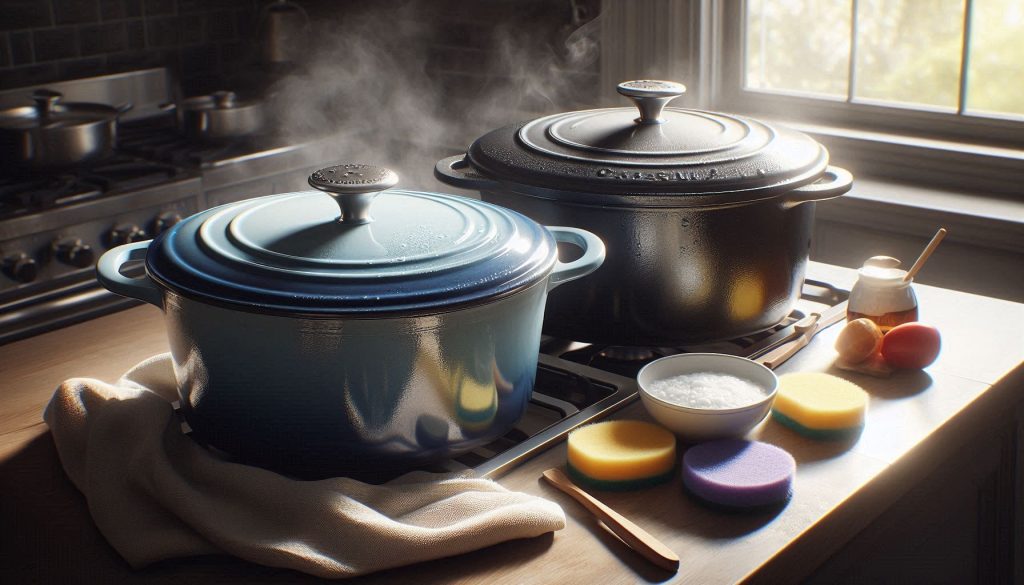
You’ll find glossy interiors (Le Creuset Signature Enameled Dutch Oven) rinse easier and show stains quickly; dark/matte interiors (Staub Cast Iron Cocotte, Staub’s black matte) hide ghosting but can trap residue in microtexture. Most enameled surfaces are non-porous glass, so stains are usually surface chemistry, not permanent absorption—if you act with the right methods.
Everyday cleaning rules
Dishwasher and detergents
Safe stain fighters and abrasives
Do NOT use bleach, oven-cleaner gels, or aggressive metal pads on enamel.
Step-by-step recovery tactics
Brown scorch marks
- Fill with warm water, add 1–2 tbsp baking soda or a dishwasher tablet.
- Bring to a gentle simmer for 10–15 minutes, cool, then scrub with a nylon pad.
- For stubborn marks, make a Bar Keepers Friend paste, apply, wait 5–10 minutes, scrub gently, rinse.
Mineral deposits (white scale)
- Boil equal parts water and white vinegar for 5–10 minutes.
- Let soak until cool, then scrub and rinse thoroughly.
- Repeat or use citric-acid powder for heavy buildup.
Superficial scratches
How your regimen affects longevity
Frequent abrasive scrubbing and dishwasher use dull glossy coatings; lax rinsing and high-heat burning encourage ghosting, especially on lighter interiors. A little prevention and the right cleaners keep both finishes looking and performing their best.
Next up: how these differences in care and wear translate into everyday aesthetics and usability during cooking.
Aesthetics and Usability: How Finish Affects Everyday Cooking
Color, saturation, and reflectivity
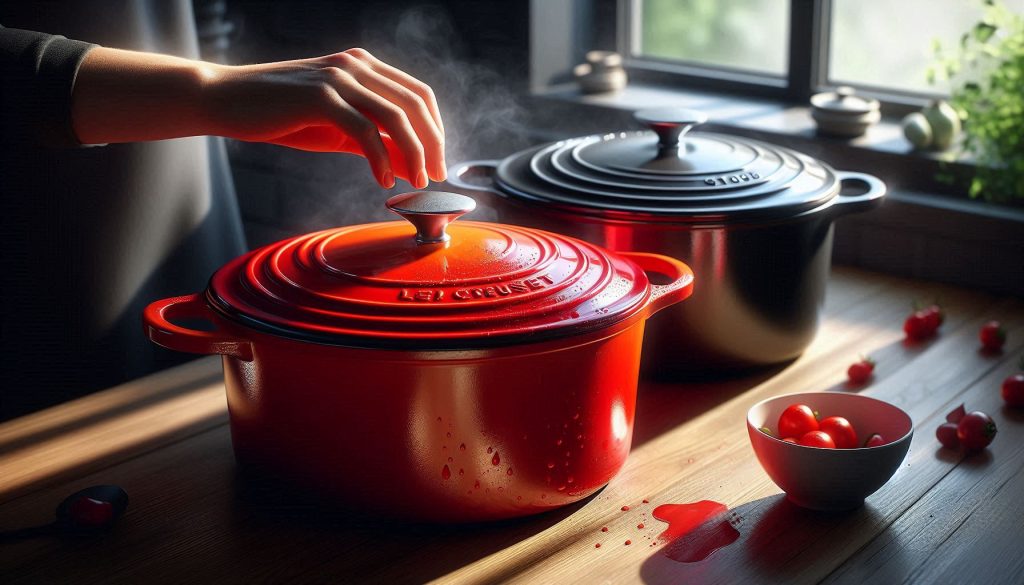
Glossy enamel (think Le Creuset Signature Enameled Dutch Oven) pushes color—the reds, blues, and yellows look richer and more saturated because the smooth glass surface reflects light evenly. Matte (for example, Staub’s black matte cocotte exterior or interior) mutes color and reduces glare; the result reads more understated and “solid.” If your kitchen gets a lot of natural light, glossy pieces will become focal points; matte pieces sit back and feel quieter.
Visibility of residue and fingerprints
Glossy surfaces show fingerprints, oil splatters, and water spots immediately; that makes them easy to spot and wipe but also raises the pressure to clean more often if you like a pristine look. Matte finishes hide fingerprints and light ghosting better, but their microtexture can trap tiny crumbs or oil films that are less obvious until they build up—so you may need occasional deeper cleaning.
Perceived weight, grip, and handling
Matte exteriors often feel slightly grippier and less “slick” when you handle lids or carry a hot pot—useful if you lift heavy pans frequently. Glossy rims and handles can feel smoother; when wet, they can be more slippery. If you regularly move hot cookware from stove to table, matte can give you more confidence without changing the actual mass of the piece.
Pouring, checking doneness, and practical use
Match to your kitchen and habits
Next up: we’ll weigh these aesthetic and usability trade-offs against cost and availability to help you pick the right finish for your budget and lifestyle.
Cost, Availability, and Choosing the Right Finish for Your Needs
Price and market positioning
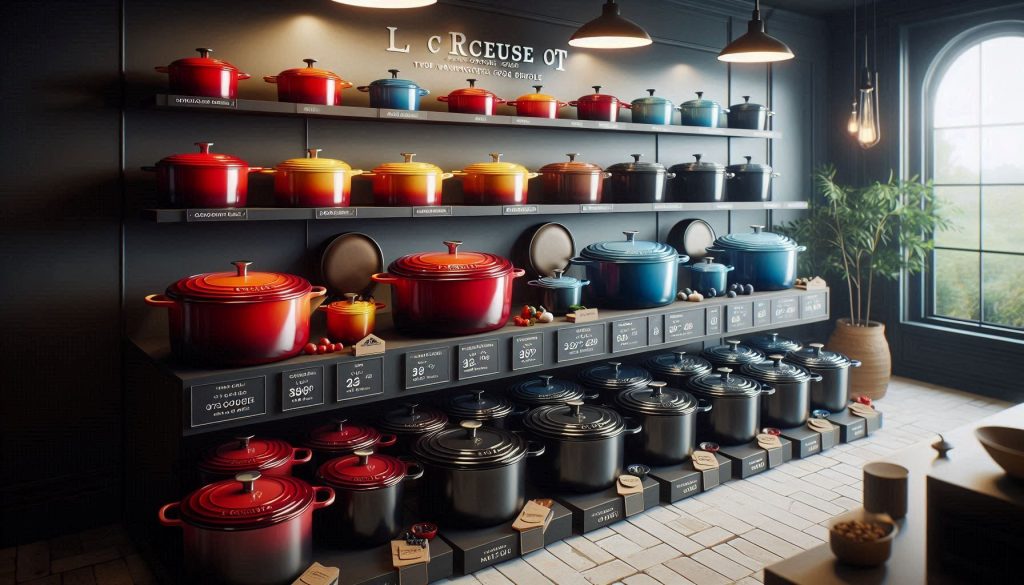
Premium glossy and matte enameled cookware from brands like Le Creuset (Signature, glossy) and Staub (matte-black interiors on many cocottes) sit at the top of the market—expect full-size Dutch ovens in the $250–$450 range. Mid‑range options (Lodge, Tramontina) usually use glossy finishes and fall in the $50–$150 range. Matte finishes—especially specialty satin or sand mattes—are less common and often command a price premium because of additional processing and limited color runs.
Warranty and after‑sale support
High‑end makers typically back products with long limited warranties that focus on manufacturing defects (many advertise multi‑decade to lifetime coverage for enamel delamination). Budget lines often offer 1–10 year warranties. When shopping, verify exactly what’s covered (chips vs. structural defects) and how claims are handled — a quick call to customer service gives a strong sense of real support.
Availability across types and sizes
Glossy enamel is widely available across sizes, colors, and cookware types (Dutch ovens, skillets, braisers). Matte finishes are more common in specific product lines (certain Staub models, artisan/limited editions) and may be harder to find in unusual sizes or bright colors. If you want a five‑quart matte Dutch oven in a rare color, expect longer waits or higher prices.
Decision matrix — which finish for which priority
Quick shopping checklist
With cost, availability, and these trade‑offs mapped out, you’re ready to translate preference into a practical purchase—next we’ll offer concrete recommendations and next steps.
Practical Recommendations and Next Steps
Summarizing the evidence: if you’re an everyday cook choose glossy for easier release and cleaning; entertainers prioritize matte for modern looks but accept gentler care; low‑maintenance users pick glossy for stain resistance; durability‑focused buyers favor hard, chip‑resistant enamel regardless of sheen. Test finishes in store by feeling texture, tapping for smoothness, and asking for sample heat/maintenance guidance. Ask manufacturers about base metal, enamel thickness, firing process, warranty, and recommended utensils.
Checklist: touch feel, inspect rim/coating edges, ask warranty, confirm care instructions, compare weight and price. Make your pick and cook confidently. Enjoy cookware that fits.