
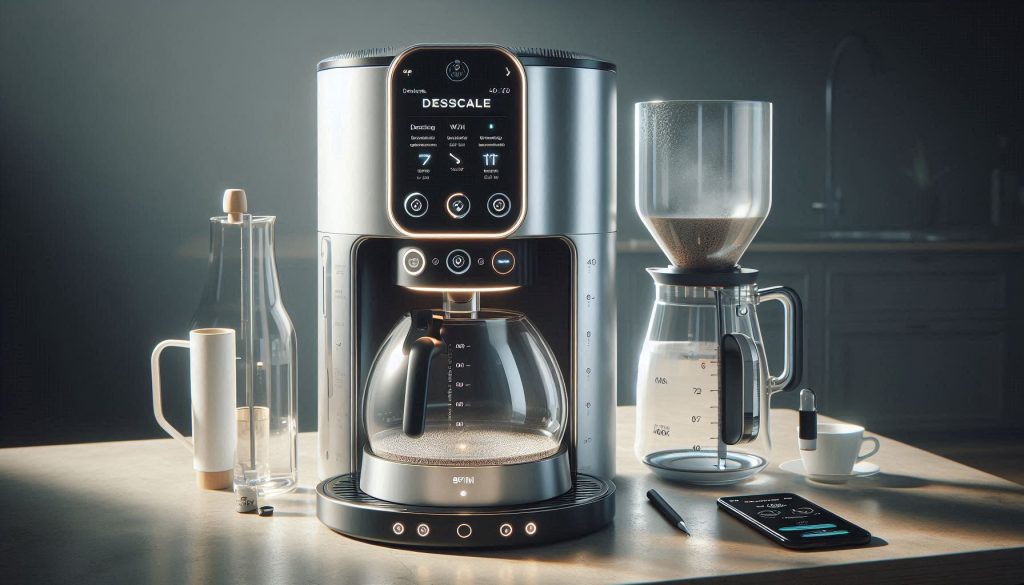
Is a persistent “descale” alert or sluggish flow ruining your morning brew? Over time, hard water minerals like calcium and magnesium build up inside your Spinn Coffee Maker, choking internal sensors, narrowing flow paths, and compromising water temperature. Left unaddressed, this scale leads to weak extraction, noisy operation, and eventual machine failure. This guide provides a comprehensive, five-step solution to fix the descale error, restore optimal pump pressure, and ensure every shot of espresso is as high-quality as the day you unboxed the machine.
Whether you are dealing with a complete blockage or simply want to perform routine maintenance, we’ll walk you through the process of diagnosing the alert, selecting safe descaling solutions, and running a thorough rinse cycle. You will learn how to distinguish a true mineral clog from other common faults and discover the pro-tested tips for resetting your machine’s software to clear those stubborn error codes. Follow along to protect your investment, extend the lifespan of your Spinn’s internal components, and get back to enjoying consistently perfect coffee in under an hour.
Why Descaling Your Spinn Matters — and What This Guide Will Do for You
Mineral scale from hard water builds inside your Spinn and chokes flow paths, sensors, and heaters. Left unchecked, scale causes poor extraction, slow brews, and error alerts that stop the machine.
This guide shows a clear five-step process to diagnose the descale alert, use approved solutions, run safe rinse and descale cycles, and verify performance afterward. You’ll learn how to tell a true descale error from other faults and how to fix common problems during the cycle.
Follow these steps to restore brew quality, protect internal parts, and prevent repeat errors. A successful descale ends with normal operation, consistent shot timing, and clean internal sensors.
You can complete the whole procedure in under an hour with basic supplies and the right approach. Read on for step-by-step instructions.
Step 1 — Diagnose the Descale Error and Take Safety Precautions
How scale forms and why it matters
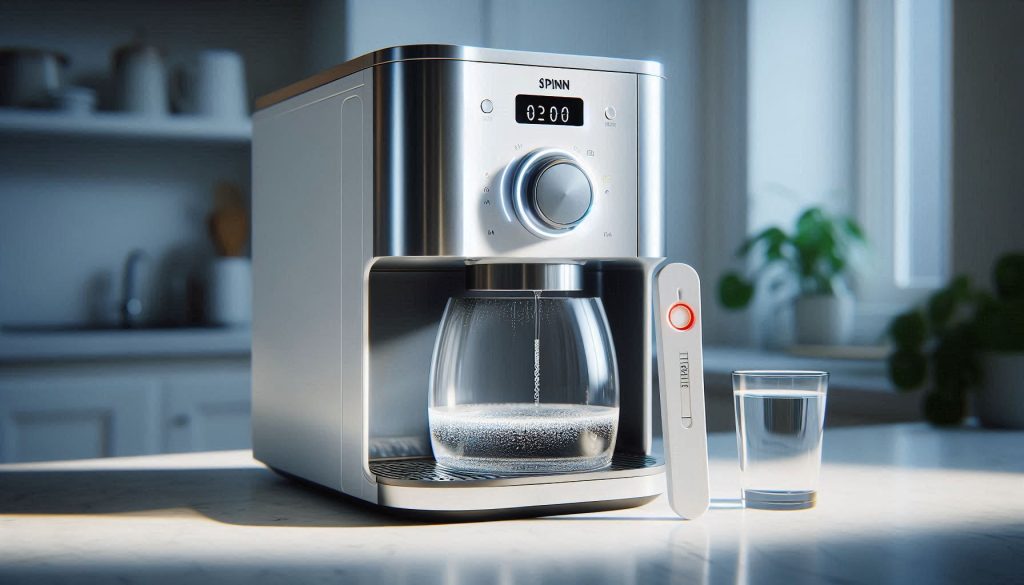
Scale is a crusty deposit of calcium and magnesium (the common “hard water” minerals) that precipitate when water is heated. Over time those deposits narrow flow paths, coat temperature sensors, and insulate heating elements. The result is slower flow, lower or inconsistent temperatures, longer brew times, and false sensor readings — exactly the conditions that trigger a Spinn descale alert.
A quick real-world test: if your sink water leaves white spots on glassware or tastes chalky, you almost certainly have mineral levels that will require more frequent descaling.
Distinguishing a true descale from other alerts
Before you start a descale cycle, verify that the alert is actually scale-related:
If you see a grinder jam message, bean-pouch warning, or a dedicated sensor fault code, clear those first — they can mimic descale symptoms.
Quick diagnostic checks you can do right now
Safety procedures before you descale
When to call a professional
Call Spinn support or an authorized technician if: you have persistent errors after one proper descale; you notice leaks, damaged tubing, or electrical smells; the machine is under warranty and the issue may be internal. For hard-water conditions with frequent failures, a pro inspection can identify corroded parts that DIY descales won’t fix.
Water-hardness guidance and solution selection are covered in Step 2, but knowing your hardness level now helps you decide whether this is a routine DIY descale or a job for a technician.
Step 2 — Gather Approved Supplies and Choose the Right Descale Solution
Quick supplies checklist
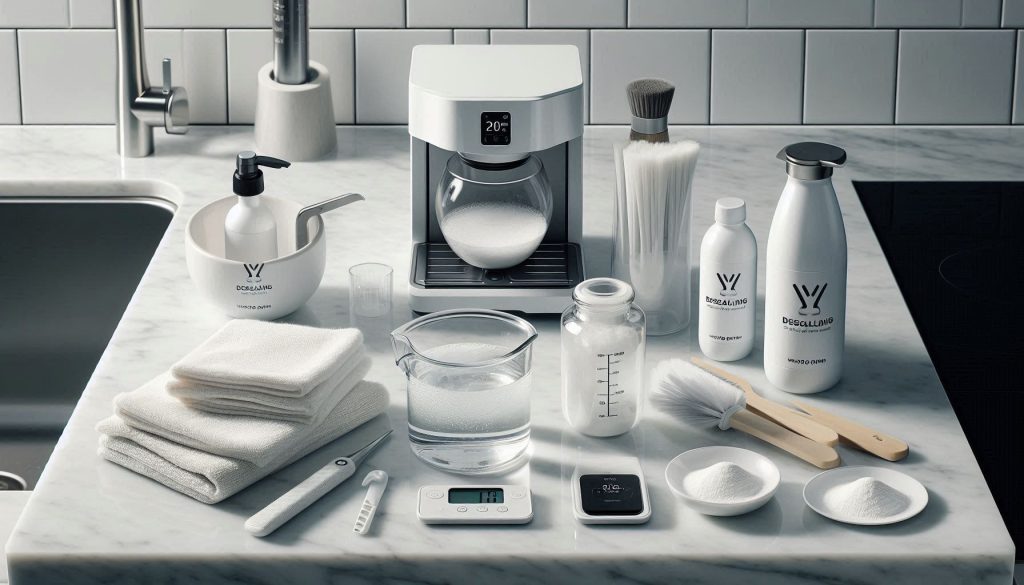
Before you start, assemble everything so the job is efficient and safe:
Why choose manufacturer-approved descaler first
Manufacturer solutions are formulated and tested for your machine’s materials and seals. Using an approved product reduces the risk of corrosion, residue, or sensor damage and helps preserve warranty coverage. Before you buy anything, check Spinn’s website or your manual for product recommendations and instructions.
Citric acid as a safe alternative (if approved)
If Spinn explicitly allows alternatives, food-grade citric acid is a good, science-backed choice. Citric acid is a weak organic acid that reacts with calcium carbonate (scale) to form soluble citrate salts that flush away easily. Home-baristas commonly use citric acid because it’s effective, low-odor, and less aggressive on metal and rubber than stronger mineral acids.
Suggested planning concentration (for planning only): typical effective ranges are approximately 1–2% w/v — about 10–20 g of citric acid per liter of water. Mix thoroughly and label the solution. Always follow Spinn’s exact instructions when available.
Why household vinegar is often discouraged
Household white vinegar (5% acetic acid) will dissolve some scale, but it’s commonly discouraged for coffee machines because:
If Spinn explicitly forbids vinegar, do not use it.
Environmental, disposal, and warranty notes
Next, you’ll prepare the machine and run a pre-descale rinse to remove loose debris and ensure the solution contacts scale effectively.
Step 3 — Prepare the Machine and Run the Pre-Descale Rinse
Empty and drain (2–5 minutes)
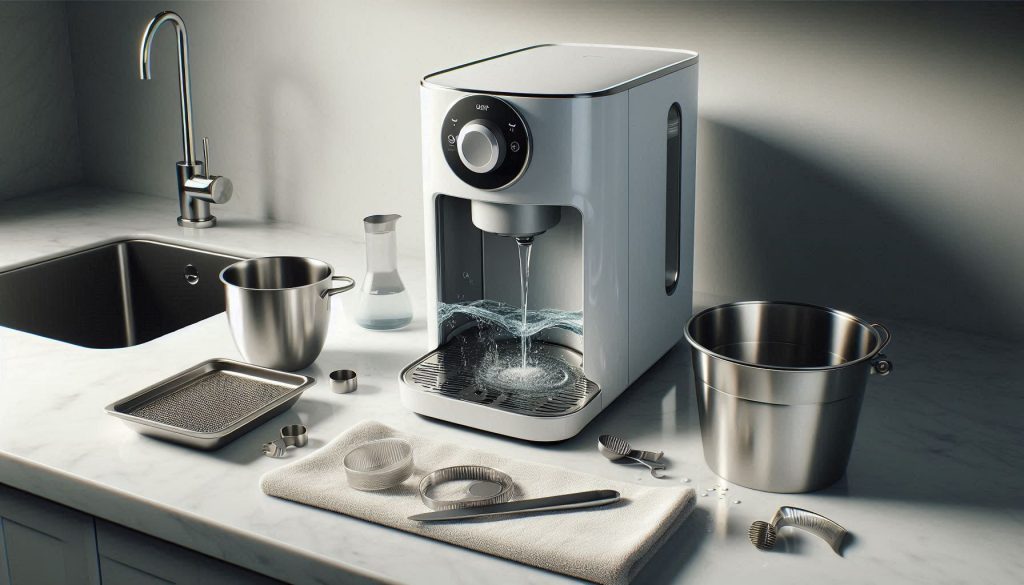
Start by draining any remaining water from the reservoir and run a short hot-water dispense into a bucket until the visible tank water is gone. This removes standing water that can dilute the descaler and concentrates debris for the pre-rinse. Expect 2–5 minutes depending on your model.
Remove and clean external parts (5–10 minutes)
Take out the removable components that can trap oils and grounds:
Allow 5–10 minutes; cleaning these parts prevents coffee particulates from re-entering the system during descaling.
Verify pump and sensor access (3–5 minutes)
Visually inspect connections you can access without disassembly:
If you find cracked plastic, oil-soaked seals, or loose tubing, stop here and contact Spinn support or a technician.
Mix the descale solution (2–4 minutes)
Follow the manufacturer recommendation. If allowed, common technician choices include Urnex Dezcal or food-grade citric acid (NOW Foods) mixed to roughly 1–2% w/v (about 10–20 g citric acid per liter) — but always prioritize Spinn’s instructions.
Pre‑descale rinse: how and why (5–15 minutes)
A pre‑descale rinse displaces coffee oils and particulates so the descaler contacts scale directly.
Avoid air locks: keep the tank seated and filled, tip the tank slightly so inlet fills, prime by running small dispenses until a steady stream appears. Listen while the pump runs—normal is a soft hum; persistent gurgling, high-pitched squeal, or dry-sputtering means air or cavitation.
Decision checklist — proceed or abort?
Proceed if all boxes below are green:
Abort and seek professional help if any of these occur:
With the machine primed and the pre‑rinse complete, you’re ready to run the full descale cycle in the next step.
Step 4 — Execute the Descale Cycle and Troubleshoot Common Problems
Run the core descale cycle (step‑by‑step)
Start descale mode if your Spinn offers it. If not, perform a manual cycle: fill the tank with the prepared descaler, run a steady dispense for 30–60 seconds, then stop and let the solution soak. Repeat these flow/soak cycles 2–4 times depending on scale severity.
Expected checkpoints to monitor while the cycle runs:
Soak times: 15–30 minutes per soak for moderate scale; up to 60 minutes for heavy, crystalline deposits. Repeat flow/soak cycles until the dispensed liquid looks free of particulates.
Troubleshooting — slow or no flow
Diagnostic test: run a plain‑water flush and listen for cavitation; measure output volume over 30 seconds.
Corrective actions:
Example: one user cleared a near‑no‑flow incident by removing a tiny coffee sediment lodged at the tank inlet screen — a 2‑minute fix.
Troubleshooting — persistent error after descale
Diagnostic test: note the error code, run a diagnostic cycle (if available), and check sensor contacts visually.
Corrective actions:
Data point: if error codes reappear after 2 full descales and cleaning, odds favor an electrical or mechanical replacement rather than more descaling.
Troubleshooting — residual taste or odor
Diagnostic test: run 2–3 full tanks of fresh hot water and taste.
Corrective actions:
When to replace parts instead of repeating descales
Consider replacement if any of these are true:
If you hit these limits, plan for targeted part replacement (pump, tubing, heating block) or professional service before further descaling attempts.
Step 5 — Rinse, Reset the Error, Verify Performance, and Plan Maintenance
Rinse protocol — flush until neutral
After the descale chemistry has done its work, remove every trace of solution. Follow this practical rinse protocol:
Tip: many Spinn owners report neutral taste after 2–3 flushes with citric descalers and 4+ with stronger products. If taste or smell persists, add an activated-carbon pitcher (Brita Longlast, PUR) or an in-line carbon filter (BWT Bestmax, 3M Aqua-Pure) to trap lingering off‑odors.
Reset the error state
Once rinsed, clear the machine’s error status before testing:
If the app can’t reach the device, reconnect Wi‑Fi or restart your router before retrying updates.
Verify performance — quick tests
Confirm the machine is truly back to normal with these checks:
Plan ongoing maintenance
Reduce future descales and extend component life:
When to call for help
Contact Spinn support or a certified technician if the same error reappears after two proper descales, if flow stays below ~30% of baseline, if metallic/chemical taste persists after 4+ flushes, or if you hear abnormal mechanical noises. Gather your log and error codes — they speed diagnosis.
Now proceed to the final wrap‑up to keep your Spinn running reliably.
Wrap-Up: Keep Your Spinn Running Reliably
You’ve followed five clear steps: diagnose and secure the machine, gather approved supplies, pre-rinse, run the descale cycle while troubleshooting, then rinse, reset, verify, and plan maintenance. Regular descaling measurably restores flow and consistent temperature, improves flavor by removing mineral buildup, and extends pump, heating, and sensor life—reducing failures and repair costs over time.
Act now if the descale error appears: use only Spinn‑approved descaling agents or recommended citric formulations, follow the steps above, and schedule recurring descales based on your local water hardness (harder water = more frequent intervals). If flow, temperature, or errors persist after a proper descale and reset, contact Spinn support or a certified technician for professional service right away.