
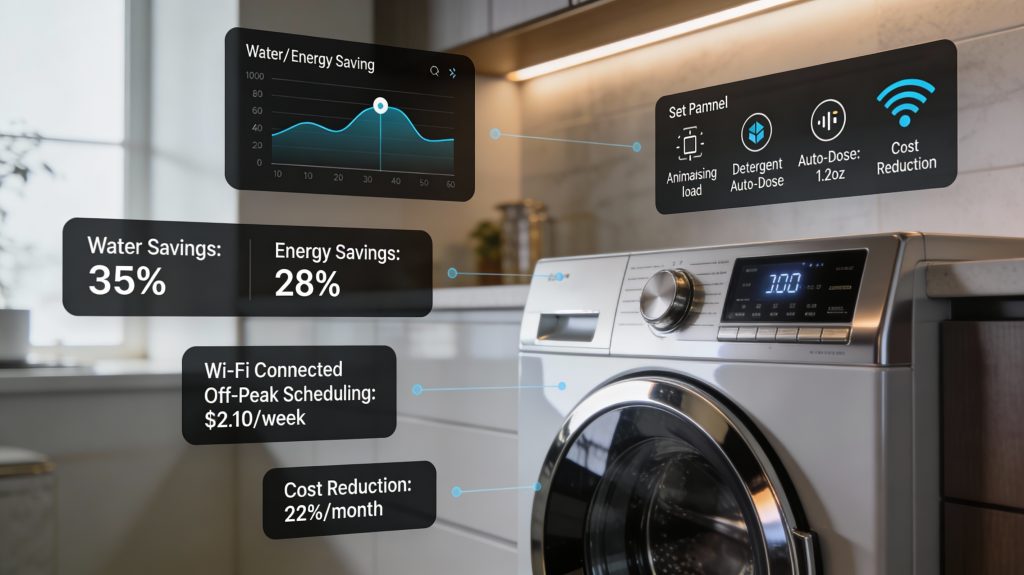
Are your monthly utility costs climbing higher than they should be? Laundry is often one of the largest hidden drains on a home’s resources, accounting for a significant portion of total water and electricity consumption. Upgrading to an energy-saving smart washer is no longer just about high-tech convenience; it is a strategic financial move. By utilizing advanced sensors and variable-speed inverter motors, these modern appliances optimize every drop of water and every watt of power. Transitioning to a smart model can lead to measurable reductions in overhead, with many households seeing 20–50% lower water usage and substantial energy savings compared to traditional machines.
Beyond just hardware efficiency, the true value of a smart washer lies in its ability to adapt to your specific laundry habits. Features like load-sensing technology, automatic detergent dosing, and high-speed spin cycles work together to minimize waste and reduce subsequent drying time. Furthermore, integrated Wi-Fi connectivity allows you to monitor real-time data and schedule loads during off-peak utility hours, effectively lowering your cost per kWh without changing your lifestyle. Whether you are looking to reduce your environmental footprint or simply want to keep more money in your pocket, understanding how these intelligent features drive down bills is the first step toward a more sustainable and cost-effective home.
Why Energy-Saving Smart Washers Matter for Your Bills
Are your laundry costs higher than they should be? Washing can be a surprisingly large share of household water and electricity use, and upgrading to an energy-saving smart washer can cut both.
Smart washers reduce usage by optimizing load size, water temperature, and cycle length, and by reporting real-time data so you change habits. Many models use sensors and inverter motors to save energy without sacrificing cleaning performance.
Expect measurable reductions: studies and manufacturer data commonly show 20–50% lower water use and 10–30% lower energy per load compared with older machines. This article helps you estimate savings, choose features that matter, and calculate payback for your household. We’ll focus on realistic numbers.
How Smart Washers Actually Cut Energy and Water Use
Where the energy goes in a wash cycle
Most of the electricity used by a washing machine goes to heating water, not to turning the drum. A useful rule of thumb:
Quick example: if a cycle draws 1.2 kWh, roughly 0.7–1.1 kWh may be for water heating. That means lowering temperature or using proven cold‑water chemistry can eliminate the largest single energy sink.
How sensors and control logic trim waste
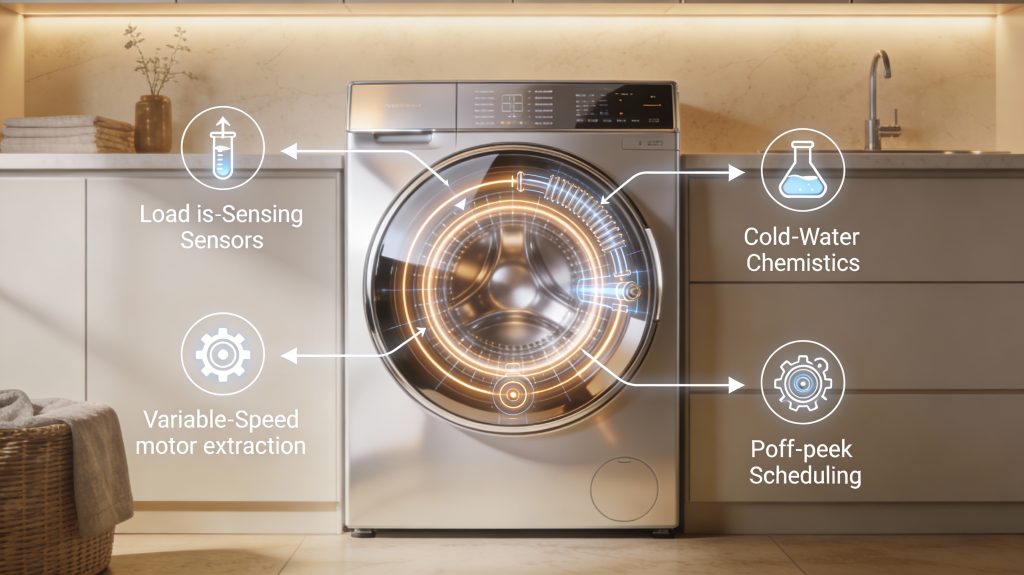
Load and soil sensors measure drum weight, fabric type, and turbidity to match water volume and run time to the job. In practice this cuts water by 15–40% and automatically shortens agitation or rinses on lightly soiled loads. Tip: run the washer’s “auto sense” or “eco” mode and avoid manual overfilling — you’ll see the biggest immediate gains.
Product note: models like the LG WM4000HWA and Bosch 800 Series use load-sensing plus adaptive cycles that frequently reduce water use versus legacy top-loaders.
Inverter and variable‑speed motors: efficient motion
Inverter (variable‑speed) motors draw only the power needed for the phase of the cycle instead of running at full power constantly. That can reduce motor energy by 10–25%, improve longevity, and enable gentler, tailored tumbling that cleans better with less water.
High‑speed spins that shrink dryer time
Advanced spin profiles extract more moisture (higher RPMs with optimized acceleration), lowering dryer energy and time. Better spin can cut dryer energy by 20–50% for the same fabric dryness — a substantial indirect electricity saving you’ll notice immediately.
Product highlight: many Samsung and Whirlpool smart front-loaders advertise high G‑force spins that measurably reduce residual moisture.
Cold‑water chemistry and optimized detergents
Enzymes in modern cold‑water detergents and washer algorithms (longer soak, different agitation patterns) let you clean in cold water without sacrificing stain removal. Since water heating is the dominant energy use, switching hot cycles to cold can save most of the per‑load energy (often 0.5–1.0 kWh or more, depending on your baseline).
Tip: use detergents labeled for cold water (e.g., Tide Coldwater, Persil Cold Water) and select “cold wash” on the machine.
Intelligent scheduling and time‑of‑use savings
Smart washers can delay or run cycles during off‑peak hours to lower your bill if you have time‑of‑use or demand pricing. This doesn’t reduce energy consumed but can cut your cost per kWh by 10–40% depending on your utility rate spread. Combine scheduling with full-but-not-overloaded loads for best results.
Practical steps you can do right now: enable auto-sensing, use eco or cold cycles, choose a high‑spin option for bulky items, and schedule large loads for off‑peak hours. These control- and hardware-driven measures are where smart washers translate technical features into real, repeatable savings.
Which Smart Features Drive the Biggest Savings
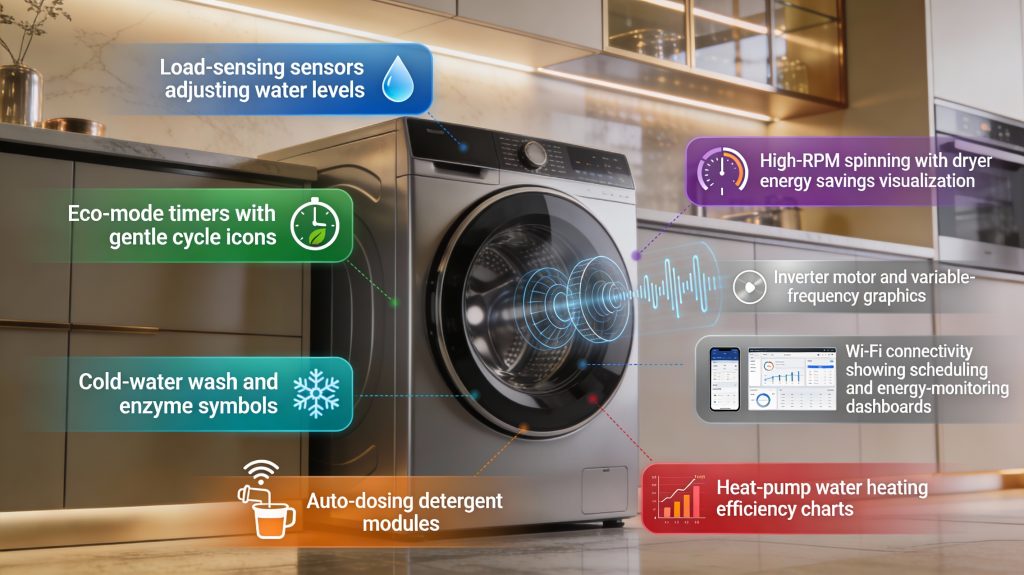
You should know which features matter most when evaluating models. Below are the high‑impact smart features, how they cut energy or water, typical magnitude of impact, and the trade‑offs you’ll weigh between time, temperature, and fabric care.
Precise load sensing & automatic water‑level control
How it saves: sensors measure load mass and soil level to match water and agitation.Typical impact: water reduced 15–40%; cycle energy trimmed proportionally.Trade‑offs/tip: can under‑treat very soiled loads—use “heavy” override when needed. Look for Bosch 800 Series or LG WM4000HWA for strong auto‑sense performance.
Eco modes (longer cycles, lower energy)
How it saves: extends wash time and uses gentler, lower‑energy actions to clean at lower temperatures.Typical impact: energy down 10–40%; water slightly lower or similar.Trade‑offs/tip: expect 20–60 extra minutes. Use on lightly to moderately soiled clothes; switch to standard mode for stains.
Cold‑water wash optimization
How it saves: enzymes, mechanical adjustments, and formulation‑aware cycles eliminate the need to heat water.Typical impact: saves 0.3–1.0 kWh per load (up to the bulk of per‑load energy).Trade‑offs/tip: stains may require pre‑treatment. Models with “EcoBubble” (Samsung) or LG ColdWash are built for this.
High spin speeds (lower dryer energy)
How it saves: higher RPMs extract more moisture so the dryer uses less energy.Typical impact: dryer energy cut 20–50% per load depending on fabric.Trade‑offs/tip: high spins can crease or stress delicates—use a lower spin for fragile items. Look for 1,200–1,600 RPM specs on front‑loaders.
Variable‑frequency/inverter motors and efficient drives
How it saves: motors modulate speed and torque precisely, avoiding wasted electricity and reducing cycle time.Typical impact: motor energy down 10–25%; quieter operation and longer life.Trade‑offs/tip: slightly higher upfront cost but lower operating noise and maintenance. LG Inverter Direct Drive and Bosch EcoSilence Drive are common examples.
Auto‑dosing of detergent
How it saves: dispenses just the right detergent amount to avoid over‑foaming and extra rinses or reruns.Typical impact: reduces detergent usage 20–40%; prevents extra rinse cycles that waste water and energy (5–15% indirect).Trade‑offs/tip: refill cartridges add cost; models include Bosch i‑DOS and Miele TwinDos.
Connectivity: energy monitoring & scheduling
How it saves: lets you run loads during off‑peak hours and monitor consumption to alter habits.Typical impact: bill reduction 10–40% if your utility uses time‑of‑use pricing (consumption unchanged).Trade‑offs/tip: requires Wi‑Fi and app learning. Check LG ThinQ or Samsung SmartThings integration.
Heat‑pump and advanced heating technologies
How it saves: heats water more efficiently than resistance elements by transferring heat.Typical impact: heating energy cut 50–70% for the heating portion of the cycle.Trade‑offs/tip: higher upfront cost and longer cycles in some designs. European models and higher‑end brands are leading here—worth considering if you frequently run warm/hot loads.
How to Estimate Your Savings and Calculate Payback
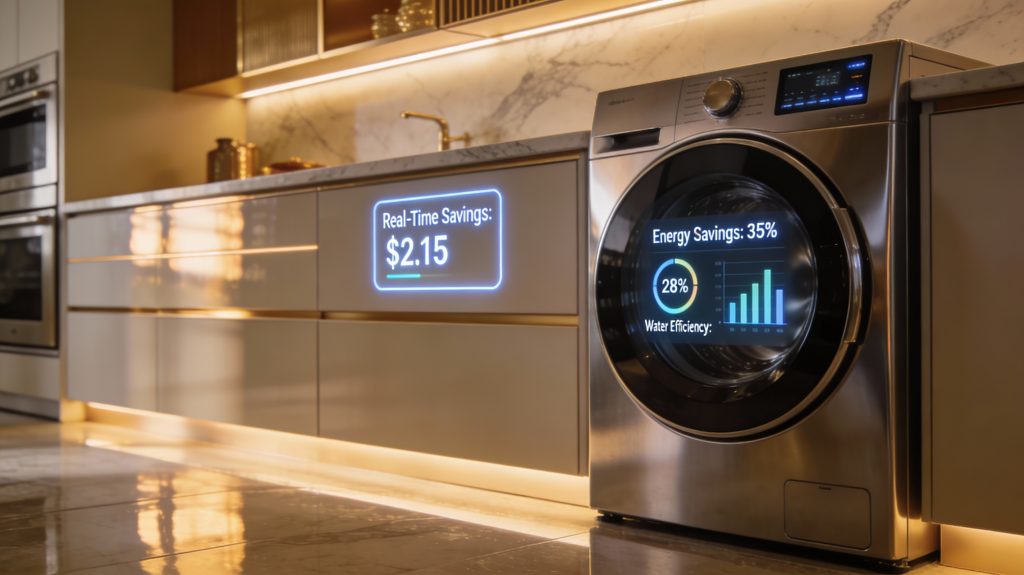
You’ll get a step‑by‑step, data‑driven method to project what a smart washer will actually save you. Follow these simple formulas, plug in your numbers, and you’ll know whether the upgrade makes financial sense for your household.
Quick recipe: the math you’ll use
Step‑by‑step with the water‑heating shortcut
- Estimate your current hot‑water energy per load. A practical formula:
Energy to heat water (kWh) = Liters per load × Temperature rise (°C) × 0.001163
Example: 50 L × 35°C × 0.001163 ≈ 2.04 kWh. - Add motor & drive energy (~0.2–0.5 kWh typical for modern machines) to get total current kWh/load.
- Estimate the smart washer’s new kWh/load from manufacturer specs (or reduce heating proportionally if you plan to use cold‑wash or Eco modes).
- Compute per‑load kWh saved and multiply by your annual load count.
Note: water heating usually dominates washer energy. In the example above the 2.04 kWh for hot water could be ~85–90% of total per‑load energy—so cutting hot usage has outsized impact.
Worked example (realistic numbers)
Assume:
New load energy = (2.04 × 0.40) + (0.3 × 0.80) = 0.816 + 0.24 = 1.056 kWh
Per‑load kWh saved = 2.34 − 1.056 = 1.284 kWh
At $0.15/kWh: savings per load (electric) = 1.284 × $0.15 = $0.19
If water drops from 50 L to 35 L (15 L saved) and water costs $2/m³ ($0.002/L): water saving per load = 15 × $0.002 = $0.03
Total saving per load ≈ $0.22
If you run 300 loads/year: annual savings ≈ 300 × $0.22 = $66/year.
Payback and sensitivity
If the smart model costs $500 more but you get a $150 rebate, net premium = $350.
Payback = $350 ÷ $66 ≈ 5.3 years.
Sensitivity (same per‑load saving):
Inputs checklist (to plug in)
For practical comparison, use model specs (e.g., LG WM4000HWA, Bosch 800 Series, Miele TwinDos) to estimate motor kWh and auto‑dosing/water use percentages, then run the simple formulas above to find the scenario that fits your household.
Installation, Daily Use, and Maintenance Tips to Maximize Savings
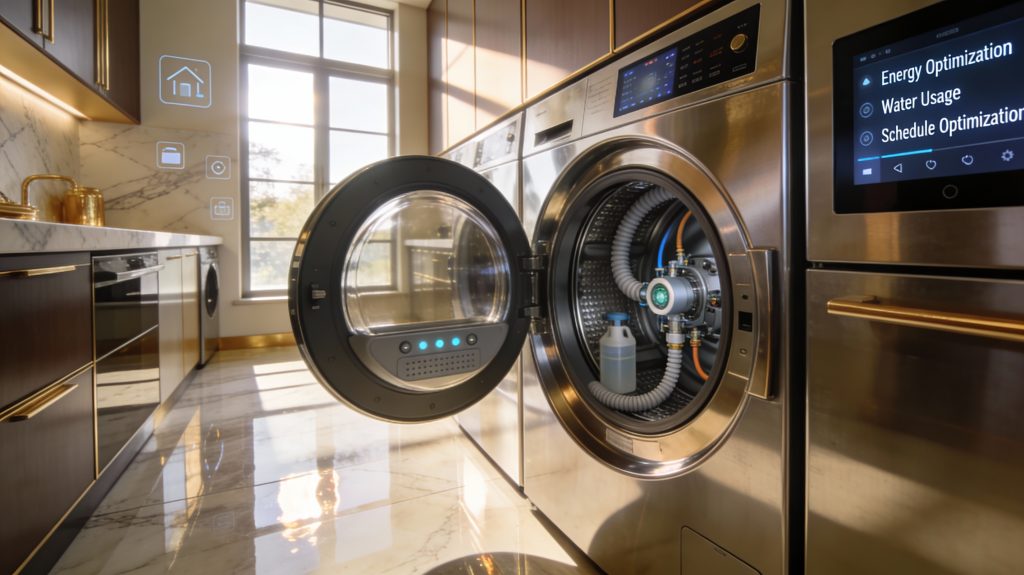
You’ve seen how much a smart washer can save on paper. Here are practical steps to ensure it actually performs at that efficiency over years of use.
Correct installation — get the basics right
Smart setup and configuration
Everyday habits that add up
Routine maintenance and common fixes
Integrate washer use with dryer and household loads
Scheduling washers to finish just before solar production peaks or to avoid overlapping with EV charging/dryer cycles multiplies savings — you’re not just reducing one appliance’s energy, you’re smoothing household demand for real bills reductions.
Next up, we’ll walk through how to choose the best smart washer model for your household and where to find rebates and incentives.
Picking the Right Smart Washer for Your Household and Finding Incentives
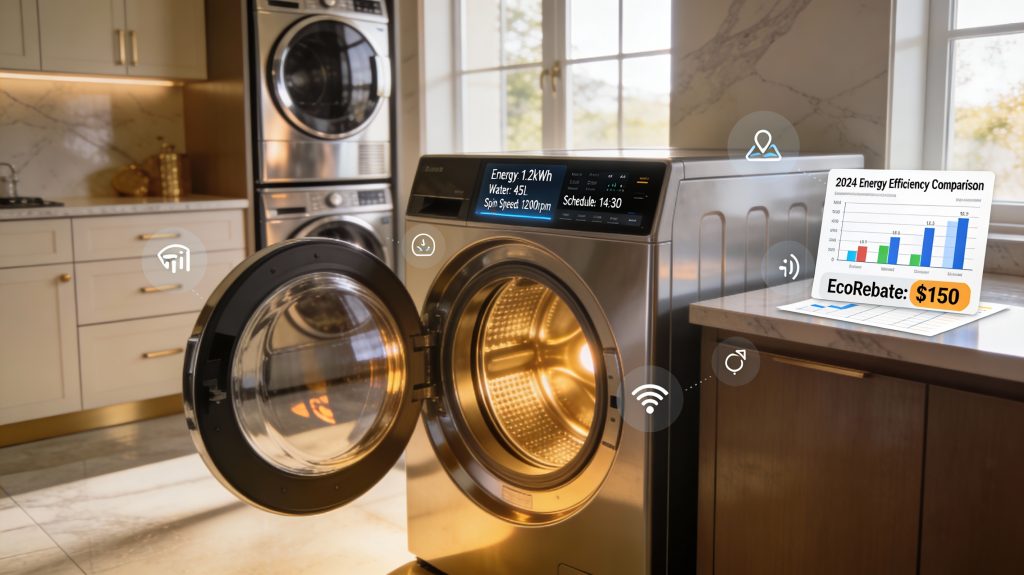
You’ve learned how smart washers save energy. Now match features to your habits and your budget so those savings actually show up on your bill.
Size, capacity, and load frequency
Choose drum size to minimize partial loads. As a rule of thumb:
If you wash multiple small loads daily (e.g., kids’ sports gear), prioritize a model with fast cycles and good soil sensing to group and shorten washes. Example models to compare on capacity and cycle time: LG WM4000HWA, Samsung WF45R6300AV, Electrolux EFLS627UTT.
Prioritizing features based on your utility rates
Map features to where your money goes.
A quick real-world check: if you pay $0.25/kWh, saving 1.5 kWh per load is worth about $0.375 — multiply by loads per year to judge ROI.
Connectivity and data privacy trade-offs
Connected features (remote start, firmware updates, usage reports) can increase savings through smarter scheduling. But cloud services often collect usage data.
Finding rebates, programs, and financing
Actionable search steps:
Comparing life-cycle costs (not just sticker price)
Estimate: (annual energy + water + maintenance) × expected years + purchase price. Use expected life = 10–12 years. Compare models by estimated 10‑year total cost, not the MSRP alone.
Quick in-store/online comparison checklist
With a chosen model and incentives identified, you’re ready to move into the final step: putting those savings into practice.
Putting Smart Washer Savings into Practice
You now have a clear, numbers-based method to decide whether a smart washer will lower your bills: map how your household uses water and energy, prioritize the smart features that match your load patterns, run savings and payback calculations with local utility rates, and factor in installation and maintenance to realize tested efficiency gains. Use the decision checklist to compare models side-by-side and the incentives guidance to reduce upfront cost.
Run the calculations for your home, claim available rebates, and set simple daily habits—correct loads, ECO cycles, and timely maintenance—to lock in savings. When you pair data-driven choice with disciplined use, the upgrade pays off for your household. Start the analysis this week now.