Is your kitchen sink secretly draining your budget? Most homeowners don’t realize that the average kitchen faucet is accessed dozens of times a day, leading to significant cumulative waste through long rinses, slow leaks, and forgotten flows. Upgrading to a smart kitchen faucet is no longer just about high-tech convenience; it is a strategic move for water conservation and household efficiency. By integrating precision sensors and flow-limiting technology, these fixtures allow you to maintain a high-end kitchen aesthetic while reducing monthly utility bills and minimizing your environmental footprint.
Navigating the world of water-saving smart technology requires more than just picking a stylish finish. To maximize your ROI, you need to understand how features like infrared motion sensors, timed shutoffs, and integrated leak detection work together to slash water usage by up to 60%. In this guide, we break down the top-rated models from industry leaders like Moen, Delta, and Kohler, focusing on EPA WaterSense certified specs and real-world data. Whether you are looking for a touchless solution to keep germs at bay or a voice-activated assistant for precise pot-filling, you’ll find the perfect balance of luxury and sustainability right here.
Why Smart Faucets Matter for Your Water Use
Do you realize your kitchen faucet is used dozens of times daily? Small drips, long rinses, and forgotten flows add up to hundreds of gallons each month. Smart faucets give you automated control, touchless sensors, and flow-limiting modes that cut waste without changing how you cook or clean.
In this article you’ll learn realistic savings ranges, which technologies drive the biggest reductions, and how to match features to your household behavior. Expect practical, data-driven guidance so you can choose a smart faucet that reduces water use, lowers bills, and fits your routines.
1
How Smart Faucet Technology Actually Reduces Water Use
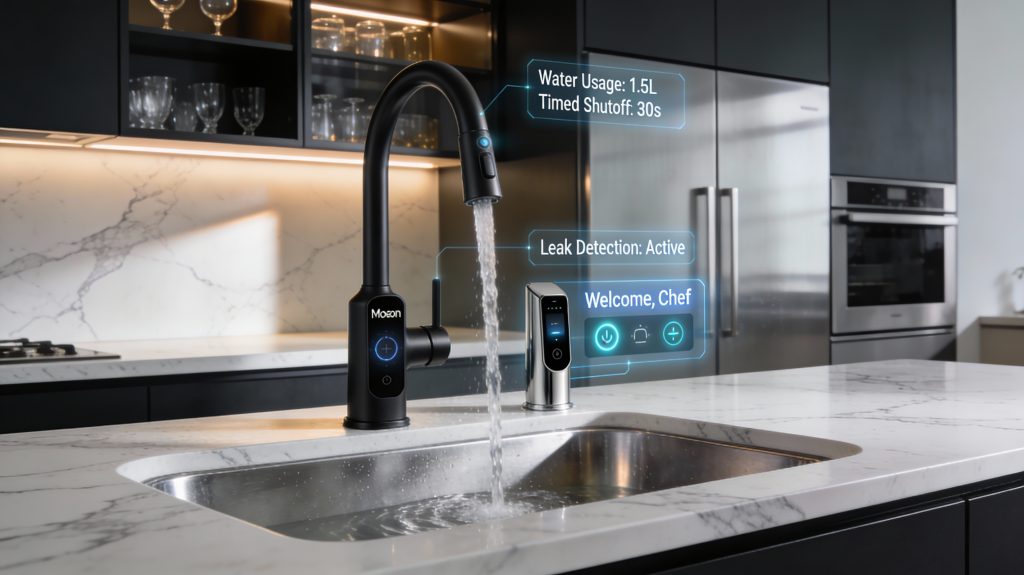
Smart faucet technology reduces water use by up to 66% with sensors, timed shutoffs, and leak detection.
You need to understand the mechanics behind savings to make a confident choice. Below are the core technologies, how each cuts waste in measurable ways, and the failure modes that can negate those gains.
Motion and touch sensors
Sensors cut run-time by starting water only when your hands (or a pot) are in position. Typical manual uses last 15–30 seconds; touchless activation can cut that to 5–10 seconds because the tap isn’t left running while you scrub or reach for a towel.
Typical flows: 2.2 GPM (8.3 L/min) is common in older or standard models; low-flow smart faucets often run 1.5 GPM (5.7 L/min) or less.
Example math: 30 uses/day × 0.5 min/use × 2.2 GPM = 33 gallons/day. Reduce run-time to 0.17 min/use (10s) and you drop to ~11 gallons/day — a ~66% reduction from run-time alone.
Practical tip: pick models with adjustable sensitivity and a short auto-shutoff delay (5–10s) to avoid unnecessary run-time.
Timed shutoffs and metering
Timed shutoffs force a maximum run-time per activation (e.g., 20–60 seconds). Metering logs volumes and can enforce limits or notify you of atypical use.
How this saves: timed caps prevent long, accidental runs (kids, distracted rinsing). Metering lets you quantify usage to target behavior change.
Product note: many higher-end Kohler, Moen, and Delta smart faucets offer flow reporting through companion apps.
Practical tip: enable alerts for unusually long activations and set conservative time caps that still let you fill a bowl.
Flow restrictors and aerators
Aerators mix air with water to maintain feel while lowering actual liters/gallons per minute. Upgrading from 2.2 GPM to a 1.5 GPM aerator reduces volume by ~32% without a perceptible loss in rinsing performance.
Practical tip: choose Neoperl-style low-flow aerators or integrated models rated ≤1.5 GPM (≤5.7 L/min) for the best balance of performance and savings.
Leak detection and automatic shutoff
Smart leak detection identifies continuous or pulsing microflows and can shut valves or alert you. Consider that a small leak of 0.25 gallons/hour wastes ~180 gallons/month—smart shutoff eliminates that hidden loss.
Practical tip: prefer systems that both alert and physically stop flow.
Common failure modes and what to watch for
False activations from reflective surfaces or bright sunlight increase run-time.
Sensor lag (slow shutoff) adds seconds per use — cumulatively expensive.
Clogging/scale in aerators and sensors reduces performance or causes valves to stick.
Dead batteries or power loss may default to always-on or manual-only modes.
Practical tip: choose faucets with accessible, serviceable aerators, adjustable sensor settings, clear documentation on battery life, and a manual override so a single failure won’t turn savings into waste.
2
The Key Specifications and Features to Compare Before You Buy
Compare key specifications—sensor type, response time, flow rate, app metering, temperature control, and leak detection—before choosing a smart faucet for water savings.
Not all smart faucets deliver the same savings. Use the checklist below to compare objective specs and features; for each item you’ll get the numbers or behaviors that indicate strong water-saving performance and the trade-offs to expect.
Sensor type and detection range
What to look for: active infrared or ultrasonic sensors with adjustable range (typically 4–12 inches).
Why it matters: a shorter, configurable range prevents false activations from reflections or nearby movements.
Trade-off: ultra-short ranges need more precise hand placement; examples: Moen and Delta models let you tighten sensitivity settings.
Response time
What to look for: 0.1–0.3 seconds on activation/shutoff.
Why it matters: each extra 0.5 seconds per use adds cumulative wasted water across dozens of daily activations.
Trade-off: extremely aggressive shutoff can feel twitchy; prefer models with configurable delays (5–10s auto-shutoff).
Adjustable flow rate and aerator specs
What to look for: aerator-rated ≤1.5 GPM (best ≤1.2 GPM) and removable Neoperl-style aerator.
Why it matters: lower GPM with a well-designed aerator keeps rinsing performance while cutting volume.
Trade-off: very low flows increase fill time for pots—consider models that let you temporarily boost flow.
On-device vs app-based metering
What to look for: per-activation counts on-device; app offers timestamps, volume estimates, and alerts.
Why it matters: apps let you spot patterns and get notified of long activations or leaks.
Trade-off: app dependency can mean cloud accounts and occasional sync delays—pick a model that stores local data too.
Data reporting granularity
What to look for: per-activation logs, daily/weekly summaries, and exportable CSV for rebate documentation.
Why it matters: fine-grain data translates into concrete behavior change and ROI measurement.
Trade-off: higher granularity can increase subscription or cloud-storage features.
Temperature control
What to look for: ability to set a safe max temperature or presets so you don’t run cold-to-hot mixing for long.
Why it matters: reduces wasted hot water and energy.
Trade-off: digital temp presets add cost and complexity compared with manual single-lever control.
Manual override
What to look for: mechanical handle or foot/knob override that works if power/battery fails.
Why it matters: prevents a single failure from turning the faucet into a continuous-water source.
Trade-off: adds a small complexity to the user interface.
Battery life and power options
What to look for: 1–3+ years on replaceable AA/AAA or hardwired/USB options for heavy use.
Why it matters: dead batteries often default to manual or always-on modes—choose reliable power with clear battery indicators.
Trade-off: hardwiring is more reliable but costlier to install.
Ingress protection and durability
What to look for: IP54 minimum for splash resistance; ceramic cartridge and brass/lead-free construction; 25,000+ cycle ratings.
Why it matters: sensors and electronics in the spray zone need robust sealing to avoid failure.
Leak detection and automatic shutoff thresholds
What to look for: continuous-flow detection (examples: detect flows >0.1–0.2 GPM) and configurable auto-shutoff times (2–5 minutes).
Why it matters: catches tiny leaks that add up (see leak math earlier).
Trade-off: overly aggressive thresholds risk false positives during legitimate long tasks—choose configurable thresholds.
Certifications and warranty
What to look for: EPA WaterSense (≤1.5 GPM), NSF/ANSI 61 (lead), and a 2+ year parts warranty (many premium models offer longer).
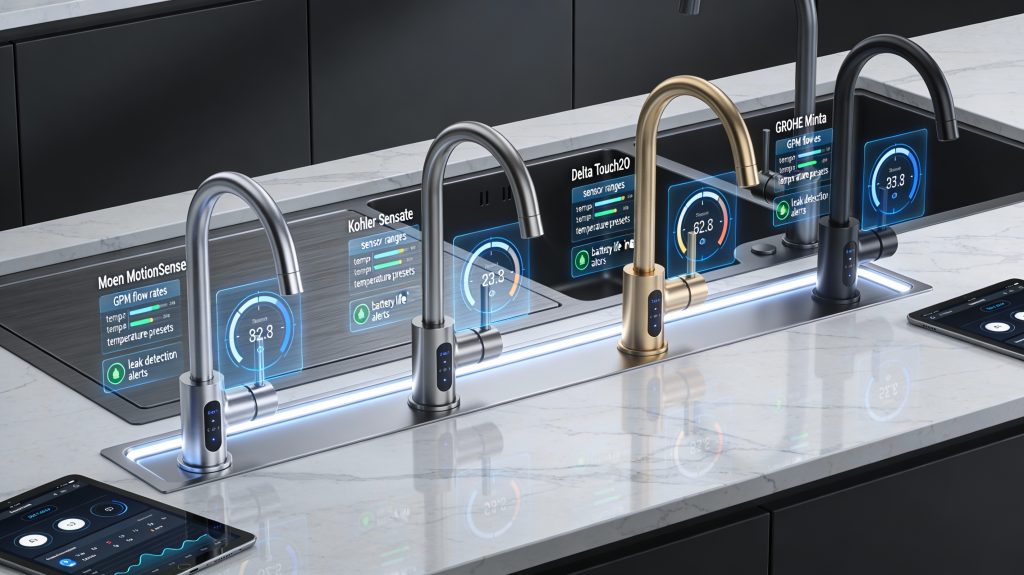
Use this checklist while comparing specific models (e.g., Moen MotionSense, Kohler Sensate, Delta Touch2O, GROHE Minta) and prioritize configurability, reliable power, and exportable data when your goal is measurable water savings.
3
Comparing Faucet Types: Which Designs Save the Most Water in Practice
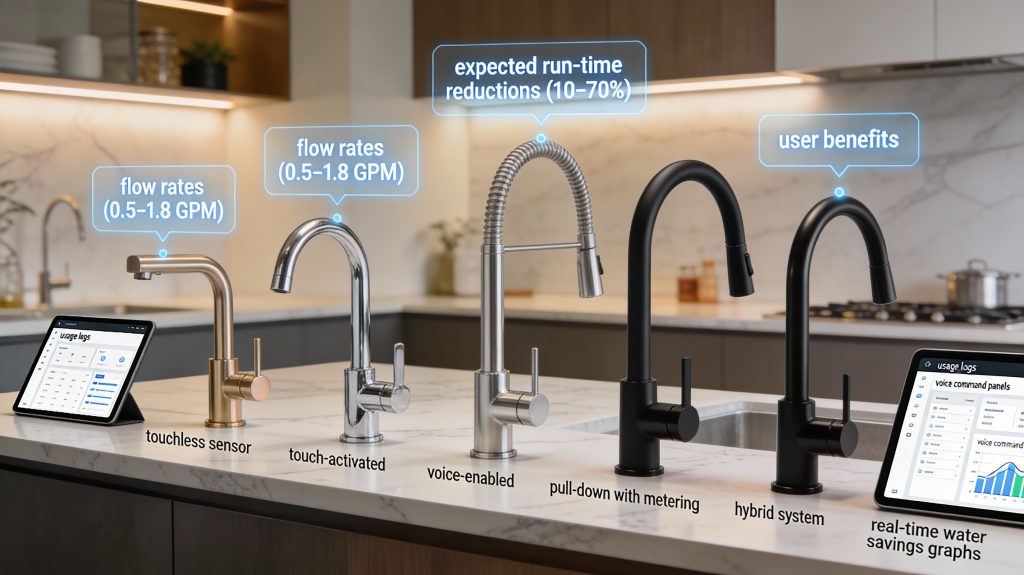
Compare faucet designs—touchless, touch-activated, voice-enabled, pull-down with metering, and hybrid—to match household habits and maximize water savings.
You’ve seen the specs checklist — now match faucet design to how you actually use the sink. Below are practical performance expectations for five major categories, with flow ranges, typical run-time reductions vs a traditional manual faucet, strengths/weaknesses for busy versus light-use homes, and who benefits most.
Touchless (infrared/ultrasonic) sensor faucets
Typical flow: 0.8–1.5 GPM (often paired with WaterSense aerators).
Expected run-time reduction: 30–50% — people stop the habit of leaving water running.
Strengths: excellent for high-traffic kitchens where hands are often messy; automatic shutoff eliminates many accidental runs.
Weaknesses: occasional false activations in busy kitchens; requires battery/power upkeep.
Best for: families with kids, home cooks, or households that frequently switch between tasks (rinsing, scrubbing, filling).
Example: Moen MotionSense-style sensors are common in this class and are practical when you want “set-and-forget” savings.
Touch-activated (tap to toggle) faucets
Typical flow: 0.8–1.8 GPM.
Expected run-time reduction: 20–35% — users deliberately tap to stop/start, cutting mid-task waste.
Strengths: intuitive, less likely to false-trigger than touchless; good for quick on/off during prep.
Weaknesses: tends to require touching the spout — less ideal when hands are very dirty.
Best for: moderate-use households and people who want direct control plus modest savings.
Example: Delta Touch2O is a representative model that blends manual feel with automated control.
Voice-enabled faucets
Typical flow: 0.5–1.5 GPM (often paired with app control).
Expected run-time reduction: 10–25% — helpful when you need hands-free control but less effective if users forget voice commands.
Strengths: accessibility, convenience when both hands are occupied.
Weaknesses: privacy, reliance on ecosystem (Alexa/Google), and mixed effectiveness for casual behavior change.
Best for: accessibility needs, multi-tasking cooks, or tech-forward households that already use voice assistants.
Example: Moen U and some Kohler setups integrate with voice assistants for hands-free commands and presets.
Pull-down / pull-out faucets with smart metering
Typical flow: 0.6–1.8 GPM; metering records volumes per task.
Expected run-time reduction: 25–60% — metering plus a pause function forces conscious use and allows flow boosts when needed.
Strengths: best for precision tasks (filling pots, rinsing); metering gives measurable feedback.
Weaknesses: more complex and pricier; benefits hinge on you reviewing usage data.
Best for: serious home cooks and households that want data-driven savings.
Example: GROHE-style pull-downs with SmartControl-like features let you pause and measure fills.
Hybrid systems (sensor + touch + app + meter)
Typical flow: 0.5–1.5 GPM.
Expected run-time reduction: 40–70% when configured and used.
Strengths: flexible controls for any situation; analytics + physical overrides cover edge cases.
Weaknesses: highest upfront cost and complexity; needs setup and occasional maintenance.
Best for: large households, green-minded owners who will act on data, and properties pursuing rebates.
Practical tip: pick the control method that matches your everyday behavior (hands-free for messy cooks, metering for data-driven savers). Next section will help you translate these percentages into gallons and dollars for your household.
4
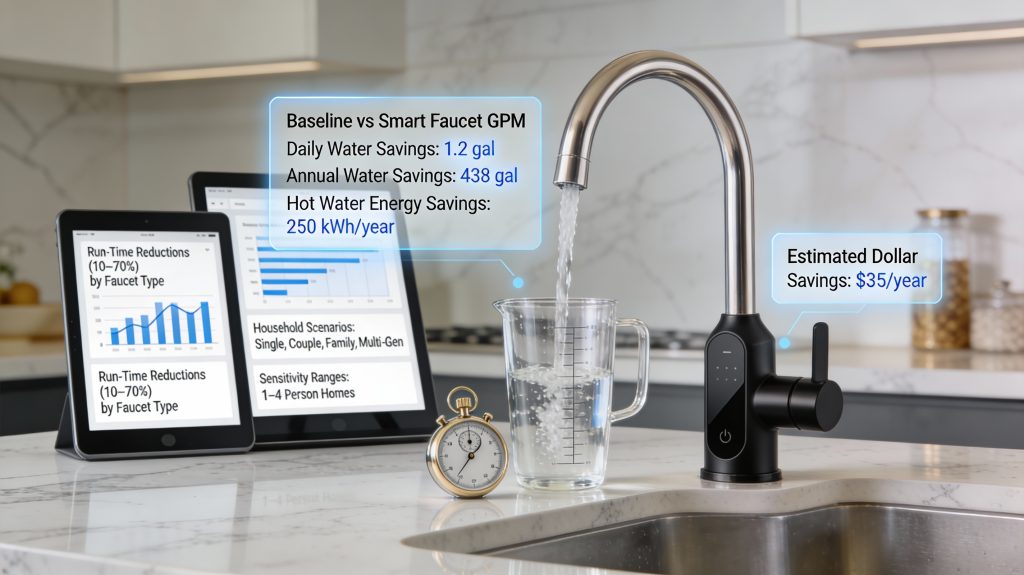
Estimating Your Water and Cost Savings: A Practical, Data-Driven Approach
Estimate your water and cost savings with smart faucets using real measurements, run-time reductions, and household data.
You can quantify likely savings before you buy. Below are step-by-step methods, a worked example, and realistic ranges so you know what to expect for your household.
1) Measure your current faucet flow
Fill a 1‑ or 2‑quart container and time how long it takes to fill.
Convert volume to gallons (1 quart = 0.25 gallons).
Flow (GPM) = gallons / minutes.
Example: a 1‑quart (0.25 gal) cup fills in 7 seconds (0.117 min). Flow = 0.25 ÷ 0.117 ≈ 2.14 GPM.
2) Time average use events
Over a day, time representative events: quick hand wash, rinsing produce, pot filling, dish pre-rinse.
Count how many of each event occur per day.
Average event duration in minutes = total event seconds ÷ 60.
3) Convert reductions to annual gallons
Use this formula:
Annual savings (gal) = (Baseline GPM × baseline minutes/day − New GPM × new minutes/day) × 365
Where “new minutes/day” reflects expected run-time reduction (e.g., touchless often reduces run-time 30–50%).
Plug your local water $/gal from your utility bill to convert gallons to dollars.
Try the quick “cup-and-timer” test for several days to build reliable averages.
Consider products with metering (GROHE SmartControl, Moen U) if you want measurable, repeatable results.
Next, you’ll use this data to compare payback periods and pick models that match your likely savings.
5
Installation, Ongoing Maintenance, Incentives, and Smart-Home Integration
Maximize smart faucet performance with proper installation, routine maintenance, and smart-home integration while leveraging rebates and incentives.
You should factor in installation, upkeep, and system integration because they directly affect long‑term performance and the savings you actually realize. Below are practical, actionable points to guide decisions before you buy.
Installation: DIY vs. professional and compatibility checks
Simple swaps (single‑hole faucets, standard supply lines, battery power) are often DIY if you’re comfortable with basic plumbing and have the right tools.
Hire a pro if you face: multi‑hole mounts, thick stone countertops, hidden valves, hardwired power, or if local codes require licensed work.
Check compatibility: deck thickness, hole count/adapters, water pressure min/max, supply-line size, and whether your hot water setup needs a pressure‑balanced valve to prevent scalding.Example: a Moen MotionSense replacement in a single‑hole sink is often straightforward; a hardwired Kohler Sensate in a retrofit may need an electrician.
Sensor placement and calibration to avoid false activations
Position the sensor so it “sees” hands, not backsplash reflections or nearby windows. Typical effective range: 6–12 inches.
Angle sensors slightly down and away from high‑splash areas; test with soapsuds to confirm no constant triggers.
Use sensitivity/timeout settings in the app (if available) to reduce accidental activations during dishwashing or when kids lean over the sink.
Routine maintenance and quick troubleshooting
Regular tasks:
Clean aerator every 3–6 months to prevent flow reduction and mineral buildup.
Replace batteries per manufacturer guidance (typical range: 6 months–2 years; lithium batteries last longer).
Replace any inline filters on schedule (varies by model).
Install firmware updates via the faucet app when available—updates can fix leaks, improve flow control, and extend battery life.
Quick troubleshooting steps:
Clean sensor lens and aerator, then power‑cycle the unit.
If water won’t turn on, check battery level and solenoid wiring; consult LED/error codes in the manual.
For connectivity issues, reset Wi‑Fi pairing and confirm your router’s 2.4 GHz vs 5 GHz compatibility.
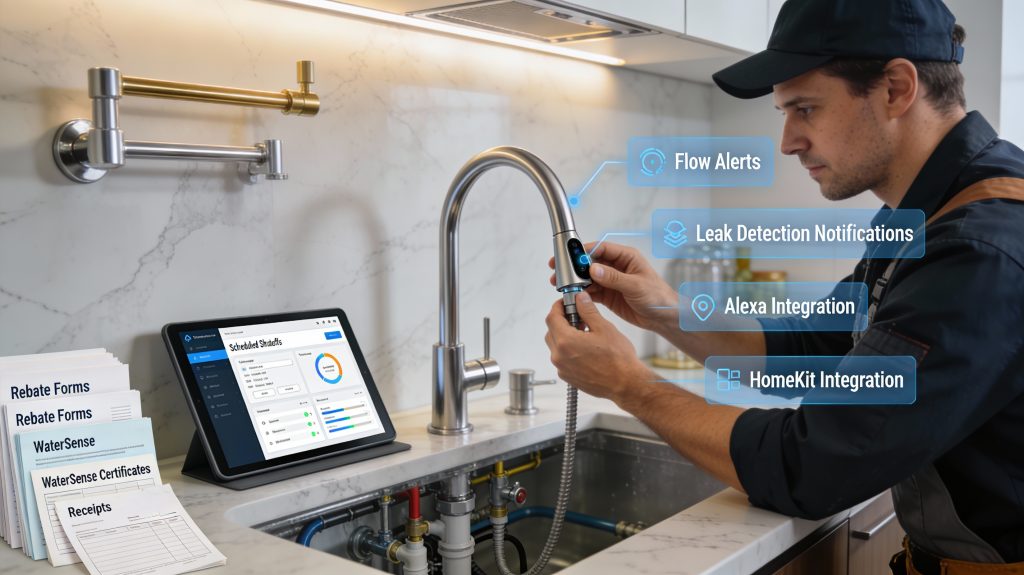
Smart‑home integration and how it increases savings
Connecting to an app or hub (Alexa/Google/HomeKit) lets you:
Receive usage alerts and unusual flow notifications that catch leaks early.
Schedule shutoffs (e.g., disable nonessential faucet use overnight).
Automate responses: a continuous‑flow alert can trigger a shutoff valve or send a text.
Example automation: if nightly flow > 5 minutes, trigger an alert and auto‑shutoff to prevent catastrophic leaks.
Incentives and rebate hunting
Check WaterSense listings, your municipal water utility, and state energy offices for rebates or pre‑approval requirements.
Steps: search “[your utility] faucet rebate,” call the rebate hotline, save model numbers/receipts, and apply before work starts if required.
With installation needs, maintenance cadence, and incentive options mapped out, you can move on to choosing a model that fits both your household habits and long‑term savings goals.
Choosing a Smart Faucet That Delivers Real Savings
You now have the framework to evaluate smart faucets by technology, specs, and likely savings. Start by measuring your current water use and identifying high-run-time fixtures. Prioritize features that reduce run-time and prevent leaks—sensor responsiveness, low-flow aerators, programmable shutoff, and reliable valves—over bells and whistles. Factor in installation complexity, maintenance needs, warranty, and any rebate or utility incentives that shorten payback.
After installation, track flow and run-time for a few months to verify savings and adjust behavior or settings. Choose the model that delivers measured reductions, not just promises. Start saving today.