
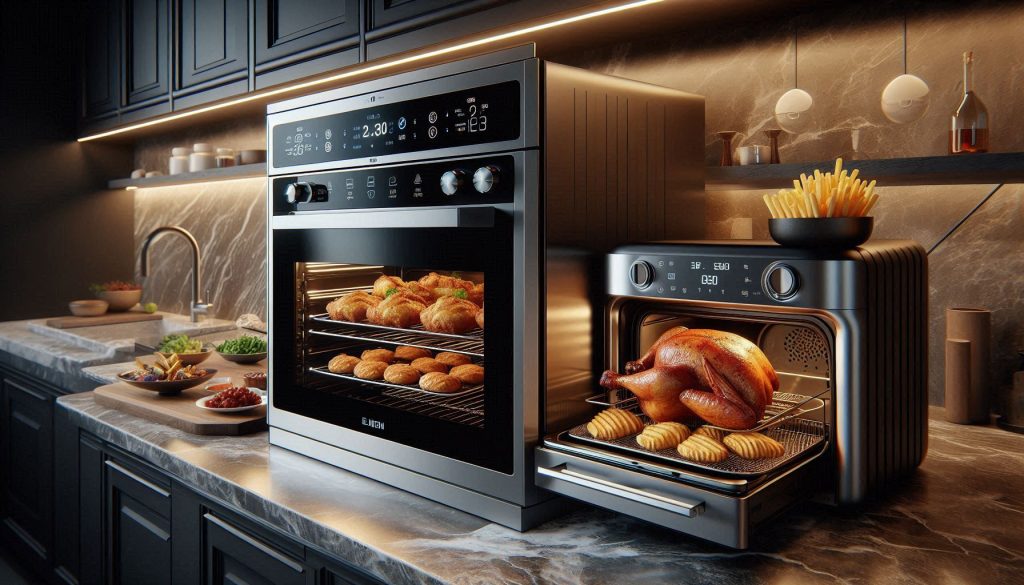
Choosing between a smart oven and an air fryer often comes down to balancing kitchen space with your specific cooking habits. While both use convection technology to circulate hot air, they cater to different culinary needs.
An air fryer excels at rapid, high-heat circulation in a compact basket, making it the go-to for crispy textures and quick weeknight snacks. A smart oven, by contrast, offers a larger footprint and advanced sensors — like Element IQ — to handle a wider range of tasks, from slow roasting a whole chicken to baking delicate pastries with professional-grade precision.
To determine which appliance deserves a spot on your countertop, evaluate measurable factors like preheat times, energy efficiency, and capacity. If you frequently cook for a large family or enjoy multi-rack baking, a smart oven offers superior versatility and return on investment. For solo cooks focused on speed and oil reduction, a high-performance air fryer is often the more practical choice. This guide breaks down the differences in heating engineering, maintenance costs, and food quality to help you make an informed decision.
Core Technologies: How Smart Ovens and Air Fryers Deliver Heat
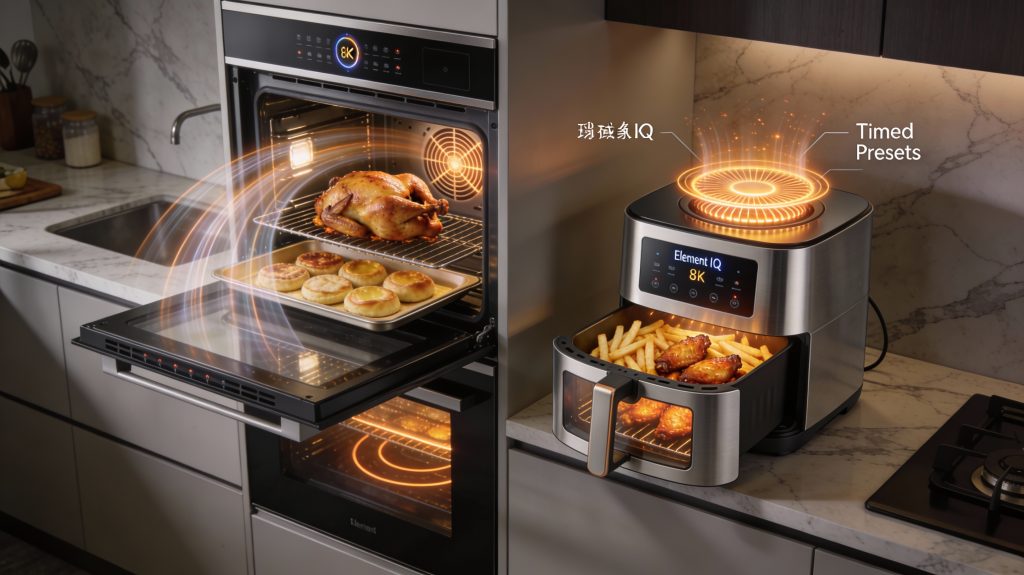
You’ll learn the engineering differences that create distinct cooking behaviors—what drives browning, how temperature holds up, and why one appliance finishes faster or more evenly than the other.
Heating elements and fans: placement matters
Smart ovens (e.g., Breville Smart Oven Air, June Oven) use multiple heating elements—top, bottom, sometimes rear—and a moderate-speed convection fan to move air around a relatively large cavity. Some models use segmented elements and “element IQ” control to direct heat to zones.
Air fryers such as the Philips Airfryer XXL and Ninja Foodi concentrate a powerful heating element directly above the food, paired with a high-speed fan that forces a narrow column of hot air down and around the basket. That proximity and speed create the rapid surface dehydration that mimics frying.
Airflow patterns and heat distribution
Airflow in a smart oven is designed for even distribution across racks — velocity is lower but circulation is broader, delivering more uniform browning across a tray. In an air fryer, airflow is intense and localized, which is excellent for single-layer items but prone to hot spots if you crowd the basket.
Size, geometry, and temperature gradients
Smaller cavities heat faster and recover temperature quickly after the door opens or food is added — which is why air fryers and compact smart ovens preheat in 3–5 minutes. Full-size countertop ovens take longer to preheat (5–15 minutes) but maintain steadier temperatures across larger volumes thanks to greater thermal mass.
Sensors, algorithms, and controls
Smart ovens include multiple sensors (thermocouples, sometimes IR cameras) and software that modulates element power and fan speed (PID loops, presets) to keep temp within ±1–3°C. They adapt during a roast or bake. Typical air fryers use simpler thermostats and timed presets; temperature stability is often ±4–8°C and control is mostly on/off.
Measurable performance characteristics (what to watch)
Cooking Performance and Food Quality: Texture, Browning, and Consistency
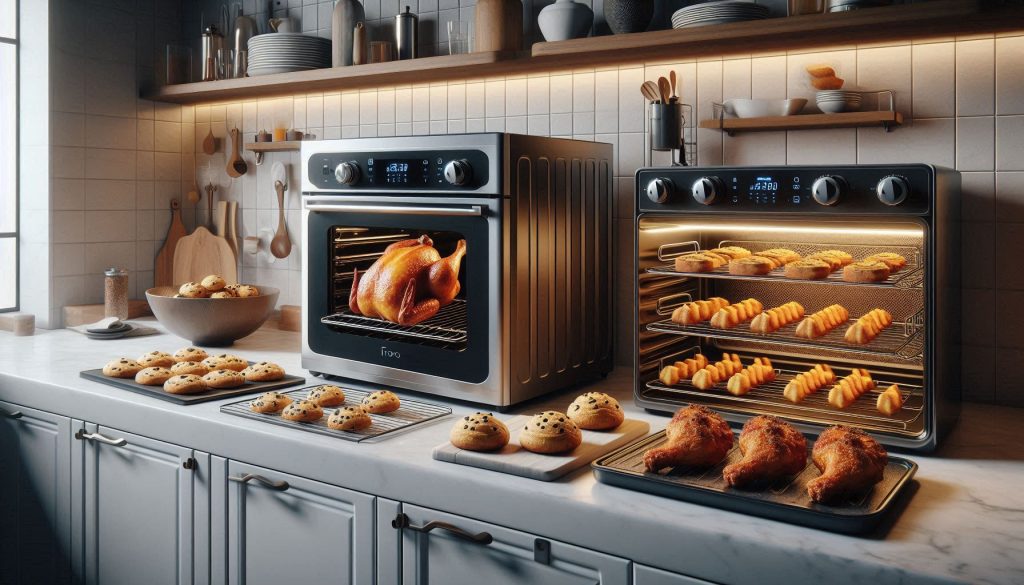
You want to predict how your meals will actually taste and feel—not buy into marketing. Below is a task-by-task, evidence-minded comparison showing how each appliance affects Maillard browning, surface dehydration, moisture retention, and internal temperature consistency.
Roasting and broiling
Smart ovens win for larger roasts and whole birds because probe-based programs and broader, gentler heat produce even internal temperatures and steady Maillard development across the surface. If you roast a whole chicken in a Breville Smart Oven Air or June Oven, you’re more likely to hit uniform doneness without overbrowning thin areas. Air fryers brown aggressively on exposed surfaces—great for a single chicken breast or wings—but can dry edges before the center reaches target temp if you don’t adjust time or flip.
Baking (cookies, bread, casseroles)
For baked goods you need even heat and controlled humidity. Smart ovens deliver more consistent crumb structure and predictable rise—cookies and small loaves come out evenly browned. Air fryers can brown tops quickly, which may collapse delicate items or give uneven crusts unless you reduce temp and bake on a tray designed for the basket.
Reheating and leftovers
Air fryers excel at bringing back crispness (leftover pizza, fries, fried chicken) in minutes—surface temps spike, re-crisping crusts while keeping interiors acceptable. Smart ovens reheat more gently and are better for saucy or layered dishes (lasagna) where you want to avoid over-drying; using a covered dish or foil keeps moisture in.
The energy use of smart oven vs air fryer varies significantly based on the model you choose.
Crispy foods (fries, wings, breaded items)
Understanding smart oven vs air fryer energy use is essential for budgeting your cooking expenses.
Comparing efficiency factors in smart oven vs air fryer technology can lead to more informed decisions.
Air fryers are purpose-built for rapid surface dehydration—fast Maillard reactions and a crunchy exterior with minimal oil. For consistent results: use a single layer, shake or flip halfway, and lightly coat with oil. Smart ovens can achieve crispness too—use a wire rack, higher temp, and, if available, a convection crisp mode—but they require more space and time.
Practical metrics and tips
Next, we’ll weigh these performance differences against real-world constraints—speed, capacity, and how much counter space you’re willing to give up.
Speed, Capacity, and Kitchen Footprint: Fit for Your Routine
Cleaning and maintenance are different in the smart oven vs air fryer, impacting long-term use.
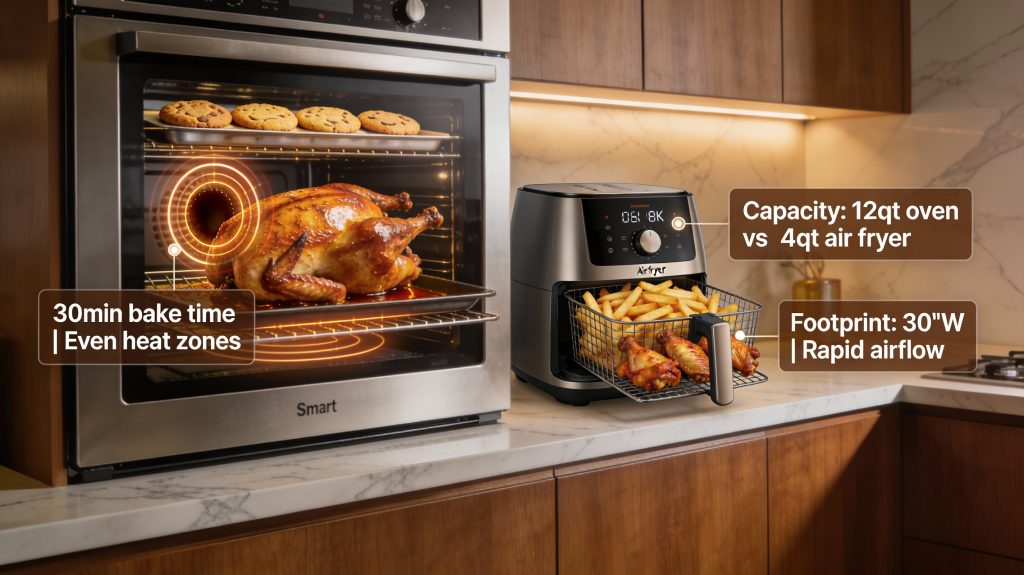
You’ve seen how each appliance affects texture and browning; now think about the practical, everyday trade-offs: how fast items cook, how much you can cook at once, and whether the unit will fit and live where you need it.
Preheat and cook times
Air fryers heat a small chamber quickly—many recipes need little or no preheat and cooking is often 10–25% faster than in a full countertop oven. Smart ovens (even convection models like the Breville Smart Oven Air or June Oven) usually need longer preheat and warm-up for larger cavities, but they keep steady temperatures for long bakes or roasts. For time-pressed dinners, an air fryer often wins; for multi-hour roasts, the smart oven’s stability matters more.
Batch size and usable capacity
Think usable surface area, not just interior liters. A compact air fryer basket is ideal for a single sheet of fries or four wings; larger “XXL” baskets (e.g., Philips-style designs) can handle family portions but still usually require a single-layer approach for best crisping. Countertop smart ovens accept sheet pans and multiple racks—better for cookies, casseroles, or a whole chicken—so throughput (plates per hour) is higher when you’re cooking for several people.
Counter, built-in, and storage footprint
Air fryers are lighter and easier to tuck away; they’re a good choice if counter space is limited or you store appliances in a cabinet. Smart ovens are bulkier and need permanent counter real estate or a built-in option (check door swing and clearance). Also consider ventilation and heat: larger ovens will warm the kitchen more when in heavy use.
Practical tips to match your workflow
Next, you’ll factor these behavioral and spatial choices into operational costs—how energy, maintenance, and cleaning change the long-term value of each appliance.
Energy Use, Operating Cost, and Maintenance Burden
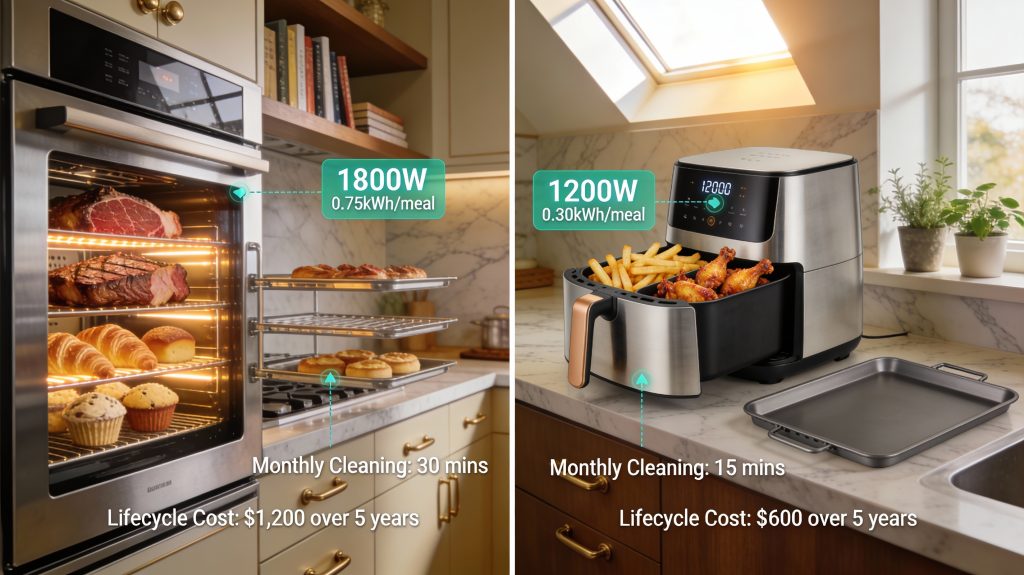
You’ve considered size and speed; now quantify what each appliance will actually cost you in energy and upkeep. Below you’ll find concrete numbers, real-world examples, and simple steps to estimate lifetime cost of ownership.
Wattage and per-meal energy math
Typical draw and sample per-meal energy (use your model’s nameplate for exact numbers):
How to estimate your cost: multiply kW by hours by your electricity rate. At $0.15/kWh the examples above cost roughly $0.08 per air-fryer meal vs. $0.16 per smart-oven meal. Over a year of daily use, that’s about $27 vs. $58; over five years, $135 vs. $290 (energy only).
Efficiency factors that change the math
A quick checklist for smart oven vs air fryer can help streamline your purchase process.
Cleaning, wear, and replacement costs
Routine tasks and typical lifespans:
Practical tips to lower lifecycle cost
Next up: how these operational choices interact with health and safety—oil use, emissions, and risk management.
Health and Safety Considerations: Oil Use, Emissions, and Risk Management
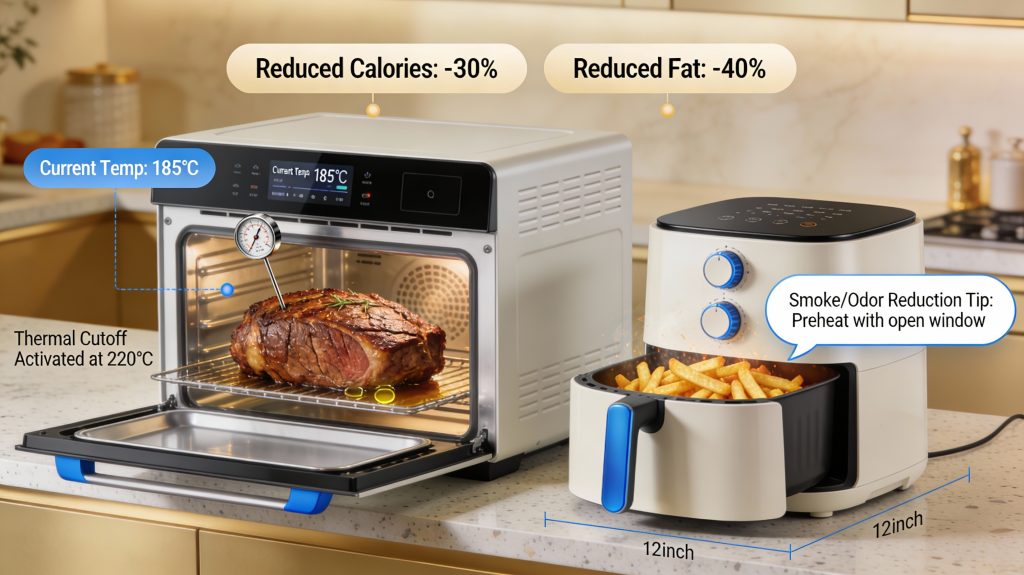
You’ve seen performance and cost — now look at how each appliance affects nutrition and safety. Below are concrete, evidence-informed points and steps you can use immediately.
Oil use and real changes to calories and fat
Air fryers let you cut oil dramatically: many recipes that call for 2 cups of oil for deep-frying need only 1–2 teaspoons in an air fryer (or none at all), which can reduce fat and calories by 80–90% compared with deep-frying. Smart ovens reduce oil relative to pan-frying too, but because you can roast or bake larger batches, per-serving oil savings may be smaller. Tip: pat proteins and starchy foods dry, then toss with a teaspoon of high‑smoke‑point oil (avocado, refined olive) for crispness rather than drenching them.
Formation of undesirable compounds (acrylamide, HCAs, PAHs)
High dry heat accelerates Maillard reactions that create acrylamide (starchy foods) and heterocyclic amines (HCAs) or polycyclic aromatic hydrocarbons (PAHs) from heavily charred meats. These form more readily above ~120°C (about 250°F) and as browning/char increases. Practical controls:
Smoke, odors, and indoor air quality
Air fryers and smart ovens emit far less aerosolized oil than pan- or deep-frying, but oily residue and overheating can still produce smoke and volatile organic compounds (VOCs). To manage:
Built-in safety features and user practices
Most modern units (e.g., Philips/Airfryer models, Instant Vortex, Breville Smart Oven Air, June Oven) include auto-shutoff, cool‑touch handles, and thermal cutoffs, but designs vary. Do this:
Quick checklist:
Decision Framework: Which One Should You Buy (or Keep)?
Make sure to include capacity and features when comparing smart oven vs air fryer options.
The quick comparison matrix highlights the advantages of both smart oven vs air fryer appliances.
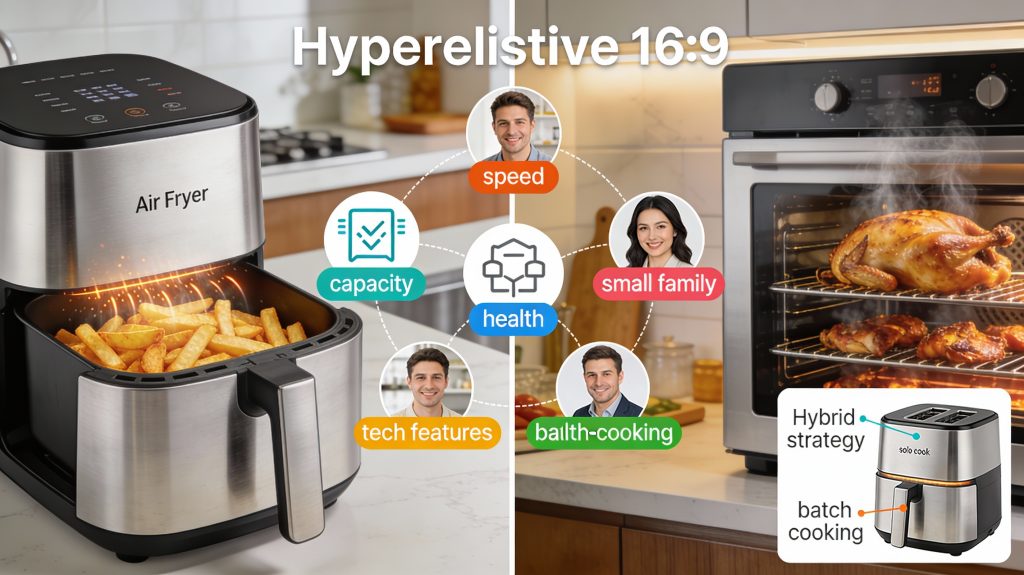
Use this as a practical decision tool: match your everyday routines and priorities to the appliance that will actually get used, not the one that looks coolest on Instagram.
Final recommendations in the smart oven vs air fryer debate can guide your purchasing decisions.
When weighing your options, consider the smart oven vs air fryer benefits for your cooking needs.
Testing both smart oven vs air fryer with staple recipes can provide valuable insights.
Profiles and recommended priorities
Solo cook
You value speed, low waste, and small footprint. Prioritize: 3–5 qt capacity, low warm‑up time, easy‑clean baskets.
Small family (2–4 people)
You need batch capacity and versatility. Prioritize: 5–6 qt air fryer or a countertop smart oven with 18–26L cavity and higher wattage.
Entertainer / family of 5+
You cook for crowds and want flexible racks and trays. Prioritize: larger smart oven or combined setup, convection and multi-rack capability.
Health‑focused cook
You want oil reduction and even browning. Prioritize: rapid air circulation, precise temperature control (±2°C), and easy removable parts for hygiene.
Tech‑enthusiast
You want apps, presets, and automation. Prioritize: Wi‑Fi, companion apps, meat probes, OTA updates.
Hybrid strategies: when to pair both
Pair if you:
Shopping checklist
Quick comparison matrix
| Need | Air Fryer | Smart Oven | Both |
|---|---|---|---|
| Best for | Fast, small batches | Large, multi‑rack meals | Maximum flexibility |
| Capacity | Small–medium | Medium–large | Any |
| Speed | High | Medium | Optimal |
| Health | Excellent (less oil) | Good | Best combined |
With your priorities and checklist mapped, you’re ready to weigh final trade‑offs and move into the article’s closing recommendation.
Final Recommendation: Match the Appliance to Your Needs
versatility and volume — consider pairing both when you need more of each.
3:29 PM
Claude responded: Match your choice to your routine: pick a smart oven if you prioritize precision, multi-function cooking, larger batches, and programmatic control; pick an air…
Match your choice to your routine: pick a smart oven if you prioritize precision, multi-function cooking, larger batches, and programmatic control; pick an air fryer if you want fast, high-heat crisping, a smaller footprint, and minimal oil. For those who need both versatility and volume, pairing the two is worth considering. Next, test each device with two staple recipes and compare time, texture, and energy use against your typical meal size. Before buying, run through this short checklist: capacity, cooking modes, footprint, cleaning difficulty, energy estimate, and warranty. Choose based on measured results, not marketing.