

For homeowners tired of lugging heavy vacuums between floors, the promise of a stair-climbing robot vacuum feels like a futuristic dream come true. While standard robot vacuums have revolutionized floor care, multi-level homes have remained a final frontier — often requiring multiple units or manual intervention. This article dives into the emerging technology behind vertical mobility in home robotics, cutting through the marketing hype to determine whether these machines can truly navigate stairs or if they’re destined to get stuck in cliff-detection limbo. We’ll also explore the real-world benefits these devices offer for multi-level living.
We evaluate the true ROI of stair-climbing vacuums by analyzing the trade-offs between mechanical complexity and cleaning efficiency. Beyond just suction power, we examine the long-term reliability of tracked and actuated systems, the safety risks for pets and children, and the hidden maintenance costs that accompany advanced drivetrains. By the end of this guide, you will have a clear decision framework to help you decide whether to invest in a premium climbing model, opt for a multi-dock strategy, or stick with the proven reliability of two separate robots for a more cost-effective cleaning solution.
Can a Stair-Climbing Robot Vacuum Solve Your Multi-Level Cleaning Needs with Stair Climbing Robot Vacuums?
You’re weighing an unfamiliar category of home appliance: robot vacuums that claim to climb stairs or overcome vertical transitions.
This introduction frames the central question — whether the added capability justifies the premium — and outlines the decision factors you’ll rely on: cleaning performance, safety, reliability, cost, and alternatives.
Understanding the potential of Stair Climbing Robot Vacuums is essential for any homeowner looking to enhance their cleaning routine.
You want data, not hype.
The article examines how these machines work and which variants exist, evaluates cleaning effectiveness and navigation limits, explores safety, reliability, and maintenance costs, and runs a cost-benefit analysis so you can judge ROI.
You’ll finish with a clear decision framework: when to buy, when to wait, and practical alternatives that deliver most benefits at lower risk and cost.
How Stair-Climbing Robot Vacuums Work and What Variants Exist
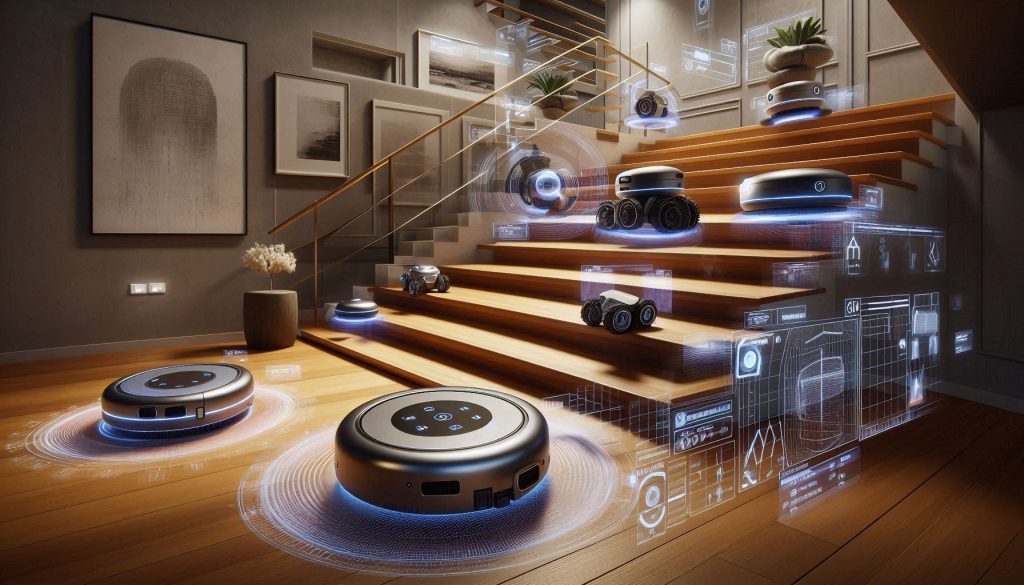
You’ll first need to understand the underlying technologies to judge practicality. Manufacturers take several mechanical and software approaches to handle vertical change; each comes with trade‑offs that determine what homes the robot will actually manage.
Mechanical approaches — the basic types
Software & sensing
Navigation systems (LiDAR, camera + SLAM, IMUs) detect edges, measure riser height, and decide whether to attempt a climb. Manufacturers often lock climbing behind conservative firmware to avoid falls — meaning a robot may detect a stair and stop rather than try to ascend.
Key performance metrics to check
Suitability by home and stair geometry
Real-world reliability constraints come from added weight, moving parts, and stricter sensor requirements — which is why many brands pair “stair-capable” messaging with multi-dock strategies (e.g., an extra base upstairs) rather than a true climbing mechanism. In the next section you’ll see how these mechanical and software choices play out in cleaning effectiveness, navigation accuracy, and real-world limitations.
Performance: Cleaning Effectiveness, Navigation, and Real-World Limitations
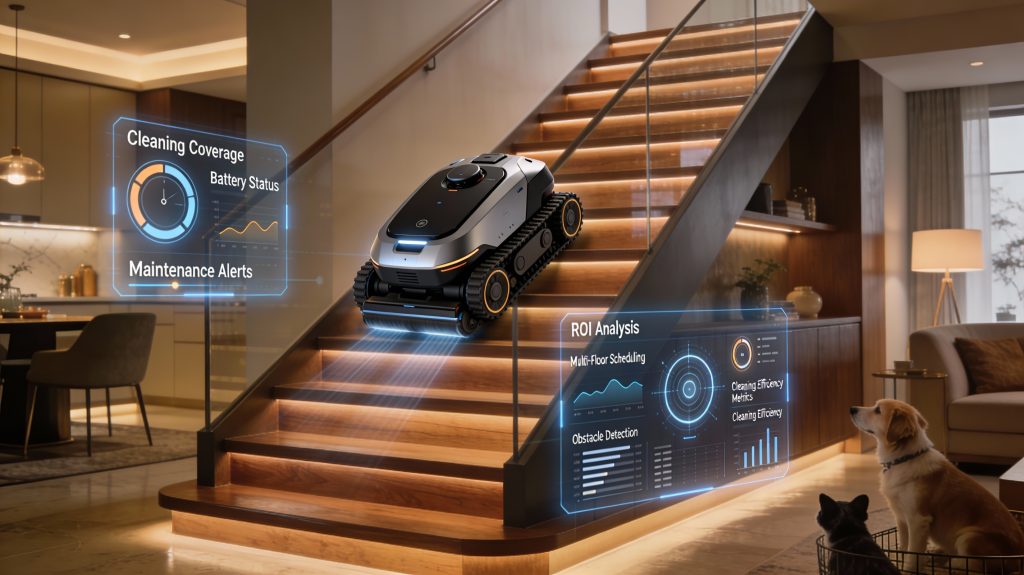
You want measurable cleaning results, not clever marketing. Below are the performance dimensions that actually predict whether a stair-capable robot will work in your home — and how to interpret the numbers and behavior you’ll see in reviews and tests.
Cleaning power across surfaces
Look for suction and brush performance reported separately for hard floors and low/medium pile carpet. Important, measurable indicators include:
High torque and strong brush agitation matter on carpeted stairs; on hard floors you want consistent edge pickup. Many multi-floor, non-climbing models (Roborock S7/S8, Ecovacs Deebot series) score well for floor cleaning but still require manual transfer between levels — a realistic trade-off to note.
Mapping, navigation, and multi‑level logic
A robot’s mapping fidelity determines how well it returns to the charging dock, avoids repeat cleaning, and resumes after interruptions.
If the robot stores multiple maps but won’t attempt a climb, manufacturers often recommend adding a second dock — a pragmatic workaround you should plan for.
Vertical transitions: what success actually looks like
Manufacturers often claim “stair-climbing” — but you should expect conservative real-world behavior:
Track-based or actuated designs will show higher step clearance in lab demos; wheel-based units typically clear thresholds under 1–2 cm reliably but struggle above that.
Battery, weight, and charging strategy
Climbing is energy intensive and adds mass; these combine to reduce usable runtime.
How to read independent test results vs. vendor claims
When comparing reviews, prefer tests that report:
Actionable tip: before buying, simulate your home’s worst-case riser and ask the seller for real-world climb success data or a return window to trial the unit.
Safety, Reliability, and Maintenance — Hidden Costs and Failure Risks
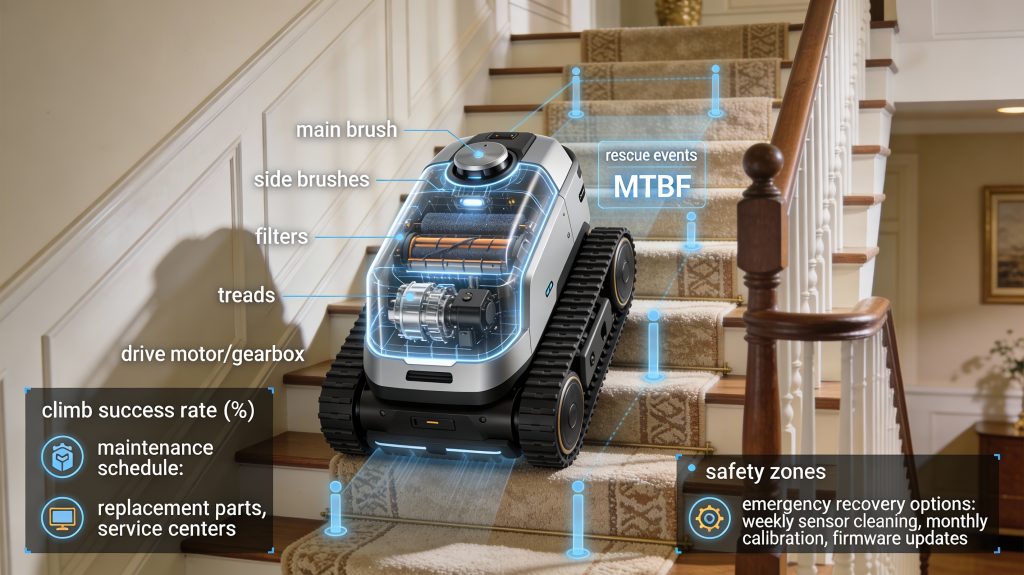
Climbing adds mechanical complexity, and you’ll want a clear picture of ongoing risk and upkeep. Below are the practical failure modes, recurring maintenance items, and negotiation tips that change the lifetime cost and usability of a stair-capable vacuum.
Parts that wear faster (and what they cost)
Track/tread systems, drive motors, and gearbox assemblies shoulder the extra torque of repeated climbs. Expect replacement intervals and ballpark retail costs roughly like this:
These ranges reflect heavier mechanical loading during climbs; a track-based unit will likely consume treads faster than a wheeled one.
Sensors, firmware, and “soft” maintenance
Climb-capable robots rely on extra sensors and control firmware. Your ongoing tasks:
Failing to keep sensors clean and updated increases aborted climbs and rescue events.
Reliability metrics to demand
Ask the seller for climb success rate (%) over at least 50 real-world attempts, mean time between failures (MTBF) for drivetrain components, and a log of rescue events per 100 runs. If they can’t provide numbers, assume higher risk and cost.
Practical rule: if MTBF for climb mechanisms is stated in hours, convert to calendar years using your expected climb hours (e.g., 2–4 climb cycles per day) to estimate expected repairs during ownership.
Safety, pets, children, and liability
Stair-capable robots introduce new hazards: pinching, hot motors, entanglement, or an appliance that falls if it fails mid-climb.
Warranty and insurance: most warranties exclude damage from misuse or falls; home insurance policies vary on covering appliance-caused damage—check both before buying.
Emergency recoveries and serviceability checklist
Emergency rescue or in-home service can cost $80–$300 per incident. Before you buy, verify:
When negotiating, ask for extended coverage of drivetrain/tread assemblies, a loaner unit during long repairs, and clear SLAs for emergency recoveries — these protect you from the most expensive failure modes.
Cost-Benefit Analysis: Purchase Price, Operating Costs, and Return on Investment
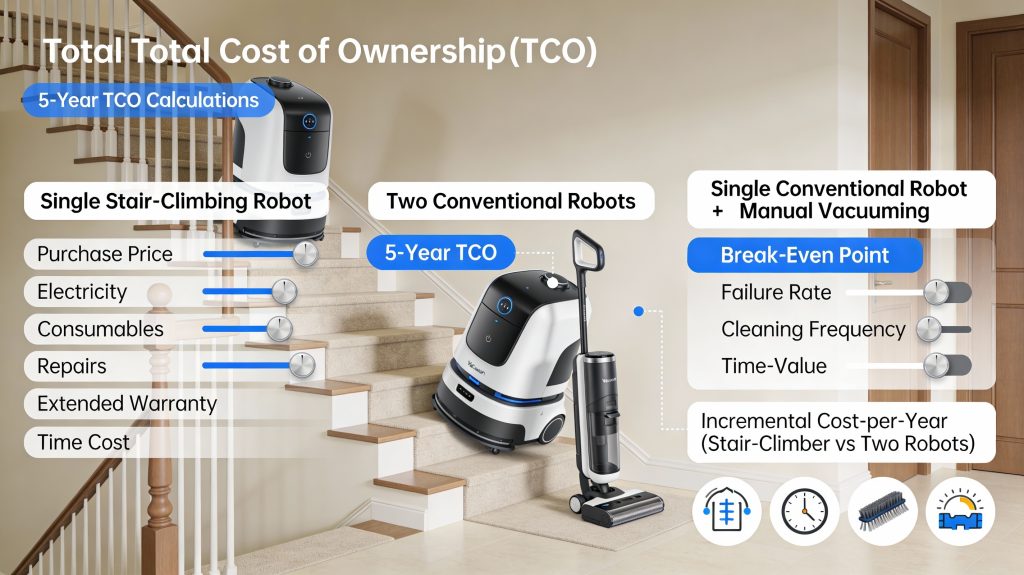
This section converts features and risks into dollars and hours so you can decide if the premium makes sense for your situation. Below are the cost line items, realistic assumptions, three example ROI scenarios on a 5‑year ownership horizon, and sensitivity knobs you can tweak for your home.
Upfront vs. ongoing cost line items (what to include)
Example ROI scenarios (5-year horizon, realistic numbers)
Assumptions: stair-climber purchase $1,400; conventional robot $500 each. Consumables/electricity/repairs averaged yearly as noted.
Scenario A — Stair-climber (single unit)
Scenario B — Two conventional robots (one per floor)
Scenario C — Single conventional robot + manual vacuuming
Interpretation: the incremental premium for the stair-capable unit over two conventional robots is ~$425 across five years (~$85/yr). Compared to manual vacuuming, robotic solutions become cost-effective quickly if you value your time.
Sensitivity: failure rates, cleaning frequency, and time-value
Quick break-even rule: compute incremental annual cost = (TCO_difference / years). Divide that by your hourly rate to find how many weekly hours of time saved justify the premium.
Practical buying guidance (how to use these numbers immediately)
Decision Framework: When You Should Buy One and Viable Alternatives
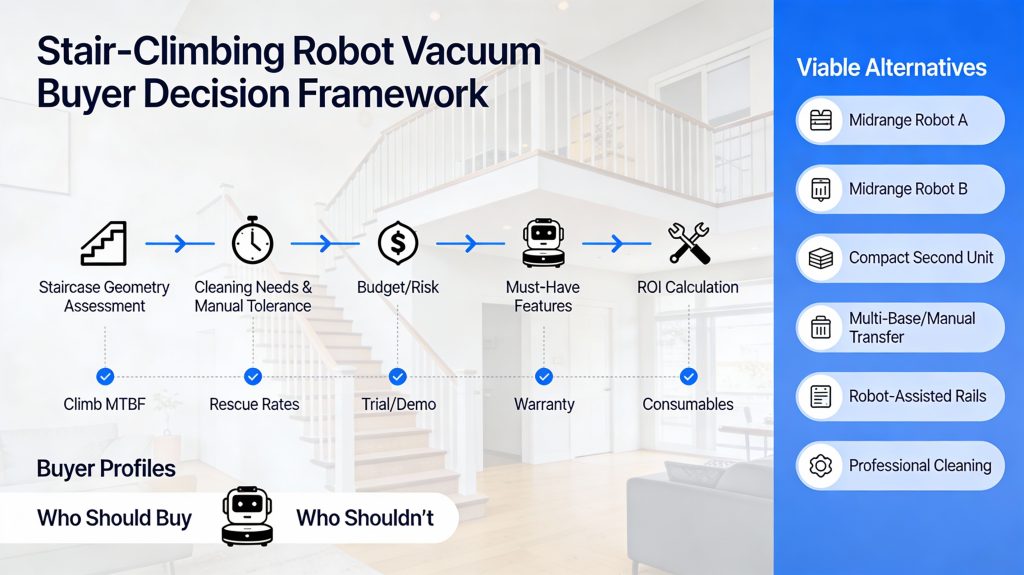
You need a clear, actionable pathway. Below is a step-by-step checklist, buyer profiles, and practical alternatives so you can decide with confidence.
Quick decision checklist (step-by-step)
Buyer profiles — who benefits most
Viable alternatives (with pros and cons)
Questions and negotiation tips for sellers/technicians
With this framework and alternatives mapped out, you’ll be ready to weigh the premium against your real-world needs and move to the final summarizing considerations.
Summing Up: Is the Premium Justified for Your Home?
You should now be equipped to weigh whether stair‑climbing capability delivers enough value for your circumstances. The core trade‑off is clear: greater autonomy and fewer manual interventions versus higher upfront cost, more complex maintenance, and elevated failure risk. Use the performance, safety, and cost metrics above to quantify benefits for your layout, traffic patterns, and pet/hair load.
If you have multiple levels, limited time, and a budget for premium devices and repairs, a stair‑climber can be justified. If you prioritize low cost, simplicity, or minimal maintenance, standard robot vacuums plus occasional manual carry or a docking routine are often the better choice. Decide based on data, budget, and risk tolerance.
How to Clean a Robot Vacuum : A 20 minute Guide5 Smart Home Automation Tips Made SimpleHow to Clean a Robot Vacuum : A 20 minute Guide5 Smart Home Automation Tips Made Simple