

Choosing the right audio setup for an expansive living area or open-concept basement can be a challenge, especially when balancing aesthetics with performance. While a 2.1 soundbar system—consisting of two stereo channels and a dedicated subwoofer—is a popular upgrade over built-in TV speakers, its effectiveness in a large room depends on specific technical variables. Factors such as total RMS power, subwoofer frequency response, and maximum SPL (Sound Pressure Level) play a critical role in determining whether the audio will feel immersive or thin. In this guide, we break down the physics of large-room acoustics and explain how a 2.1 system handles increased air volume and sound decay.
Beyond just “loudness,” achieving high-quality sound in a big space requires understanding how room modes and surface reflections impact clarity and bass punch. We will compare the performance of standard 2.1 units against more robust multi-channel 5.1 systems and premium Dolby Atmos soundbars to help you identify the best value for your budget. Whether you are prioritizing crisp dialogue for evening dramas or deep, room-shaking bass for movie nights, this article provides the calibration tips, placement strategies, and measurable benchmarks you need to decide if a 2.1 setup can truly fill your home with sound.
Quick answer and what to expect
You want to know whether a 2.1 soundbar will deliver satisfying audio in a large room. Short answer: sometimes — but it depends on measurable factors like power (watts), frequency response, maximum SPL, subwoofer capability, and your room’s acoustics. This article uses those criteria plus practical listening tests to give a clear recommendation you can apply.
You’ll get a technical yet practical explanation of what a 2.1 system is, how large-room acoustics shape sound, real strengths and limits in big spaces, and how it stacks up vs multi-channel systems. Finally, you’ll find placement, calibration, room-treatment tips, and scenario-based advice so you can choose the right setup for your space and budget. With confidence today.
What a 2.1 soundbar actually is (components and capabilities)
The format in plain terms
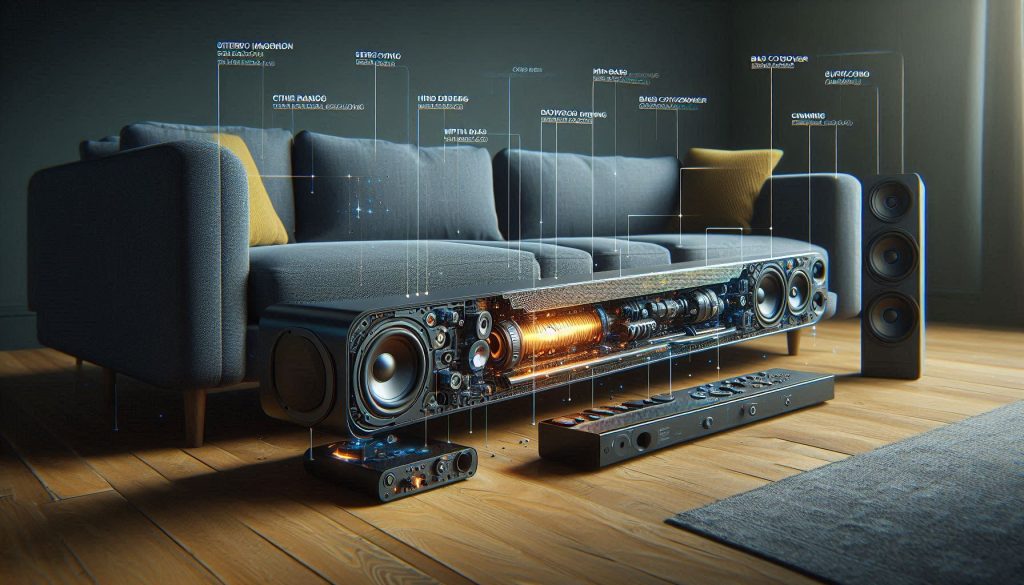
A 2.1 soundbar provides two discrete main channels — left and right — plus one dedicated subwoofer (the “.1”). That means stereo imaging and a separate low-frequency driver for bass. In real life you’ll see this in products like the Sony HT‑S350, Polk Signa S2, JBL Bar 2.1, or Vizio V‑Series 2.1: a slim main bar and a wireless powered subwoofer.
Typical hardware breakdown
Measurable specs that matter
Which metrics affect what you hear
Quick tip: prioritize a real RMS power spec, a subwoofer low‑end number, and mention of room calibration when comparing models. Next, we’ll show how your room’s size and surfaces can dramatically alter these measurements in practice.
How large-room acoustics shape what you hear
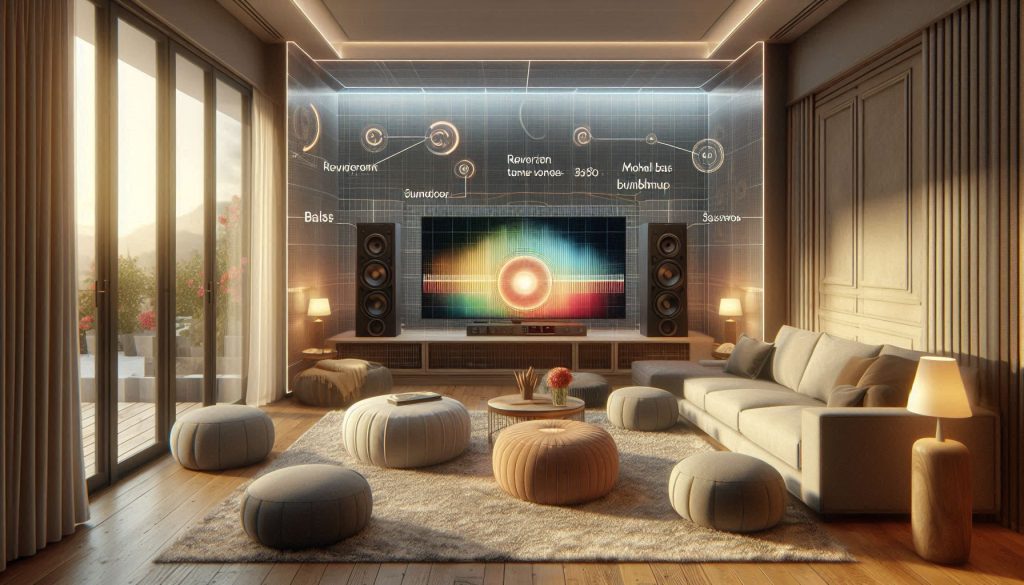
When you move from a compact living room to a large open space, your 2.1 soundbar faces a very different acoustic environment. Below are the key physical factors to watch, how each one changes bass, clarity, imaging and loudness, and quick, practical ways to check whether your room will push a typical 2.1 past its limits.
Room volume and dimensions
Room volume (length × width × height) determines how much air the speakers must move to reach a given sound pressure level (SPL). A larger volume needs more output (more watts and headroom) to reach the same perceived loudness.
Reverberation time (RT60)
RT60 is how long sound takes to drop 60 dB. Long RT60 smears dialog and weakens punch.
Room modes and standing waves
Low-frequency energy builds up at modal frequencies determined by room dimensions. That creates bass peaks and nulls (boominess or holes).
Surface reflections and imaging
Hard floors, glass and bare walls boost reflections, blurring stereo imaging and dialog. Soft surfaces — rugs, curtains, upholstered furniture — tame reflections and improve clarity.
Speaker-to-listener distance and SPL needs
Greater distance reduces direct sound and raises required SPL for immersion. For movies you may want average listening levels in the 75–85 dB range and peaks near 95–100 dB. If you must crank a 2.1 above its clean output (or hear distortion before those levels), the system is undersized.
Put these checks together: if your room is large (high volume), rings for more than ~0.7 s, and forces you to push levels past ~85 dB to feel immersed, a typical small 2.1 will struggle. Next we’ll look at how a 2.1 performs in that reality and what alternatives to consider.
How a 2.1 soundbar performs in a large room (strengths and limits)
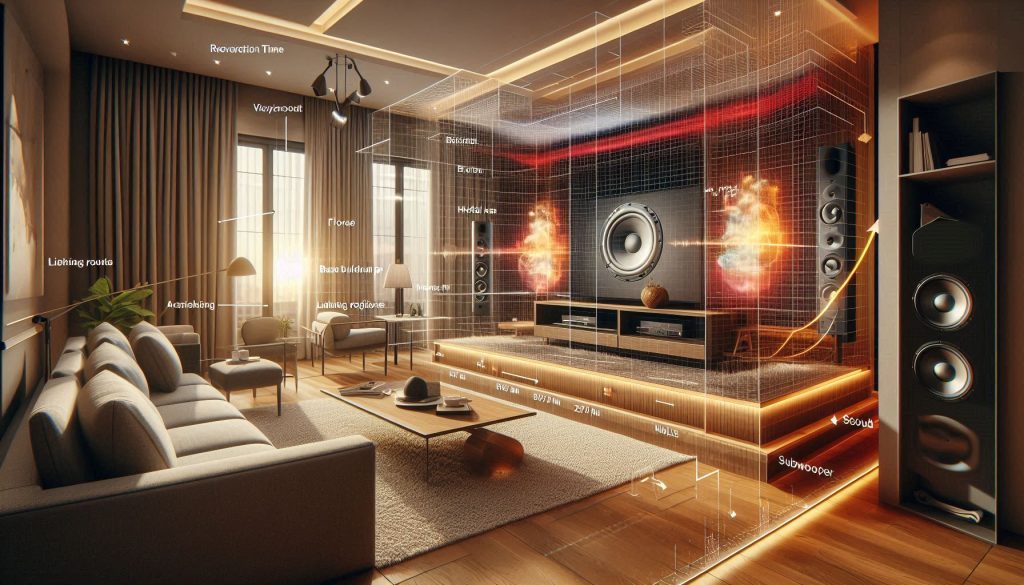
Strengths you can count on
A 2.1 soundbar often delivers predictable, useful gains in these areas:
Examples: compact packages such as the JBL Bar 2.1 or Vizio V-series 2.1 systems show how a small bar + external sub gives clearer dialog and tighter bass than the bar alone.
Measured loudness and coverage
Physics matters: sound follows the inverse-square law. If you double distance from the bar you lose roughly 6 dB of SPL. In a large room, you’ll commonly see:
Quick test: use an SPL meter app at different seats. If you can’t reach ~75–80 dB average without audible strain, the system is undersized.
Low-frequency response and decay
Typical small subwoofers in 2.1 packages extend to roughly 40–60 Hz (varies by driver size and enclosure). A single 6–8″ driver will sound full for dialog and many effects but won’t reproduce deep 20–30 Hz rumbles.
Imaging and immersion limits
Virtual surround processing can widen perceived space, but a single bar can’t recreate true rear-channel energy or precise envelopment. Measured lateral energy and reverberant-to-direct sound ratios in true multi-channel setups remain higher — you’ll notice the difference with complex surround mixes.
Practical immediate steps
If you need more even loudness, deeper extension, or genuine surround envelopment, there are clear trade-offs to consider in the next section.
Alternatives and comparisons: multi-channel systems and more robust soundbars
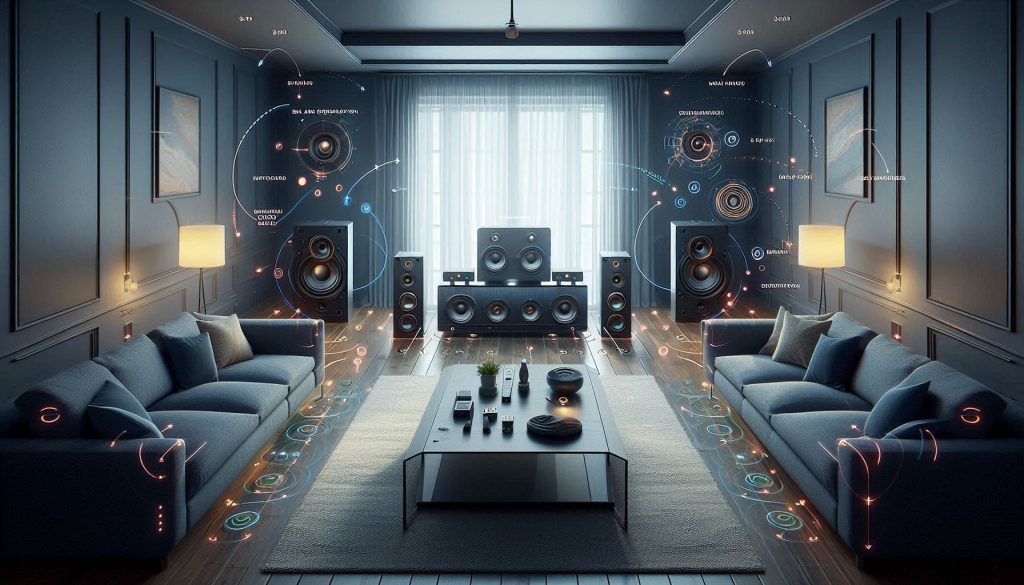
Discrete 3.1 / 5.1 systems
A true discrete setup (AV receiver + center, left/right, surrounds, and one or more subs) gives the clearest technical gains:
Examples: a Denon AVR-X with ELAC or Klipsch mains + SVS sub(s) is a common, cost-effective path. Trade-offs: higher cost, wiring, and setup time.
Modular soundbars (soundbar + sub + wireless surrounds)
These hybrid systems scale: start with a bar + sub and add wireless rear modules later (e.g., Sonos Beam/Arc + Sub + One SL; Samsung Q-series with wireless rears).
Higher-end multi-driver soundbars
Premium single-piece bars use upward-firing and side-firing drivers plus DSP (Sonos Arc, Sennheiser Ambeo, Samsung HW-Q990C).
Trade-offs and practical rules of thumb
Quick decision heuristics
How to maximize 2.1 performance in a large room: placement, calibration, and room treatment
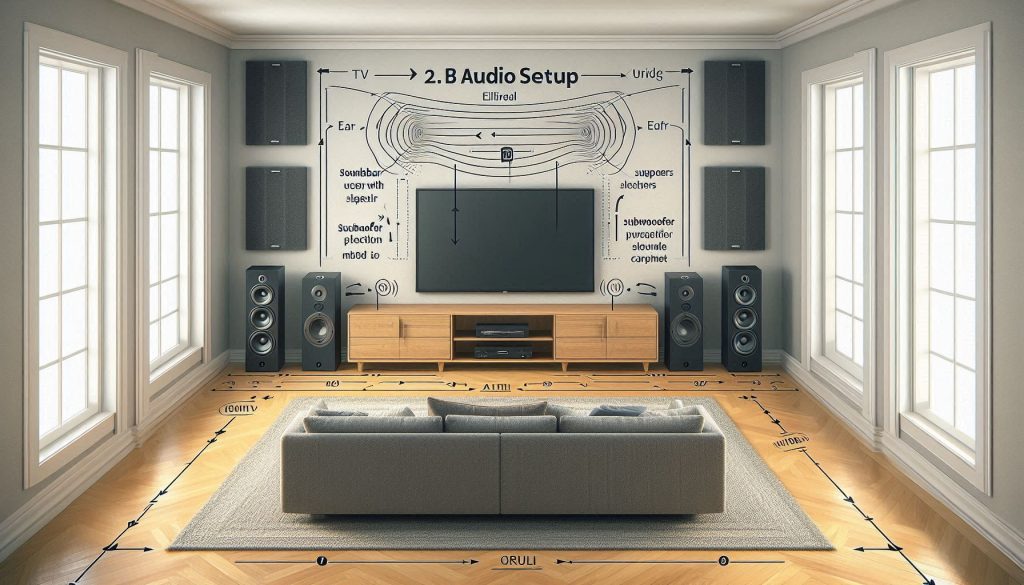
Place the bar and sub for maximum reach
Place the soundbar centered under or above the TV, aimed at ear level when seated. If it must sit in a cabinet, pull it forward or use spacers—enclosures can reduce clarity and high-frequency output by several dB.
For the subwoofer, use the “sub crawl”: start the sub in your seating position, play a low-frequency sweep or bass-heavy track, then crawl the room perimeter to find the spot where bass sounds fullest. Typical large-room starting points: a corner for maximum SPL and extension, or 1/3 along a wall for fewer nulls. Expect room-dependent differences of 6–12 dB between positions.
Calibrate: built-in systems and DIY measurement
Use the soundbar’s auto-calibration (Sonos Trueplay, Samsung Room EQ, etc.) first—these give quick, often substantial gains in tonal balance. Then, refine with measurements:
Target smoother frequency response: reduce low-frequency modal peaks and aim for ±3–6 dB consistency across listening seats. You can typically reduce seat-to-seat variance by several dB with good placement + EQ.
Crossovers, gain, and phase alignment
Set the crossover near the lowest reliable output of the bar: 60–80 Hz is common. If your bar lacks low extension, raise crossover to 100 Hz and let the sub handle more.
Adjust sub gain so bass matches perceived midrange level—not overpowering. For phase: play a mono bass tone and adjust the sub’s phase or delay until waveforms add constructively at the listening seat. A constructive alignment can raise apparent bass by 3–6 dB and remove cancellations.
Targeted acoustic treatment (prioritize for impact)
Products to consider: SVS or REL subs paired with a Sonos/Denon bar for hardware; GIK Acoustics 244 bass traps and 242 panels, Auralex for budget absorption, Vicoustic for diffusion. Start with sub placement and calibration, then add two first-reflection absorbers and one set of corner traps for the best cost-to-benefit ratio.
These steps typically yield measurable SPL stability, smoother low-end response, and fewer seat-to-seat surprises—preparing you to pick the right system upgrade in the next section.
Making the right choice for your needs: scenarios and recommended actions
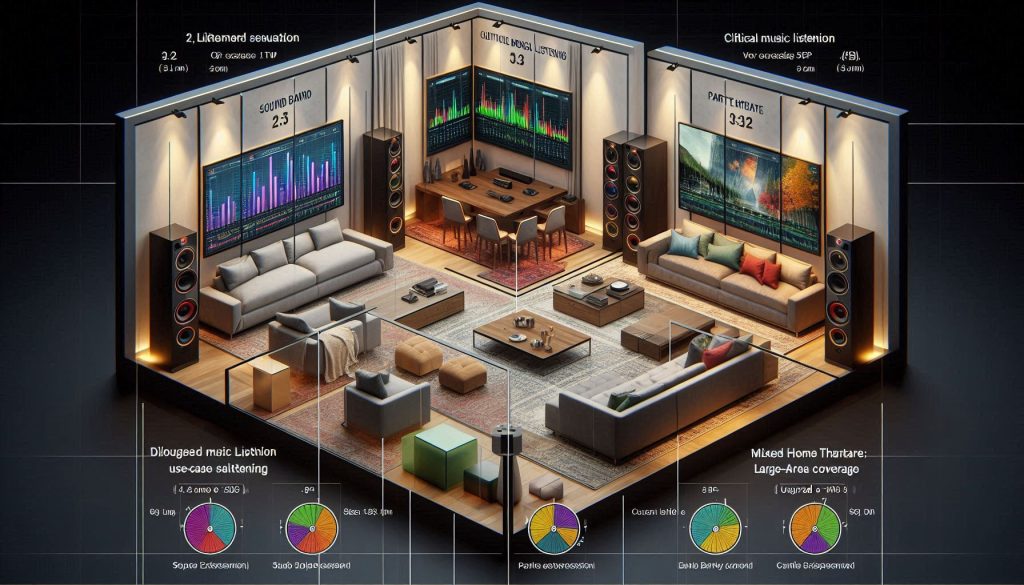
Decision framework (how to choose)
Match three inputs: your primary listening habit, the size/shape of your room and seating distances, and your budget. If one of those disproportionately demands performance (e.g., frequent parties, critical music listening), bias your choice toward a more capable system. Think in practical terms: are you chasing clear dialogue at 10–15 ft, or chest‑thumping bass for movies and gatherings?
Common scenarios and recommended paths
Dialogue-driven TV (news, sitcoms, dramas)
Music-focused listening (critical or bass-heavy)
Mixed-use home theater (movies + TV + music)
Parties/large-area coverage
Quick trial checklist and measurable thresholds
Use these scenarios and measurements to make a fact‑based choice about keeping, optimizing, or replacing your 2.1 system—then move on to the final recommendations.
Final verdict and next steps
A 2.1 soundbar can be enough in a large room for TV dialogue, streaming, and casual movie watching if you calibrate it, place it well, and apply basic room treatment. It will give clearer mids and improved punch over TV speakers and can handle modest bass tasks using its subwoofer, but physical limits mean deep, room-filling bass and uniform spatial immersion are unlikely without additional speakers or a larger sub.
Measure your room, audition a 2.1 in a similar space, and prioritize a quality subwoofer and calibration tools. If you want deep bass, full surround, or even coverage, plan to upgrade to a 3.1/5.1 system or a higher-end multi-driver soundbar. Decide based on measured priorities.