
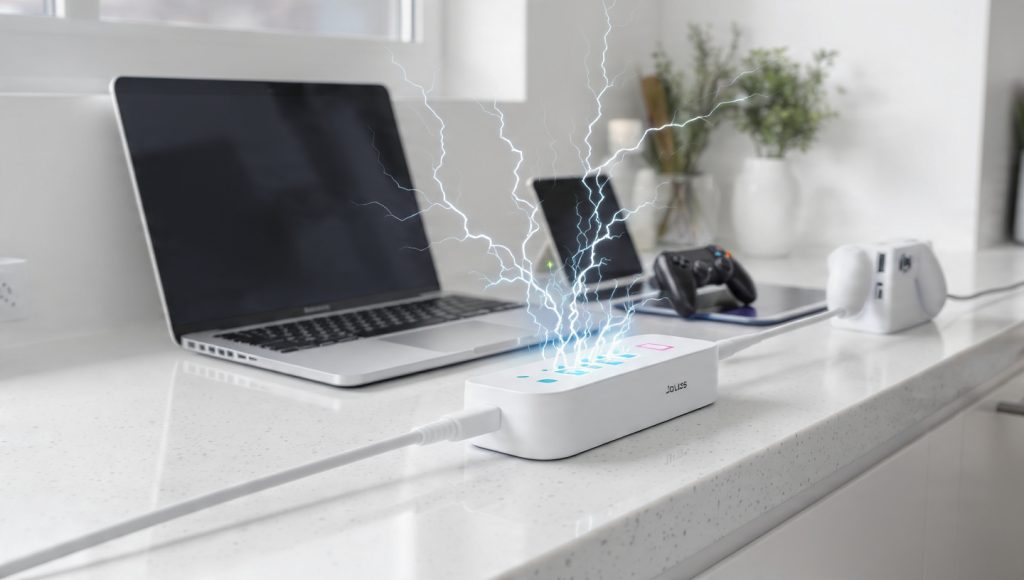
Why You Should Check Joules Before Buying a Surge Protector
Ever wonder how much real protection a surge protector offers? The joules rating gives you a clear, objective measure of how much surge energy a device can absorb before it fails. By checking joules, you cut through marketing claims and know whether a protector matches the value and sensitivity of your equipment.
When building a modern home office setup or upgrading your kitchen tech, most people prioritize the number of ports and sleek design. However, the most critical spec often goes overlooked: the surge protector joule rating. A joule rating measures the total energy your device can absorb from unexpected power spikes and electrical surges before its internal components fail. Without a high-capacity surge protector, even a minor voltage fluctuation can cause permanent damage to sensitive electronics like MacBooks, gaming consoles, and high-speed USB-C charging stations.
In 2026, as our homes become more crowded with high-value mobile devices, understanding the difference between a basic power strip and a heavy-duty surge protector is essential for long-term safety. While entry-level hubs may offer convenience, they often feature low clamping voltage and minimal joule protection, leaving your hardware vulnerable to the “silent killer” of micro-surges. Choosing a countertop charging hub with a robust joule rating ensures that your gear remains shielded from everything from lightning strikes to the daily cycling of large household appliances.
You should treat joules as a core specification when comparing models. Joules matter for lifespan, device safety, and potential replacement costs after a failure. When you choose a protector with an appropriate joules rating, you reduce risk, avoid false economy, and make a data-driven purchase decision that aligns with your priorities. This single spec helps you match protection level to device importance and budget without guesswork. Reading the joules number is simple and actionable. Do it first, always.
Joules Quantify the Energy Capacity of a Surge Protector
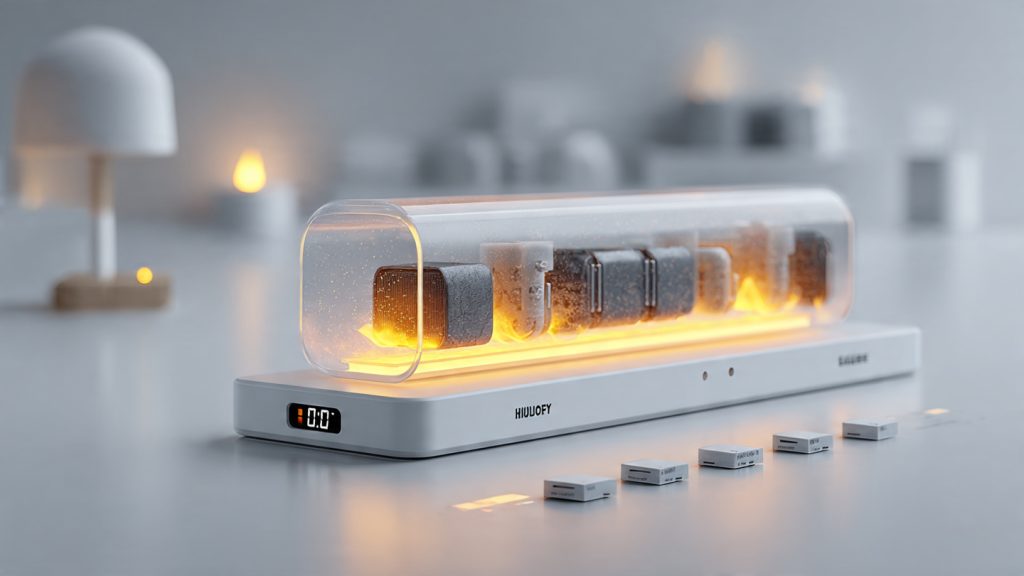
Joules = the energy the protector can absorb
A joule is simply a unit of energy — think of it as the “how much” a protector can soak up from a power spike. For a quick mental image: one joule is roughly the energy it takes to lift a small apple one meter, or to run a 1‑watt LED for one second. When you read a surge protector’s joules rating, you’re reading how much transient energy it can absorb before its internal components are spent.
Repeated hits use up that capacity
Surges aren’t always single, dramatic lightning strikes. Many are smaller, repeated transients (switching noise, motor starts, grid bumps). Each event consumes part of the protector’s joule budget. Protectors using MOVs or similar components degrade with each absorbed event until they can no longer protect.
Practical ranges and quick decision rules
When comparing models (APC, Belkin, Tripp Lite and others), use the joules number as an objective shorthand: higher joules = more headroom and longer service life under repeated surges.
A Higher Joules Rating Usually Means a Longer Effective Lifespan
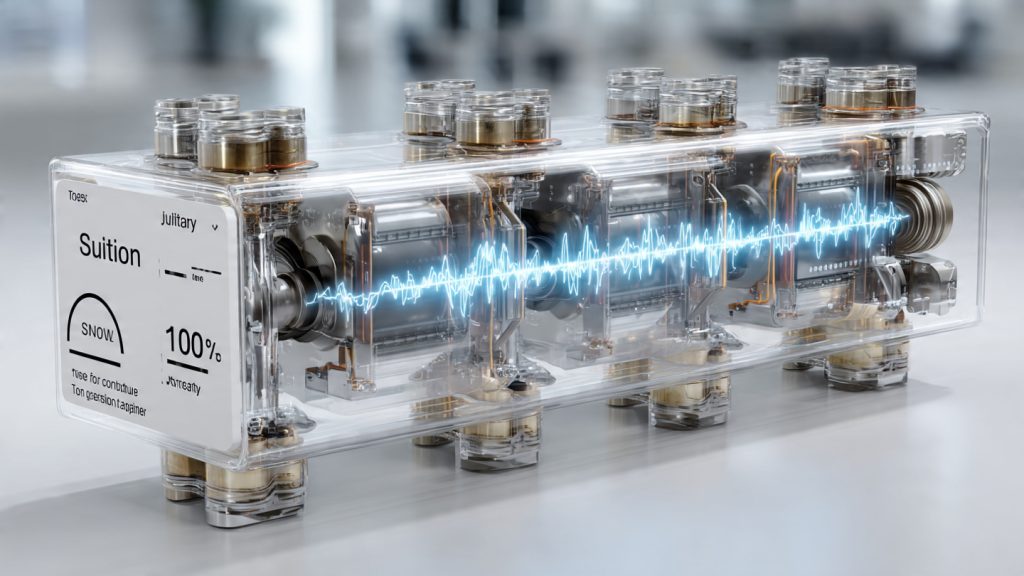
How repeated surges shorten a protector’s life
You should treat a protector’s joules rating as a finite energy budget. Every transient — from a utility switching event to a nearby lightning strike — eats away at that budget. Many common suppressors use metal‑oxide varistors (MOVs) that progressively degrade; a higher initial joules rating simply gives you more buffer before the device can no longer clamp surges effectively.
Estimating when to replace a unit
You won’t get an exact “hours left” number, but you can make practical judgments:
Quick, actionable tips
Keeping joules in mind helps you estimate longevity and replacement timing — which directly informs how much protection you should buy for specific equipment.
Joules Help Determine the Level of Protection for Your Equipment

How joules translate into real-world risk
You don’t want under‑protection for a thousand‑dollar monitor or your home office PC. Think of joules as the “energy budget” a protector can absorb before it gives up. Routine transients from motor starts or utility switching are often modest; lightning‑linked or utility faults can dump much larger energy. A protector with too few joules may absorb a few small hits but fail when you need it most.
Practical guidance: match joules to device value and sensitivity
Product examples and quick checks
Brands like APC (SurgeArrest line), Tripp Lite (Isobar series), Eaton and Leviton publish joule ratings and warranties—use those labels to compare models. When evaluating, check the joule number, warranty terms, and whether the device lists protected equipment examples.
Decide by inventorying what you can’t afford to replace and choosing a joule level that covers those items; next, you’ll learn how to match those joules to appliance sensitivity and importance.
Match the Joules Rating to Appliance Sensitivity and Importance
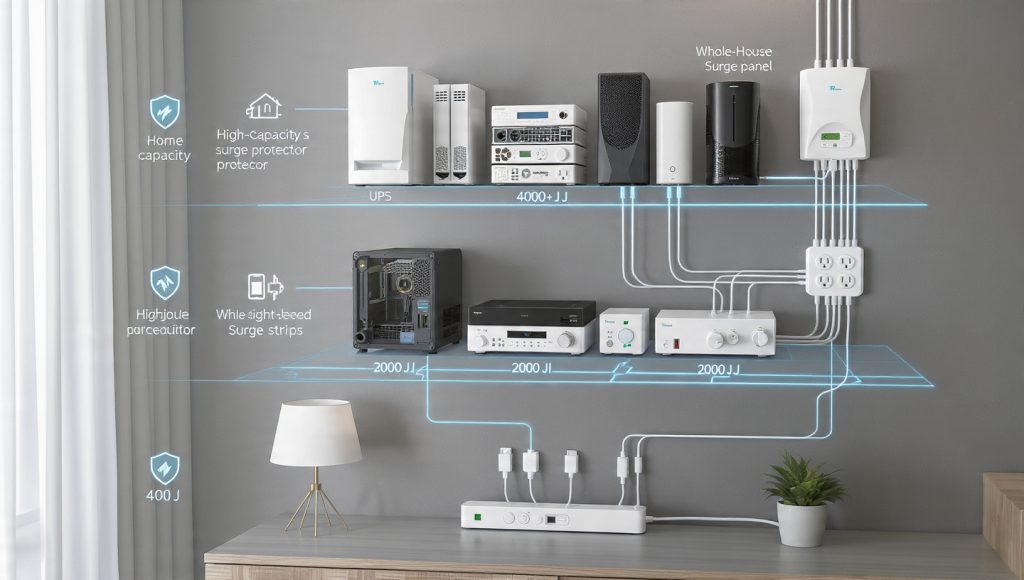
Prioritize by value and function
Not every device deserves the same joule budget. Think in tiers and protect upward from what would cause the biggest pain if it failed:
When a modest rating is acceptable
If a device is cheap, easily replaced, or behind a UPS that conditions power, you can accept lower joules. For example, a Back‑UPS (APC Back‑UPS Pro 1500) offers battery backup plus decent surge handling so you can prioritize higher‑joule strips for the rest of your rack.
Layer protection: practical how‑to
Use this prioritization to allocate joules where they reduce risk most effectively.
Joules Ratings Factor Into Insurance and Liability Considerations

Why insurers and vendors care
Insurers and manufacturers expect “reasonable” preventive steps for high‑value equipment. If a surge damages a server or studio rig and you can’t show adequate protection, a claim or warranty dispute is more likely. Courts and adjusters commonly look for documented, industry‑standard protection — and joules are a concrete, measurable part of that story.
How to document protection for claims
Practical steps to reduce liability
These actions make your risk profile and warranty position clearer — and they set you up to argue a credible defense if a claim arises. Next, look at how joules interact with clamping voltage and response time so you can gauge real-world performance.
Joules Interact with Clamping Voltage and Response Time — Don’t Ignore the Whole Picture
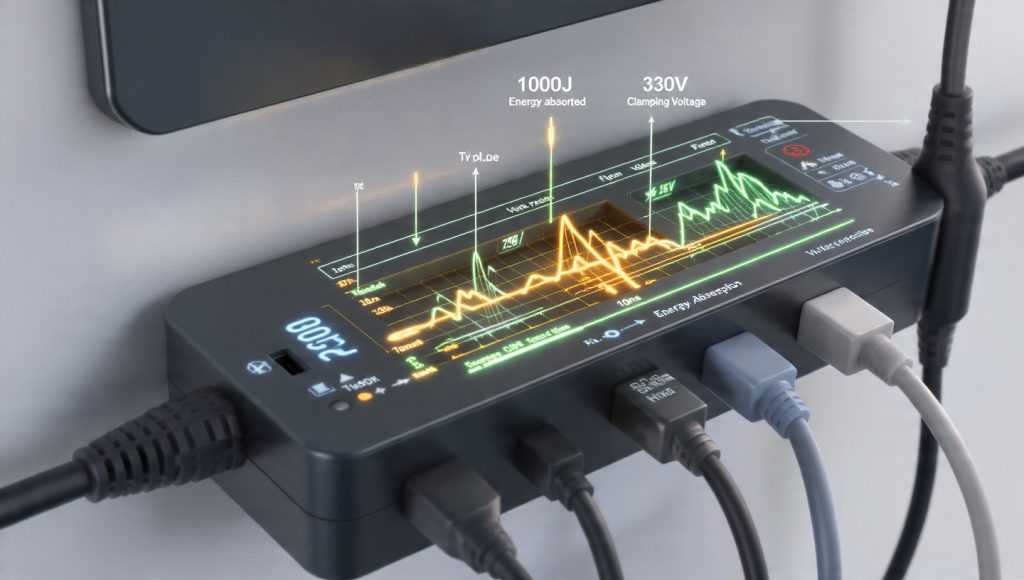
What each spec really tells you
Joules measure how much energy a device can absorb before it’s spent. Clamping (let‑through) voltage tells you how much voltage still reaches your gear during the event — lower is better. Response time tells you how fast the protector starts working — faster is better. All three determine whether a surge leaves your equipment scratched or fried.
How to read specs together
Practical comparison tips
Quick checklist before buying
Next, you’ll learn how to use joules to decide between whole‑house and point‑of‑use protection.
Use Joules to Decide Between Whole-House and Point-of-Use Protection
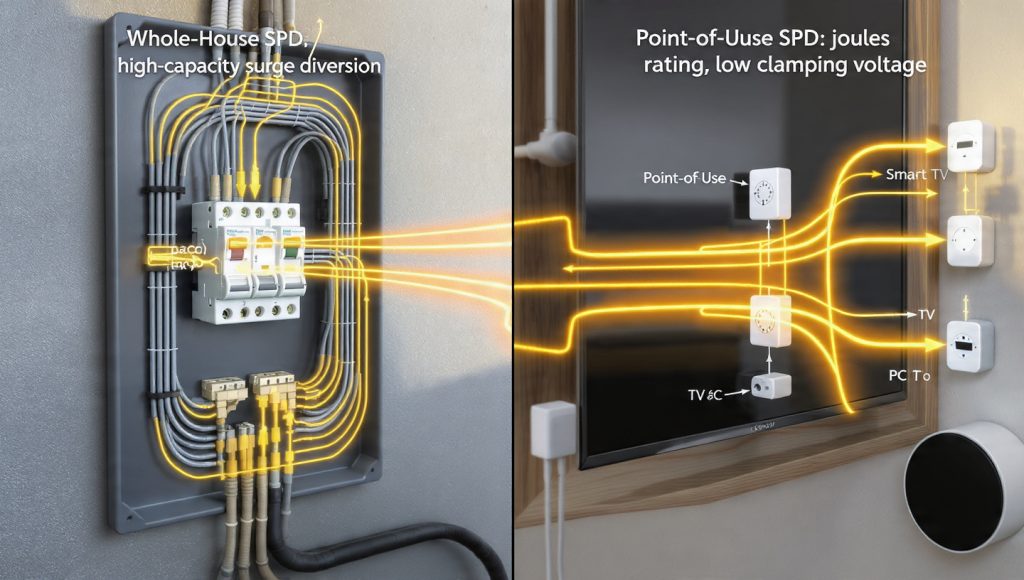
Why a layered approach makes sense
You’ll rarely rely on a single device. Whole‑house arresters at the service entrance are designed to absorb large external surges (utility cross‑faults, lightning-induced currents) while point‑of‑use protectors catch residual energy and clamp lower voltages right at your gear. Joules help you decide what each layer should be asked to do.
How to split expectations by joules
Practical steps you can take now
This joules‑driven division of labor gives you measurable, layered protection instead of leaving everything to a single device.
Joules Enable Objective Product Comparisons and Avoiding Misleading Marketing
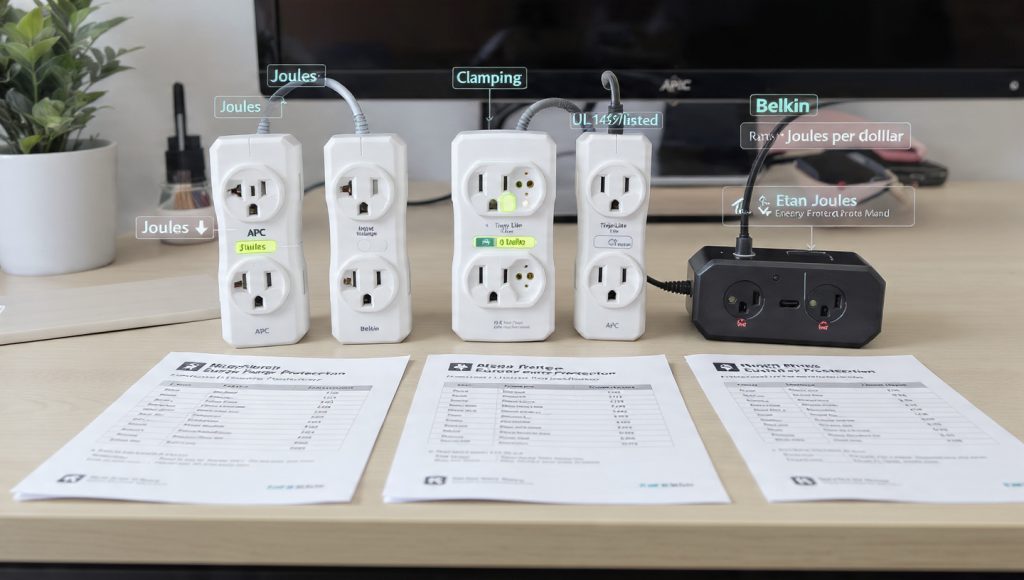
Read the label like a technician
When you compare units, start with the spec sheet — find the joules rating, clamping (let‑through) voltage or VPR, and whether it’s UL 1449 listed. Those three numbers give you a real sense of capability, not the glossy box copy. If a product hides joules, treat that as a red flag.
Spot common marketing distractions
Manufacturers will highlight:
How to rank products quickly
Next, you’ll see why checking joules prevents the false economy of cheap protectors and how that impacts long‑term costs.
Checking Joules Helps You Avoid False Economy from Cheap Protectors
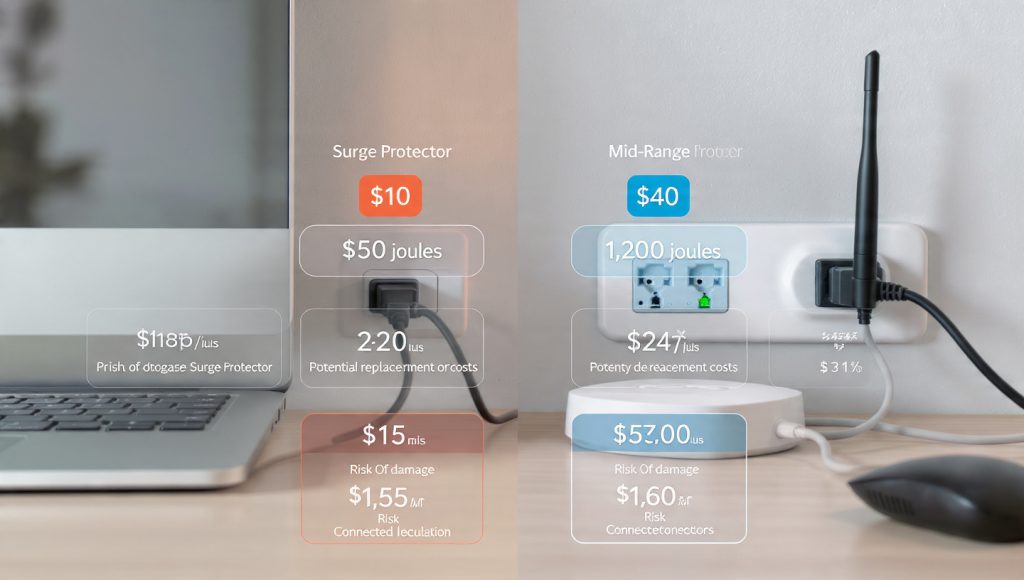
Quick cost math that reveals the risk
You can be tempted by a $10 power strip, but a low‑joule protector (200–300 J) can absorb only a handful of small spikes before its internal components are spent. Compare that to a $40 unit rated at 1,200 J: the higher‑joules device may survive many more events. Do the simple math: divide the joules by price to get joules-per-dollar — it’s a quick filter to avoid bargains that offer poor value.
A short, realistic example
Imagine a router (~$120) connected through a $12, 250 J strip. A surge breaches the strip, kills the protector and fries the router. You pay $132 (strip + router) versus spending $45 up front for a 1000 J unit that likely would have protected the router.
Actionable buying steps
Joules Influence Long-Term Cost, Downtime, and Business Continuity

Calculate the true cost of an outage
You protect devices to avoid replacement costs — but downtime often costs more. If your small office loses $500/hour in billable work, a single 6‑hour outage costs $3,000. Spending an extra $60–$200 on a higher‑joule protector that prevents that outage is a clear ROI. Run a quick cost-of-downtime estimate for your operation before you shop.
Practical steps to balance upfront cost and risk
Layer protection to reduce business continuity risk
Use a layered approach: whole‑building surge arresters for large events plus high‑joule point‑of‑use strips for servers, NAS, and telecom. This combination reduces both repair/replacement frequency and operational disruption.
A real example: a freelance design studio that invested $150 more in higher‑joule protection avoided a single storm‑related data loss worth thousands. With these calculations and steps, you can justify the right joules level for resilience and move on to the article’s final takeaways.
Make Joules a Key Part of Your Surge Protection Decision
Before you finalize a purchase, verify the joules rating and interpret it in the context of your equipment value, local surge risk, and other key specs like clamping voltage. Treat joules as a primary, data-driven factor that informs expected lifespan, energy-absorption capacity, and the likely level of protection for critical devices. A clear numeric comparison helps you avoid misleading marketing claims and choose a protector sized for real-world threats rather than lowest price.
Balance joules with clamping voltage, response time, and placement (whole-house versus point-of-use) to build a defensible protection strategy. When in doubt, prioritize higher joules for high-value equipment and document your decision—this reduces downtime, supports insurance discussions, and gives you measurable justification for the cost and future readiness.